
Child Benefit in the UK is a tax-free financial payment made to parents or guardians to help with the cost of bringing up a child. Administered by HM Revenue and Customs (HMRC), it is available to anyone who is responsible for a child under the age of 16, or under 20 if they stay in approved education or training. While the application process is straightforward, navigating the eligibility rules, the High Income Child Benefit Charge, and ongoing maintenance requirements demands careful attention from claimants.
What is Child Benefit and Who Qualifies?
Child Benefit is a cornerstone of family support within the British social security framework. It serves as a universal entitlement, meaning that eligibility is not strictly dependent on National Insurance contributions or income levels. However, while everyone can claim it, the tax system may claw back some or all of the payment if someone in the household earns above a certain threshold.
To qualify for Child Benefit, you must meet two foundational criteria: you must be responsible for a child, and you must live in the UK. Understanding the nuances of these requirements ensures that eligible families do not miss out on vital financial assistance, while also preventing accidental overpayments that could lead to unexpected tax liabilities.
Establishing Responsibility for a Child
You are generally considered responsible for a child if they live with you, or if you are paying money towards looking after them equivalent to at least the amount of Child Benefit you would receive. This financial contribution can take the form of food, clothing, or pocket money, provided it matches or exceeds the benefit amount.
Only one person can receive Child Benefit for a specific child. If two parents live together, they must decide who will be the named claimant. If parents separate, the person with whom the child primarily lives will usually claim. In situations where a child splits their time equally between two homes, the respective parents must reach an agreement on who claims, or HMRC will make a decision based on where the child spends the majority of their time and who bears the primary day-to-day responsibility.
Residency and Immigration Status
To satisfy the residency requirement, you must normally have your main home in the UK and be legally permitted to live there. The UK includes England, Scotland, Wales, and Northern Ireland.
Individuals who are subject to immigration control—such as those with "no recourse to public funds" stamped on their visa—are generally not eligible to claim Child Benefit. However, there are important exceptions for individuals from the European Economic Area (EEA) or Switzerland who fall under specific transitional protection rules, as well as those holding settled or pre-settled status under the EU Settlement Scheme, provided they meet the habitual residence test.
Age Limits and Approved Education or Training
Child Benefit payments do not automatically stop on a child's sixteenth birthday. While the baseline eligibility covers any child under 16, support can continue up until the child turns 20 if they remain in approved education or training.
Recognized educational pathways include full-time education, which is defined as more than an average of 12 hours a week of supervised study or course-related work experience. This typically encompasses:
- A-Levels or equivalent qualifications (such as International Baccalaureate).
- Scottish Highers or Advanced Highers.
- T Levels.
- NVQs up to level 3.
- Home education, provided it started before the child turned 16 or they have special educational needs.
Approved training courses also qualify, provided they are unpaid. Examples include traineeships in England, foundation apprenticeships in Wales, or modern apprenticeships in Scotland. Crucially, higher education courses—such as university degrees or BTECs funded by higher education institutions—do not qualify for Child Benefit, even if the student is under 20.

Payment Rates and Frequencies
Child Benefit is split into two distinct rates: a higher amount for the eldest or only child, and a lower flat rate for any subsequent children. HMRC typically pays these funds directly into a bank or building society account every four weeks, though single parents or individuals receiving certain other benefits can sometimes opt for weekly payments.
The table below outlines the structural tiering of Child Benefit payments:
| Child Status | Payment Frequency | General Eligibility Note |
|---|---|---|
| Eldest or Only Child | Every 4 weeks | Higher baseline rate applicable to the first qualifying child in a family. |
| Additional Children (Each) | Every 4 weeks | Lower flat rate applied to every subsequent qualifying child. |
| Children in Approved Education (16–20) | Every 4 weeks | Subject to continuous verification of full-time study or unpaid training. |
Note: Specific monetary rates are subject to annual review and uprating by the UK government. Claimants should check the official GOV.UK portal for the exact up-to-date weekly figures applicable to the current tax year.
The High Income Child Benefit Charge (HICBC)
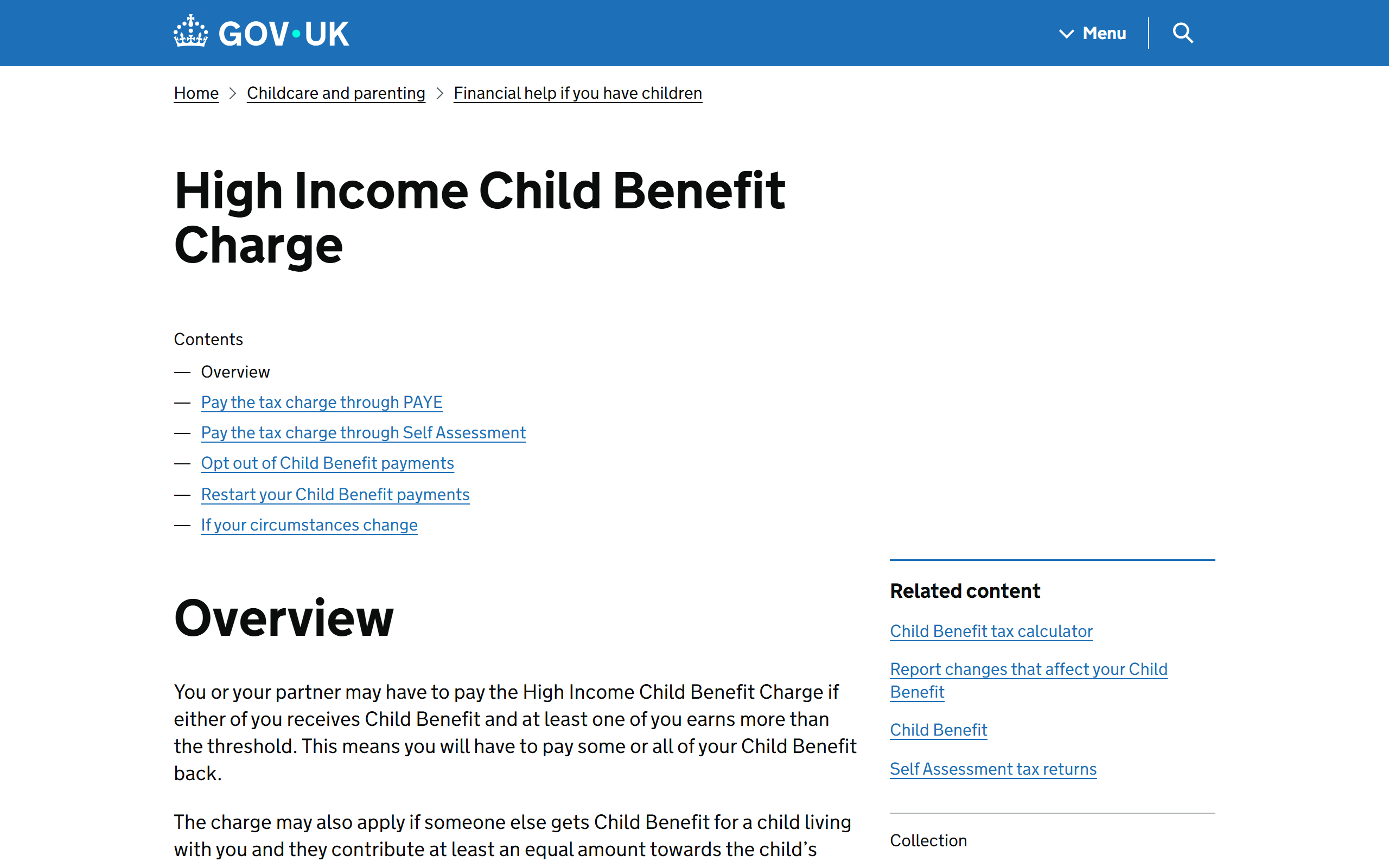
One of the most complex aspects of Child Benefit in the UK is the High Income Child Benefit Charge (HICBC). Introduced to ensure that higher earners contribute back a portion or all of the benefit received, the HICBC applies if you or your partner have an "adjusted net income" over a specific legislative threshold.
How the Charge is Calculated
The HICBC is triggered when an individual's adjusted net income exceeds the high-income threshold. Adjusted net income generally means total taxable income before personal allowances, minus certain deductions such as pension contributions made under relief at source and Gift Aid donations.
The charge is levied through the Self Assessment tax system. For every pound your adjusted net income exceeds the threshold, you must pay back 1% of the total Child Benefit received. If your adjusted net income is significantly above the upper threshold, the charge equals 100% of the Child Benefit paid, effectively neutralizing the financial value of the benefit.
The Claim-and-Opt-Out Dilemma
Even if your household income exceeds the threshold where the HICBC claws back 100% of the benefit, it is often still advantageous to make a formal claim for Child Benefit and then elect to stop receiving the payments.
Submitting a claim serves two crucial functions:
- State Pension Protection: The person claiming Child Benefit receives National Insurance credits towards their State Pension for every week they care for a child under 12, provided they are not working or earning enough to pay Class 1 National Insurance.
- Child's National Insurance Number: Children whose parents claimed Child Benefit are automatically issued a National Insurance number shortly before their sixteenth birthday, streamlining their entry into the workforce or higher education.
By claiming the benefit and choosing not to receive the physical payments, high earners bypass the tax charge while preserving these valuable administrative and pension protections.
How to Apply for Child Benefit
Applying for Child Benefit is a structured process managed primarily through digital channels on GOV.UK, though paper application forms remain available for those unable to use online services.
Step-by-Step Application Procedure
- Register the Birth: Before applying, you must register the birth of your newborn child. You do not need to wait for the physical birth certificate to arrive, but the birth must be officially registered.
- Gather Required Documentation: You will need the child's original birth certificate (though HMRC sometimes accepts copies or alternative identity documents under specific circumstances), your National Insurance number, and details of your bank or building society account.
- Submit the Online Claim: Log into the official GOV.UK Child Benefit portal using a Government Gateway account. Fill out the CH2 application form with accurate personal and household details.
- Send Supporting Documents (If Requested): HMRC may occasionally ask you to mail original documents, such as passports or birth certificates, to verify identity. Always use a secure postal tracking method if instructed to send physical paperwork.
- Await Decision: Processing times can vary depending on seasonal demand and whether additional verification is required. Backdating is generally available for up to three months if you delay your claim after the child's birth.
Ongoing Responsibilities and Reporting Changes
Once your Child Benefit claim is active, you carry a legal obligation to inform HMRC of any changes in your circumstances that might affect your entitlement or payment amounts. Failing to report these changes promptly can result in overpayments, which HMRC will aggressively claw back.
Changes You Must Report
- Family Dynamics: If a child stops living with you, goes to live with someone else, or if you separate from your partner.
- Educational Status: If a child aged 16 or over leaves approved education or training, starts working for more than 24 hours a week, or begins receiving certain benefits like Universal Credit or Employment and Support Allowance (ESA).
- Immigration and Travel: If you or your partner move abroad, or if you spend a prolonged period outside the UK.
- Custody Changes: If a child goes into local authority care, hospital, or residential accommodation for more than eight weeks.
Failing to update HMRC regarding a child leaving education is one of the most common triggers for accidental overpayments. It is vital to notify the department immediately when a young person transitions out of secondary school or college.
Frequently Asked Questions
Can I claim Child Benefit if I am not a British citizen?
Yes, you can claim Child Benefit if you are a non-British citizen living in the UK, provided you have a legal right to reside here and are not subject to immigration control that explicitly bars access to public funds. Individuals holding settled status under the EU Settlement Scheme or specific work and family visas often meet this requirement, provided they satisfy the habitual residence test.
What happens to Child Benefit if my teenager repeats a year of college?
Child Benefit continues during approved full-time education up to the age of 20. If your teenager is repeating a year, or moving from one approved course to another, the benefit will remain active as long as the total hours of study meet the Department for Education's definition of full-time education and the course is non-advanced.
Do I have to pay tax on Child Benefit payments?
Child Benefit itself is completely tax-free and does not count towards your taxable income for standard income tax calculations. However, if you or your partner have an adjusted net income above the high-income threshold, you will be subject to the High Income Child Benefit Charge, which recovers some or all of the benefit value through your annual Self Assessment tax return.
Can grandparents claim Child Benefit if they look after their grandchildren?
Grandparents can claim Child Benefit only if they are the primary providers of care and the child's parents are not claiming it. If a grandparent is helping out during the day while working parents retain primary responsibility and receive the benefit, the grandparent cannot claim. However, if the grandparent has formal legal guardianship or is the sole daily caregiver, a claim may be permitted.
How far back can I backdate a Child Benefit claim?
You can backdate a Child Benefit claim for a maximum of up to three months from the date HMRC receives your application. It is vital to submit your claim promptly after a child's birth or adoption to ensure you do not lose out on these three months of backdated financial support.
Next Actions for Claimants
To secure your entitlements and maintain compliance with HMRC regulations, review your household income against the current high-income thresholds to determine if you need to register for Self Assessment. If you have a newborn or a child transitioning into secondary education, visit the official GOV.UK Child Benefit Service to submit your initial application or update your existing family records today.
Image Gallery
Select an image to open it in a new tab.


Omar Farooq
EdTech Innovation and Virtual Pedagogy Journalist
