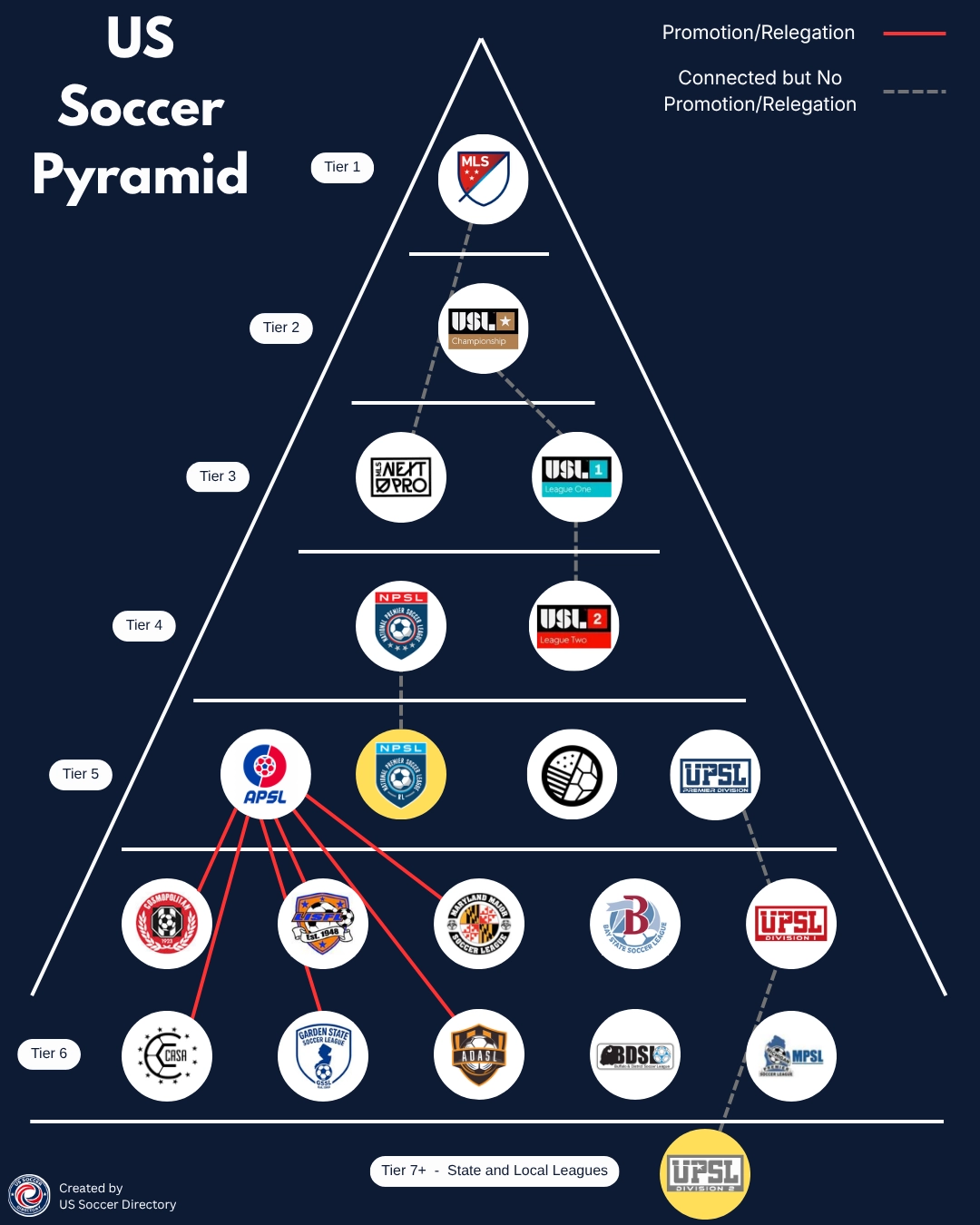
The United States soccer hierarchy is a multi-tiered regulatory and operational framework governed by the U.S. Soccer Federation (USSF), which acts as the national governing body under the jurisdiction of FIFA. This structure integrates professional leagues, amateur organizations, and grassroots development programs to manage sanctioned play, player pathways, and international representation across the country.
The Role of the U.S. Soccer Federation (USSF)
At the apex of the American soccer ecosystem sits the United States Soccer Federation, officially known as the United States Football Federation. Founded in 1913, the USSF is a non-profit organization recognized by the United States Olympic & Paralympic Committee (USOPC). Its primary function is to serve as the national governing body for the sport in the United States, representing the country within the Fédération Internationale de Football Association (FIFA) and the Confederation of North, Central America and Caribbean Association Football (CONCACAF).
The USSF does not simply manage the national teams; it is the ultimate regulatory authority for the entire sport. This includes overseeing the licensing of coaches, the accreditation of referees, the sanctioning of professional leagues, and the oversight of youth and adult amateur organizations. By setting the standards for governance, financial stability, and player safety, the USSF ensures that soccer in the United States adheres to international regulations while maintaining the logistical flexibility required for a nation of this geographical scale.
Professional League Sanctioning and Tiering
One of the most complex aspects of the US soccer hierarchy is the sanctioning of professional leagues. Unlike many European nations that utilize a strict promotion and relegation system based solely on sporting merit, the United States employs a closed-league structure. Leagues must meet specific technical, financial, and facility requirements set forth by the USSF to be granted "Professional League" status.
The hierarchy of professional men’s soccer is officially categorized by the USSF into three distinct levels:
- Division I: Currently represented by Major League Soccer (MLS). This is the highest level of professional competition in the country, subject to the most stringent requirements regarding stadium capacity, ownership net worth, and territorial rights.
- Division II: Currently represented by the USL Championship. These leagues operate with a lower threshold for entry than Division I but still require substantial operational infrastructure and financial guarantees.
- Division III: Represented by leagues such as USL League One and MLS NEXT Pro. These leagues serve as a bridge between high-level professional play and developmental or semi-professional tiers.
For women’s soccer, the primary professional tier is the National Women's Soccer League (NWSL), which operates as the Division I league, setting the standard for the highest level of competition in the country.
The Youth and Grassroots Framework
The foundation of the hierarchy is the youth development system. This segment is divided into several administrative bodies that ensure thousands of children and adolescents can participate in organized play. The USSF partners with national state associations to manage this vast network.
The player pathway for youth athletes generally progresses through a mix of club-based programs and talent identification initiatives. Key components include:
- State Associations: These are the regional entities that oversee local youth leagues and clubs. They are responsible for risk management, coaching education, and the implementation of USSF grassroots initiatives.
- Academy Systems: High-level environments, such as MLS NEXT or the ECNL (Elite Clubs National League), provide specialized pathways for elite talent. These programs are often designed to bridge the gap between youth development and professional or collegiate opportunities.
- Olympic Development Program (ODP): Though its role has evolved with the rise of private academies, the ODP remains an important USSF-sanctioned initiative to identify players for regional and national team pools.
The College Soccer Context
In the United States, collegiate soccer remains a unique and significant pillar of the hierarchy, distinguishing it from most international models. The National Collegiate Athletic Association (NCAA) oversees soccer competition at the Division I, II, and III levels. While the NCAA operates independently of the USSF, there is a functional integration; many players use the collegiate system as a pathway to professional play (via the MLS SuperDraft or direct signings) or to further their development while pursuing academic degrees.
The USSF collaborates with the NCAA to ensure that university programs align with broader player development philosophies, though the primary control of these programs rests with the universities and their respective athletic departments.
Comparison of Organizational Responsibilities
The following table summarizes the primary roles within the US soccer hierarchy:
| Entity | Primary Responsibility | Jurisdictional Scope |
|---|---|---|
| USSF (U.S. Soccer) | National governance, FIFA/CONCACAF liaison | Nationwide |
| Professional Leagues | Division I, II, III competition management | League-wide |
| State Associations | Local league sanctioning, grassroots admin | Regional/State |
| NCAA | Collegiate athletics governance | National (University level) |
| Referees/Coaches | Implementation of standards and rules | Field-level / Club-level |
Governance, Licensing, and Compliance
The USSF ensures the integrity of the hierarchy through rigorous licensing and compliance protocols. Coaching education is perhaps the most visible aspect of this. The Federation offers a "Pro" license down to "D" and grassroots-level certifications. By standardizing the curriculum for coaches, the USSF aims to harmonize the development philosophy across the country.
Similarly, the referee program is strictly hierarchical. Referees are classified based on their experience and the level of matches they are qualified to officiate. Advancement through the referee ranks requires ongoing training, assessment, and adherence to the Laws of the Game as defined by the International Football Association Board (IFAB).
Navigating the Hierarchy: Practical Next Steps
For players, parents, or coaches looking to understand their place in the hierarchy, the process begins with verification of sanctioning.
- Identify the Organization: Always confirm that the club or league you are joining is a member of a USSF-sanctioned state association or professional league.
- Verify Licensing: Ensure that coaches possess the appropriate USSF coaching licenses for the age group and level of competition they are training.
- Check Registration Portals: Official participation is tracked through state-level registration systems connected to the USSF database, which is vital for insurance coverage and legal eligibility.
- Monitor Official Channels: The USSF website and the websites of local state associations are the definitive sources for rules, bylaws, and updates on player safety protocols.
Frequently Asked Questions
Does the USSF control the NCAA soccer programs? No. The NCAA is an independent governing body for collegiate athletics. However, they coordinate on development standards, and collegiate players are subject to NCAA eligibility rules which are distinct from USSF professional registration rules.
Is there a promotion and relegation system in the US? No. The professional soccer structure in the United States is a closed system. Teams do not move between divisions based on their league performance at the end of a season. Entry into higher tiers is based on meeting financial, stadium, and ownership criteria set by the USSF.
How do I know if a youth league is legitimate? A legitimate youth league will be registered under a USSF-affiliated State Association. You can verify the status of any league or club by searching the official directory provided on the U.S. Soccer Federation’s regional member portal.
What is the role of CONCACAF in the US hierarchy? CONCACAF is the confederation that oversees soccer in North America, Central America, and the Caribbean. The USSF is a member of CONCACAF, meaning that US clubs and national teams participate in tournaments (such as the CONCACAF Champions Cup or the Gold Cup) sanctioned by this regional body.
Can a player move from an amateur status to professional? Yes. Amateur players can sign professional contracts with USSF-sanctioned teams at any time, provided they meet the age and registration requirements of the specific league and comply with the governing rules of their current registration status (e.g., amateur vs. collegiate eligibility).
Final Recommendation
To effectively operate within the US soccer hierarchy, prioritize transparency. Whether you are a parent choosing a youth club or an aspiring professional, always cross-reference the organization’s standing with the USSF-affiliated state association. Documentation, coaching certifications, and current sanctioning status are the metrics of a stable and compliant soccer environment. When in doubt, consult the official U.S. Soccer Federation member directory to ensure that your participation is officially recognized and supported.

Image Gallery
Select an image to open it in a new tab.
Zara El-Hashem
Sociocultural Dynamics and Academics Writer
