Software Estimation Myths and Realities: Bridging the Gap Between Expectations and Outcomes

Software estimation is the probabilistic process of predicting the amount of effort, time, and resources required to build or maintain a software system. The reality is that estimates are not fixed guarantees but ranges of likelihood influenced by project complexity, team experience, and evolving requirements, whereas myths often treat these predictions as firm, unchanging commitments.
Defining Software Estimation in 2026
By 2026, the landscape of software development has shifted toward highly modular, cloud-native, and AI-augmented workflows. However, the fundamental challenge of estimation remains: translating human intentions into technical execution. Software estimation is not merely a "guess" at a timeline; it is a calculated assessment based on historical data, technical debt, and functional scope.
In modern project management, estimation serves three distinct purposes:
- Investment Analysis: Determining if a project is worth the cost before resources are committed.
- Resource Allocation: Ensuring that developers, testers, and infrastructure are available when needed.
- Risk Management: Identifying areas of high uncertainty where project failure is most likely to occur.
Understanding the difference between an estimate, a target, and a commitment is essential. An estimate is a technical prediction. A target is a business objective (e.g., "We need this by the Q3 trade show"). A commitment is a negotiated agreement to deliver a specific scope by a specific date. Problems arise when organizations use these terms interchangeably, leading to the "myths" that plague the industry.
Common Myths in Software Estimation
The persistence of certain myths leads to "death march" projects and stakeholder friction. Deconstructing these fallacies is the first step toward more accurate delivery.
Myth 1: Adding More Developers Will Shorten the Timeline
This is perhaps the most famous myth, famously articulated as Brooks’s Law in the 1975 book The Mythical Man-Month. The logic suggests that if one developer can complete a task in ten days, ten developers can complete it in one. In reality, adding manpower to a late software project makes it later.
In 2026, this is even more true due to the complexity of microservices and distributed systems. New team members require "ramp-up" time, consuming the productive hours of existing senior developers who must train them. Furthermore, the communication overhead increases exponentially. The formula for communication paths is $n(n-1)/2$. A team of 5 has 10 paths; a team of 10 has 45 paths. The time spent coordinating exceeds the time gained in coding.
Myth 2: An Estimate is a Binding Commitment
Stakeholders often treat an initial estimate as a "price tag" or a contract. If a lead developer says a feature might take three weeks, it is often recorded in the project management software as a hard deadline.
The reality is that software development is "discovery-based" work. Unlike manufacturing, where you produce the same item repeatedly, software involves solving new problems every time. An estimate is a snapshot in time based on current information. As the project progresses and requirements are refined, the estimate must be updated. Treating it as a static commitment creates a culture of fear, leading developers to "pad" their estimates excessively to avoid repercussions.
Myth 3: Technical Estimates Account for All Project Work
Non-technical managers often assume that if a developer estimates 40 hours for a task, the task will be done in one week. This ignores the "hidden" work that constitutes a significant portion of the software development life cycle (SDLC).
A 40-hour coding estimate rarely accounts for:
- Peer code reviews and refactoring.
- Automated test suite maintenance.
- CI/CD pipeline troubleshooting.
- Synchronous and asynchronous meetings.
- Context switching and "shallow work" (emails/Slack).
- Deployment and post-release monitoring.
Myth 4: Tools and AI Can Eliminate Estimation Error
With the rise of predictive AI and machine learning models in 2026, many believe that human judgment is no longer necessary. While AI can analyze millions of lines of historical data from GitHub or Jira to suggest timelines, it cannot account for "unknown unknowns."
AI models are excellent at identifying patterns in known variables. They cannot predict a lead developer getting sick, a sudden change in government regulation, or a third-party API breaking. Estimation remains a human-centric skill that requires understanding team dynamics and nuanced client requirements.
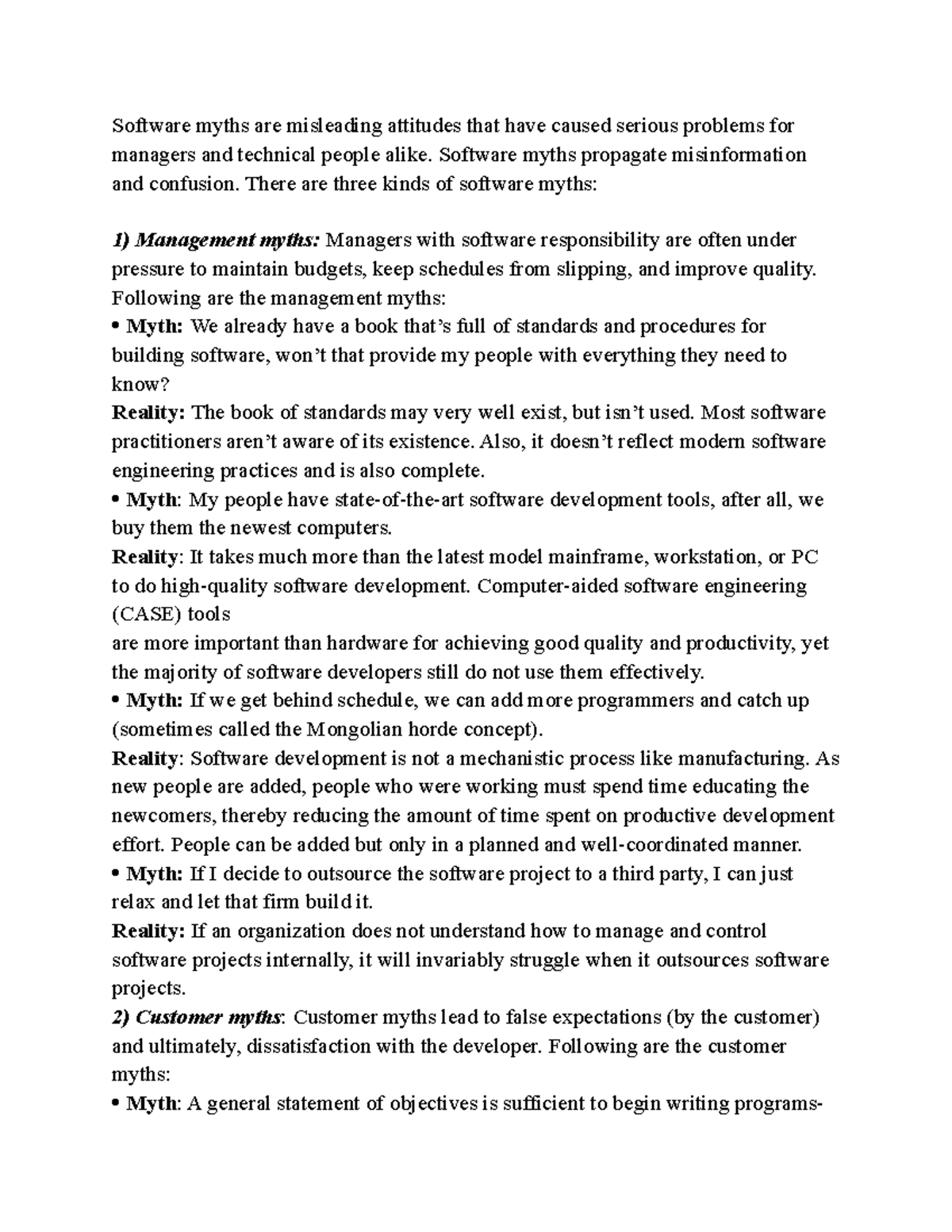
The Reality of Software Estimation
The realities of software estimation are grounded in mathematics, psychology, and empirical evidence. Accepting these realities allows teams to build trust with stakeholders through transparency.
The Cone of Uncertainty
The "Cone of Uncertainty," a concept popularized by Steve McConnell, describes the evolution of the amount of uncertainty during a project. At the beginning of a project (the "Initial Concept" phase), the variability of an estimate can be as high as 4x or 0.25x the actual result.
As the team defines requirements, designs the architecture, and begins implementation, the cone narrows. By the time the code is complete, the uncertainty is zero. The reality is that early-stage estimates are naturally inaccurate, and any professional estimation process must involve re-estimation at key milestones.
The Impact of Non-Functional Requirements
Estimation often focuses on "features" (functional requirements) while ignoring "qualities" (non-functional requirements). Real-world performance, security, scalability, and maintainability requirements often consume more time than the actual business logic. For example, building a login page is easy; building a login page that supports multi-factor authentication, rate limiting, OAuth2 integration, and SQL injection protection is a different reality altogether.
Historical Data as the Only Reliable Benchmark
The most accurate way to predict the future is to look at the past. Organizations that track their velocity (the amount of work completed in a set timeframe) provide much more reliable estimates than those that rely on "expert intuition." If a team has consistently delivered 20 story points per sprint for the last six months, estimating that they will deliver 50 points in the next sprint is a myth, regardless of how much overtime is planned.
Psychological Biases in Estimation
Human psychology is often the greatest enemy of accuracy. Several documented biases influence how developers and managers estimate work.
- Optimism Bias: Developers tend to assume the "happy path"—that everything will go right, the documentation will be perfect, and there will be no bugs.
- Anchoring: If a manager says, "I think this is a two-week job," the developer’s estimate will subconsciously gravitate toward that number, even if it is unrealistic.
- The Planning Fallacy: This is the tendency to underestimate the time needed for a task, even when one has experience with similar tasks overrunning in the past.
- Social Pressure: In a group setting, developers may agree with a more senior team member's low estimate to avoid appearing slow or incompetent.
Comparison of Estimation Methodologies
Different methodologies offer varying levels of precision and effort. Choosing the right one depends on the project's current phase and the level of detail required.
| Methodology | Best Used For | Pros | Cons |
|---|---|---|---|
| Planning Poker | Agile/Scrum Sprints | Encourages team consensus; avoids anchoring. | Can be time-consuming for large backlogs. |
| Wideband Delphi | Large-scale architecture | Highly accurate; uses multiple expert opinions. | Requires significant preparation and coordination. |
| COCOMO II | Budgetary planning | Mathematical and repeatable; based on KLOC (Lines of Code). | Difficult to apply to modern, high-level languages. |
| Three-Point Estimation | High-risk projects | Accounts for best-case, worst-case, and most likely scenarios. | Requires three times the initial estimation effort. |
| Story Pointing | Feature-level relative sizing | Focuses on complexity rather than hours; accounts for team velocity. | Difficult for non-technical stakeholders to understand. |
| T-Shirt Sizing | Early-stage roadmapping | Fast and high-level (S, M, L, XL). | Very low precision; only useful for initial triage. |
Practical Steps for Accurate Estimation in 2026
To align myths with reality, organizations should adopt a structured approach to prediction.
1. Decompose the Work
Estimation error increases with the size of the task. A one-month task is harder to estimate than four one-week tasks. Break requirements down into the smallest possible functional units (User Stories or Tasks). If a task is estimated to take more than 16 hours, it usually contains hidden complexities and should be subdivided further.
2. Use a Range, Not a Date
Instead of stating "This will be done on October 12," use a range: "There is a 90% probability we will finish between October 10 and October 20." This communicates the inherent uncertainty of the work and protects the team from minor delays.
3. Track Your "Estimation Error"
Mature organizations in 2026 perform "post-mortems" not just on code, but on estimates. Compare the estimated time to the actual time logged. If the team is consistently 20% over, apply a 1.2x multiplier to all future estimates. This empirical adjustment compensates for the inherent optimism of the team.
4. Account for "The Buffer"
A buffer is not "padding"; it is a contingency for the unknown. A common industry standard is to add a 20-30% buffer to the base estimate to account for administrative tasks, unplanned bugs, and environment issues. This aligns the technical estimate with the business reality.
The Role of Technical Debt in Estimation
As we move through 2026, the accumulation of technical debt—short-term "hacks" used to meet past deadlines—significantly impacts current estimates. A task that takes two hours in a clean codebase might take two days in a "spaghetti" codebase.
Real-world estimation must include a "debt tax." Before providing a timeline, developers must assess the health of the module they are modifying. If the code is brittle, the estimate must include the time required for refactoring or the increased time required for manual testing to ensure no regressions occur.
FAQs
What is the difference between a top-down and bottom-up estimate?
A top-down estimate starts with the total budget or timeline and allocates it to various phases of the project. It is useful for early-stage feasibility. A bottom-up estimate involves estimating every small task and summing them up to reach a total. Bottom-up estimates are more accurate but require a fully defined scope to be effective.
Why is software estimation harder than construction estimation?
In construction, the materials (bricks, steel) and processes are standardized and physical. In software, we are building "invisible" logic. Every project is essentially a prototype. Once a piece of software is successfully built once, it can be replicated for near-zero cost. Therefore, every new project represents a unique problem that has never been solved in that exact context before.
Does the "NoEstimates" movement have merit?
The NoEstimates movement argues that because software estimates are so often wrong, the time spent estimating is "waste." Instead, they suggest focusing on delivering the most valuable small pieces of work as fast as possible. While this works for some highly agile teams, most businesses still require estimates for budgeting, coordination with marketing, and high-level strategic planning.
How do modern AI tools change estimation?
In 2026, AI tools can automate "Static Analysis Estimation." They scan the codebase for complexity metrics and historical commit patterns to flag tasks that are likely to take longer than expected. However, these tools still function as "assistants" rather than "replacements" for human judgment, as they cannot understand the context of business requirements or team morale.
Should developers be held accountable for their estimates?
Accountability should be focused on the process of estimation, not the outcome of a single number. If a developer is penalized for an estimate that was wrong due to unforeseen technical hurdles, they will stop being honest and start over-estimating to stay safe. Accountability should mean providing updates as soon as an estimate is known to be inaccurate.
Recommendation for Next Actions
To improve your organization's software estimation accuracy, begin by implementing Historical Data Tracking immediately. Do not rely on "gut feeling" for your 2026 project roadmap. Use a project management tool to record initial estimates alongside actual time spent. Over three to four months, you will identify your team's specific "Optimism Factor."
Furthermore, move away from single-point estimates. Present stakeholders with a Three-Point Estimate (Optimistic, Most Likely, and Pessimistic). This shift in communication manages expectations and highlights the areas of the project where further research is needed to narrow the "Cone of Uncertainty." By treating estimation as a continuous, data-driven conversation rather than a one-time event, you align your project outcomes with business realities.
Image Gallery
Select an image to open it in a new tab.


Declan O'Connor
Higher Education and Campus Culture Reporter
