For a software developer, an embedded system is a specialized computing platform where software is tightly integrated with hardware to perform a dedicated function. Unlike general-purpose systems like PCs or servers, embedded systems operate under strict constraints regarding real-time responsiveness, power consumption, memory, and hardware-level reliability within a larger mechanical or electrical ecosystem.
The transition from high-level application development to embedded systems engineering requires a fundamental shift in perspective. In the world of web or mobile development, hardware is an abstracted commodity. In embedded systems, the hardware is the primary interface, the constraint, and the objective. By 2026, the boundaries between "high-level" and "embedded" have blurred significantly due to the rise of Edge AI and powerful RISC-V and ARM architectures, yet the core principles of deterministic behavior and resource management remain paramount.
The Core Distinction: Embedded vs. General-Purpose Computing
To understand embedded systems, a developer must first recognize that these systems are not designed to be flexible workstations. A laptop is designed to run any arbitrary application the user chooses. Conversely, an embedded system—whether it is a flight controller, a medical insulin pump, or a smart thermostat—is designed to do one thing (or a small set of things) with near-perfect reliability.
Resource Constraints and Determinism
Most developers are accustomed to "virtually infinite" resources. If an app leaks memory, the OS kills it or the swap file expands. In an embedded environment, you are often working with kilobytes of RAM and fixed-size Flash memory. There is no "swap." If your stack overflows, the system crashes, often with physical consequences.
Determinism is another critical factor. In web development, a 200ms latency is acceptable. In a hard real-time embedded system (like an anti-lock braking system), a delay of even 5ms in processing a sensor input can result in system failure. Embedded developers spend a significant portion of their time ensuring that code execution paths are predictable and that the "worst-case execution time" (WCET) fits within the required window.
The Hardware Foundation for Developers
An embedded developer must understand the "silicon" they are writing for. The hardware usually falls into three categories:
- Microcontrollers (MCUs): These are "computers on a chip." They contain the CPU, RAM, and Flash memory (storage) all in one package. They are low-power and designed for direct interaction with sensors and actuators. Common examples include the ARM Cortex-M series and the increasingly popular RISC-V modules.
- Microprocessors (MPUs): These are more powerful (like the ARM Cortex-A series found in the Raspberry Pi) and require external RAM and storage. They typically run an Operating System like Embedded Linux.
- Digital Signal Processors (DSPs) and FPGAs: Used for high-speed mathematical processing or custom hardware logic. In 2026, many MCUs now include "NPU" (Neural Processing Unit) cores to handle localized machine learning tasks at the edge.
Memory-Mapped I/O (MMIO)
As a developer, you interact with hardware through memory addresses. Unlike using an API to "print to screen," an embedded developer writes a specific value to a specific memory address (a register) to toggle a physical pin (GPIO), start a timer, or send data over a bus. Understanding the memory map provided in a chip's datasheet is the first step in writing any embedded driver.
The Software Stack: From Bare Metal to RTOS
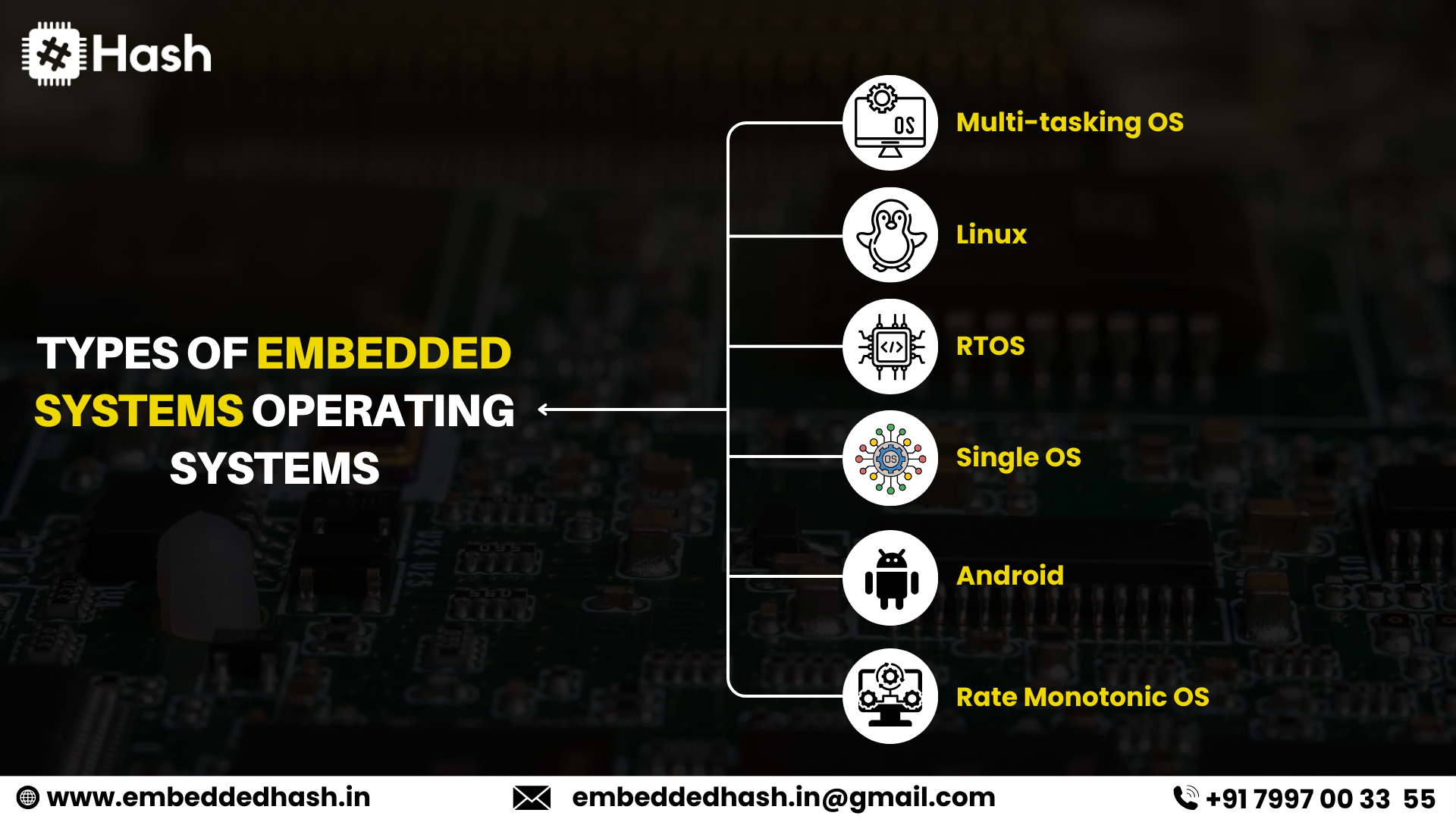
The architecture of an embedded application depends heavily on the complexity of the task and the hardware capabilities.
Bare Metal Development
In "Bare Metal" programming, there is no operating system. Your code starts executing immediately after the bootloader finishes. The structure is usually a "Super Loop" (a while(1) loop) combined with Interrupt Service Routines (ISRs). This offers the highest level of control and lowest overhead but becomes difficult to manage as the application grows in complexity.
Real-Time Operating Systems (RTOS)
An RTOS provides a scheduler, allowing developers to organize code into tasks with different priorities. Unlike Windows or macOS, which use "fair" scheduling (giving everyone a turn), an RTOS uses "preemptive" scheduling. This means the highest-priority task always runs the moment it is ready, ensuring that critical events (like a safety sensor trigger) are handled immediately. Popular RTOS options in 2026 include FreeRTOS, Zephyr, and Azure RTOS (ThreadX).
Embedded Linux
For complex systems requiring networking stacks, file systems, and sophisticated UI, developers use Embedded Linux. This involves using tools like Yocto or Buildroot to create a custom, stripped-down Linux distribution that fits the specific hardware. While this offers more "modern" development features, it sacrifices the strict real-time determinism found in MCUs.
Essential Communication Protocols
Embedded systems rarely work in isolation. They must talk to sensors, displays, and other controllers. A developer must be fluent in the following "Big Three" low-level protocols:
- UART (Universal Asynchronous Receiver-Transmitter): The simplest form of serial communication, often used for debug consoles and simple GPS or Bluetooth modules.
- I2C (Inter-Integrated Circuit): A two-wire bus that allows a master device to talk to multiple slave devices (like temperature sensors or OLED displays) using addressing.
- SPI (Serial Peripheral Interface): A faster, four-wire protocol used for high-speed data transfer, such as writing to SD cards or driving high-resolution screens.
Beyond these, modern systems often utilize CAN Bus (automotive/industrial), Ethernet, and wireless protocols like Matter and Thread for IoT connectivity.
The Toolchain and Workflow
The development environment for embedded systems differs significantly from standard software engineering.
Cross-Compilation
Since the target hardware (e.g., an ARM Cortex-M4) is different from your development machine (e.g., an x86_64 Mac or Windows PC), you must use a cross-compiler. This tool runs on your PC but generates binary code for the target architecture. The most common toolchains are based on GCC (GNU Compiler Collection) or LLVM/Clang.
Debugging with JTAG and SWD
You cannot simply "print" to a console if the hardware doesn't have a screen or a serial port. Developers use hardware debuggers (like J-Link or ST-LINK) that connect to the chip via JTAG or SWD (Serial Wire Debug) interfaces. This allows you to pause the processor, inspect memory, and step through code line-by-line while it is running on the actual physical device.
Hardware-in-the-Loop (HIL) Testing
Testing is more rigorous in embedded development. HIL testing involves connecting the embedded controller to a simulator that mimics real-world sensor inputs and actuator loads. This allows developers to test "edge cases"—such as how a drone controller handles a motor failure—without actually crashing a physical drone.
Programming Languages: C, C++, and the Rise of Rust
While C remains the "lingua franca" of embedded systems due to its proximity to hardware and minimal runtime overhead, the landscape has shifted by 2026.
- C: Still dominant for drivers and tiny MCUs where every byte of Flash counts.
- C++: Widely used in more complex systems. Modern "Embedded C++" avoids heavy features like RTTI (Run-Time Type Information) and exceptions to keep the footprint small.
- Rust: By 2026, Rust has moved from an experimental language to a primary choice for safety-critical embedded systems. Its "ownership" model prevents common memory bugs like buffer overflows and null pointer dereferences at compile time, which is invaluable in systems that cannot be easily rebooted or patched.
- MicroPython/CircuitPython: Used for rapid prototyping and non-critical applications where development speed is more important than raw performance.
Comparison: Microcontrollers (MCU) vs. Microprocessors (MPU)
| Feature | Microcontroller (MCU) | Microprocessor (MPU) |
|---|---|---|
| Typical CPU Speed | 8MHz - 480MHz | 600MHz - 2GHz+ |
| On-chip RAM | Kilobytes to low Megabytes | None (requires external DDR) |
| Operating System | Bare Metal or RTOS | Full OS (Linux, Android, QNX) |
| Power Consumption | Very Low (uA to mA range) | High (hundreds of mA to Amps) |
| Boot Time | Near-instant (milliseconds) | Seconds to minutes |
| Best For | Sensors, motor control, IoT nodes | Gateways, Media players, Complex UI |
Critical Challenges in Embedded Development
Power Management
In the world of mobile and battery-operated IoT, power is the most expensive resource. Developers must implement sophisticated "sleep modes," where the CPU is turned off for 99% of the time, waking up only when a hardware interrupt occurs. Writing code that minimizes "wake time" is as important as writing code that functions correctly.
Security and Trust
In 2026, security is no longer an afterthought. With the prevalence of IoT attacks, embedded developers must implement a Root of Trust (RoT). This includes secure boot (ensuring only signed firmware runs), hardware-accelerated encryption, and secure key storage. Developers must be familiar with Trusted Execution Environments (TEEs) and ARM TrustZone.
Interrupt Latency and Jitter
When a hardware interrupt occurs (e.g., a button press or a data packet arrival), the CPU stops what it is doing to handle the event. The time it takes to switch contexts is "latency." "Jitter" is the variation in that latency. For high-precision control systems, developers must minimize both to ensure system stability.
Frequently Asked Questions
Do I need to know electrical engineering to be an embedded developer?
While you don't need to be a circuit designer, you must be able to read a schematic and use a multimeter or oscilloscope. You need to understand concepts like pull-up/pull-down resistors, voltage levels (3.3V vs 5V), and signal noise to troubleshoot why your software isn't communicating with the hardware.
Why is C still so popular in embedded systems?
C provides a stable, predictable mapping to machine code. In embedded systems, there is no "garbage collector" to pause execution at random times, and the overhead of more abstract languages can exceed the limited memory available on many microcontrollers. Its ubiquity also means that silicon vendors almost always provide "Hardware Abstraction Layers" (HALs) in C.
What is the difference between an embedded system and IoT?
An embedded system is the core technology—the specialized computer. "IoT" (Internet of Things) refers to an embedded system that has a communication interface (Wi-Fi, Cellular, LoRaWAN) allowing it to connect to the internet or other devices. All IoT devices contain embedded systems, but not all embedded systems are connected to the internet.
Can I use modern Agile practices in embedded development?
Yes, but with modifications. Continuous Integration (CI) in embedded systems often requires "Board Farms," where code is automatically flashed onto real hardware in a server rack and tested. Because hardware iterations take longer than software cycles, embedded teams often use hardware emulation (like QEMU) to develop software before the physical PCB is even manufactured.
How do I handle firmware updates in the field?
This is known as OTA (Over-the-Air) updates. For a developer, this requires implementing a "bootloader" that can receive new binary data, verify its integrity and authenticity, and write it to a secondary slot in Flash memory before switching the active partition. This process must be "atomic"—if the power fails halfway through, the device must not be "bricked."
Practical Recommendation for Entering the Field
If you are a software developer looking to move into embedded systems in 2026, the most effective path is to bridge the gap between high-level logic and low-level hardware. Start by acquiring a development board based on the ARM Cortex-M or RISC-V architecture (such as an STM32 or an ESP32-C series).
Focus your learning on memory management without a heap, understanding interrupt-driven architectures, and mastering peripheral drivers (I2C/SPI). Transitioning your mindset from "how do I solve this algorithmically" to "how do I solve this within these hardware limits" is the hallmark of a successful embedded developer. Additionally, gaining proficiency in Rust for Embedded will position you at the forefront of the industry's shift toward memory-safe systems.
Image Gallery
Select an image to open it in a new tab.
Celine Dubois
Contemporary Living and Global Arts Columnist
