
Investing in altcoins involves purchasing digital currencies other than Bitcoin to capitalize on technological innovation, niche market growth, and higher volatility. By diversifying into project-specific tokens—such as Layer 2 scaling solutions, AI-driven protocols, or Real World Assets (RWA)—investors aim to outperform Bitcoin’s returns while managing the heightened risks of the broader crypto ecosystem.
The cryptocurrency landscape in 2026 has matured significantly from the speculative "Wild West" era of the early 2020s. While Bitcoin remains the primary store of value and the entry point for institutional capital, the altcoin market has bifurcated into distinct sectors with tangible utility. Modern investors no longer treat altcoins as a monolithic group; instead, they view them as a collection of technology startups, decentralized service providers, and financial instruments. Succeeding in this environment requires a deep understanding of tokenomics, protocol governance, and the specific macroeconomic factors that drive liquidity into smaller-cap assets.
The Evolution of the Altcoin Market in 2026
To understand altcoin investing today, one must recognize how the market structure has shifted. In previous cycles, altcoins primarily functioned as "leveraged bets" on Bitcoin; when Bitcoin rose, altcoins rose further, and when it fell, they crashed harder. In 2026, we see a decoupling of assets based on fundamental value. The integration of the Markets in Crypto-Assets (MiCA) regulation in Europe and clearer frameworks from the SEC in the United States have forced projects to provide greater transparency.
The market is now dominated by institutional-grade protocols. We have moved past the era of "meme coins" driving the majority of volume—though they still exist as a subculture—and toward a focus on modularity and interoperability. Investing in altcoins now requires an analysis of how a protocol fits into the broader "modular stack," where different blockchains handle execution, data availability, and settlement separately.
Fundamental Analysis: Evaluating the Potential of an Altcoin
Unlike traditional equities, altcoins do not offer quarterly earnings reports in the standard sense. Instead, investors must rely on "on-chain" metrics and fundamental pillars to determine a project's viability.
Tokenomics and Supply Dynamics
The economic model of a token, or its tokenomics, is the most critical factor in long-term price appreciation. An investor must examine the total supply, circulating supply, and the issuance schedule. In 2026, many projects have moved toward "deflationary" models where a portion of transaction fees is burned (removed from circulation), theoretically increasing the value of remaining tokens.
Key questions for evaluating tokenomics include:
- What is the inflation rate? If a project releases 20% of its total supply every year to rewards or venture capital (VC) unlocks, the price faces constant downward pressure.
- What is the utility? Does the token have a "sink"? A token that is only used for governance (voting) often carries less value than one required for gas fees or collateral within a popular ecosystem.
- Vesting Schedules: Check for "cliff" dates where early investors or team members receive large amounts of tokens. These events often precede significant market volatility.
The Development Team and GitHub Activity
In a decentralized world, the "moat" of a project is its code and the developers who maintain it. Analyzing a project’s GitHub repository provides insight into its health. Consistent commits and a high number of active contributors suggest a living project. Conversely, a project that hasn't updated its code in months is often a "zombie" protocol, regardless of its marketing presence.
Community and Network Effects
Metcalfe’s Law states that the value of a network is proportional to the square of the number of its users. For altcoins, this translates to active addresses, daily transaction volume, and Total Value Locked (TVL) in decentralized finance (DeFi) protocols. A project with a billion-dollar market cap but only a few hundred daily active users is likely overvalued and prone to a correction.

Categorizing Altcoins: Where to Allocate Capital
In 2026, the altcoin market is categorized by use case. Successful portfolios usually balance exposure across these specific segments rather than picking random tokens.
Layer 1 and Layer 2 Solutions
Layer 1s (L1) are foundational blockchains like Ethereum, Solana, and Avalanche. However, the 2026 market focuses heavily on Layer 2 (L2) scaling solutions. These protocols sit on top of L1s to process transactions more cheaply and quickly. With the completion of major upgrades like Ethereum’s "Surge" phases, L2s have become the primary hubs for retail activity. Investing here is a bet on the underlying infrastructure of the internet of value.
DePIN (Decentralized Physical Infrastructure Networks)
One of the fastest-growing sectors in 2026 is DePIN. These projects use tokens to incentivize the building and maintenance of physical hardware, such as decentralized wireless networks, storage providers, or energy grids. By investing in DePIN altcoins, you are backing projects that compete with traditional telecom and utility giants by lowering overhead through decentralization.
AI and Machine Learning Tokens
The intersection of Artificial Intelligence and blockchain has moved beyond hype. Altcoins in this space often focus on decentralized compute power (allowing AI models to train on a distributed network) or data marketplaces. As AI models become more ubiquitous, tokens that facilitate "verifiable inference"—proving that an AI output was generated correctly without tampering—have gained significant traction.
Real World Assets (RWA)
RWA tokens represent the "tokenization" of physical assets like real estate, gold, or U.S. Treasury bills. This sector provides a bridge between traditional finance (TradFi) and decentralized finance. Investing in RWA altcoins allows for exposure to stable, yield-bearing assets while maintaining the liquidity and 24/7 trading advantages of blockchain technology.
Comparison of Major Altcoin Sectors (2026 Data)
| Sector | Primary Value Driver | Risk Profile | Recommended Holding Period |
|---|---|---|---|
| Layer 2 (L2) | Transaction throughput and fee revenue. | Medium | 2–5 Years |
| DePIN | Growth of physical network nodes. | High | 3–7 Years |
| DeFi (Lending) | Interest rate spreads and TVL. | Medium-High | 1–3 Years |
| AI Tokens | Demand for decentralized GPU/Compute. | Very High | 1–4 Years |
| RWA Tokens | Yield from underlying physical assets. | Low-Medium | 2–10 Years |
Practical Steps for Investing in Altcoins
Once you have identified a sector or specific project, the execution phase requires a focus on security and liquidity.
- Selection of Exchange or DEX: High-cap altcoins (like Solana or Chainlink) are available on centralized exchanges (CEXs) such as Coinbase or Binance. However, "gem hunting" for newer, small-cap altcoins often requires using Decentralized Exchanges (DEXs) like Uniswap or Raydium.
- Wallet Management: Never leave significant amounts of altcoins on an exchange. For long-term holdings, use a Hardware Wallet (Cold Storage). Ensure the wallet supports the specific blockchain of your altcoin (e.g., Ledger for Ethereum/ERC-20, or specialized wallets for Cosmos/Solana).
- Liquidity Verification: Before buying a small-cap altcoin, check the "slippage." If the liquidity is low, a $1,000 purchase might move the price by 5%, meaning you start with an immediate loss. Use tools like DexScreener to verify pool depth.
- Tax Documentation: In 2026, tax authorities in most jurisdictions have sophisticated on-chain tracking. Every altcoin-to-altcoin trade is a taxable event. Use automated crypto tax software from day one to track your cost basis and capital gains.
Risk Management and the "Altcoin Trap"
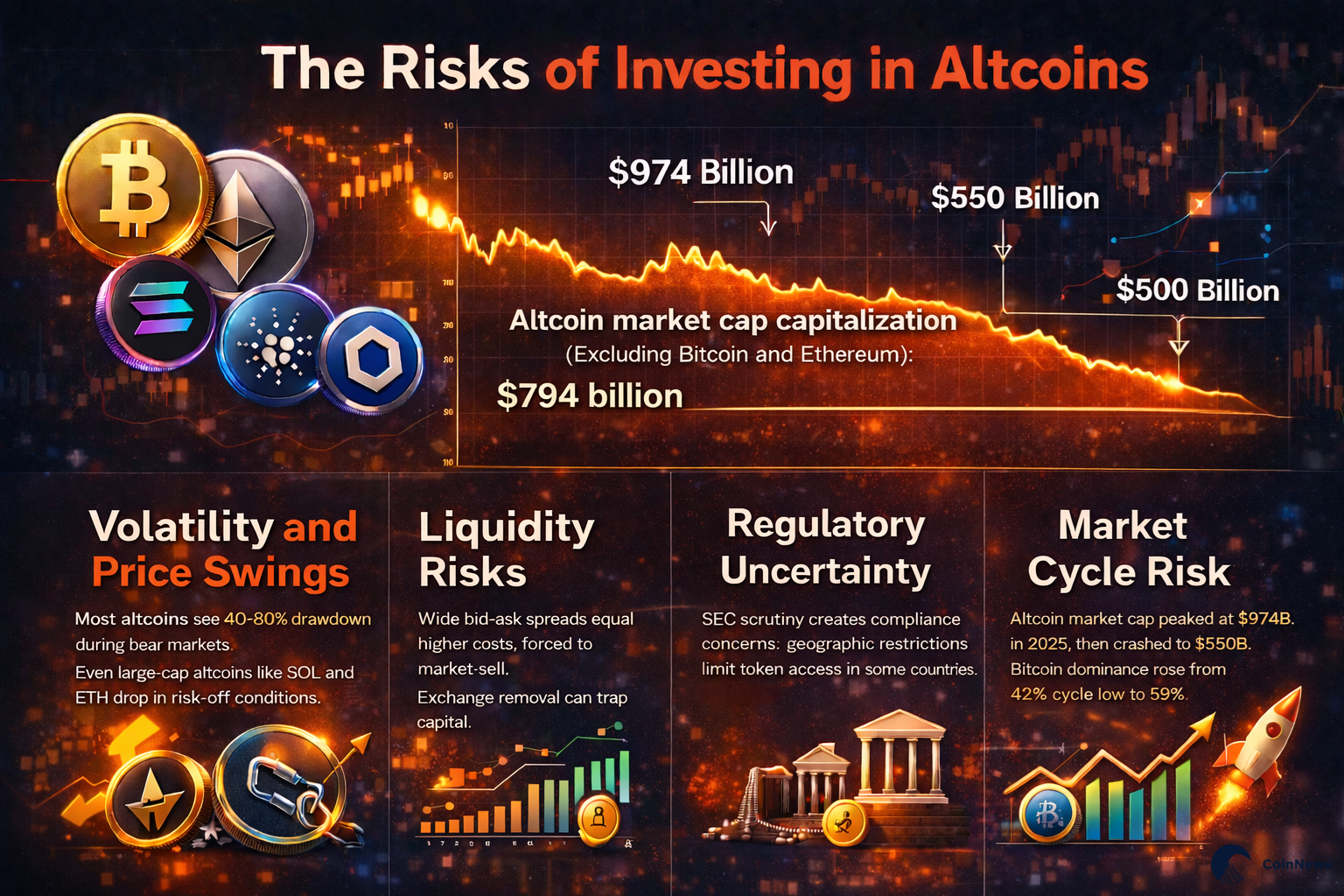
The primary mistake investors make is over-allocation. Because altcoins can see 100x returns, there is a temptation to "go all in." However, the "altcoin trap" occurs when an investor holds a bag of tokens that lose 90% of their value and never recover, even when Bitcoin hits new all-time highs.
The 80/20 Rule of Crypto
A common institutional approach is to keep 80% of a crypto portfolio in "Blue Chips" (Bitcoin and Ethereum) and allocate only 20% to altcoins. Within that 20%, diversification is key. If you invest in five different L2 solutions, you are protected if one protocol suffers a critical smart contract bug or a regulatory shutdown.
Stop-Losses and Take-Profit Levels
Because the altcoin market operates 24/7, price crashes can happen while you are asleep. Setting trailing stop-losses can help protect your principal. Equally important is "taking profit." In a bull market, it is easy to become greedy. A disciplined investor sells a portion of their holdings (e.g., 25%) after a 100% gain to "play with house money."
Identifying Scams and Rug Pulls
Despite better regulation, scams remain. Be wary of projects with:
- Anonymous Teams: Unless there is a massive community track record, anonymous founders are a red flag.
- Guaranteed Returns: No legitimate protocol can guarantee 1% daily returns. This is almost always a Ponzi scheme.
- Locked Liquidity: Check if the developers have locked the liquidity pool. If not, they can "rug pull" (withdraw all the funds) at any moment.
Frequently Asked Questions
Is it too late to invest in altcoins in 2026?
No, but the "easy money" from blind speculation is gone. The market has matured, and gains are now driven by adoption and utility. While you may not see the 10,000% returns of the 2010s, the altcoin market offers a high-growth alternative to the traditional stock market, particularly in sectors like AI and DePIN.
What is the difference between a "coin" and a "token"?
A "coin" (like Bitcoin, Ethereum, or Solana) operates on its own independent blockchain. A "token" (like Chainlink or Uniswap) is built on top of an existing blockchain (usually Ethereum). For investors, the distinction matters because tokens require the "native coin" of the parent blockchain to pay for transaction fees.
How do I know when an "altcoin season" is starting?
"Altcoin season" typically occurs when Bitcoin’s price stabilizes after a major run-up. Investors, looking for higher returns, move their profits from Bitcoin into higher-risk altcoins. One key indicator is Bitcoin Dominance (BTC.D); when this percentage starts to drop while the total crypto market cap stays steady or rises, it usually signals an altcoin rally.
Should I participate in altcoin "staking"?
Staking allows you to earn rewards (yield) for helping secure a Proof-of-Stake network. While it is a great way to grow your holdings, be aware of "unbonding periods." Some altcoins require you to lock your funds for 7 to 21 days before you can sell. In a fast-crashing market, this delay can be costly.
What is "Modular vs. Monolithic" and why does it matter?
This is a core technical debate in 2026. Monolithic chains (like Solana) do everything in one place. Modular chains (like Celestia or Ethereum + Rollups) break tasks apart. As an investor, understanding which architecture wins the most developers will determine which altcoins gain the most value.
Next Steps for the Altcoin Investor
To begin, do not rush into a purchase. Start by following three to five projects in a single sector—such as Layer 2s or RWA—and monitor their development for at least two weeks. Read their whitepapers and join their community forums (Discord or X). When you are ready to invest, start with a small "pilot" position to familiarize yourself with the specific wallet and exchange requirements of that ecosystem. Always prioritize security by using multi-factor authentication (MFA) and hardware storage, and never invest more than you can afford to lose in a single market cycle.
Image Gallery
Select an image to open it in a new tab.


Vivian Cho
Executive IT and Emerging Technologies Reporter
