The Baseball Base Shape Explained: Geometry, Dimensions, and Historical Evolution

In modern baseball, the bases at first, second, and third are square bags measuring 18 inches per side, while home plate is a unique five-sided pentagon 17 inches wide. These specific shapes are designed to define the strike zone, maximize player safety during high-speed slides, and facilitate precise officiating on the basepaths.
The Anatomy of the Pentagon: Why Home Plate is Different
Home plate is the most geometrically distinct element on a baseball diamond. While the other three bases are raised, cushioned squares, home plate is a flat, five-sided slab of whitened rubber set flush with the ground. Its shape is not arbitrary; it is a meticulously calculated design that serves both the pitcher and the umpire.
The dimensions of home plate consist of a 17-inch front edge that faces the pitcher, two 8.5-inch sides that run parallel to the batter's box, and two 12-inch edges that meet at a point at the back. This "house" shape is oriented so that the point fits perfectly into the intersection of the first and third-base foul lines.
Defining the Strike Zone
The primary reason for the 17-inch width of home plate is to provide a physical reference for the strike zone. The strike zone is a three-dimensional volume of space above the plate. By having a flat, wide surface with a clearly defined front edge, the umpire can more accurately judge whether a ball has passed over the "black" (the edges of the plate).
If home plate were a circle or a simple square, the "point" would not exist to guide the foul lines, and the vertical prism of the strike zone would be much harder to visualize. The five-sided design allows the umpire to stand directly behind the catcher and use the angles of the plate to track the trajectory of the ball as it crosses the hitting area.
Historical Evolution of the Plate
In the mid-19th century, home plate was often a circular stone or a white marble slab. This was remarkably dangerous for players sliding home. In the 1870s, it transitioned to a square 12-inch base, similar to the other bases of that era. However, the move to the current pentagon shape occurred in 1900. The change was spearheaded to help umpires see the strike zone more clearly. By angling the back of the plate toward the catcher, the "edges" of the strike zone became more distinct from the umpire's perspective behind the catcher's shoulder.
The Square Bags: First, Second, and Third Base
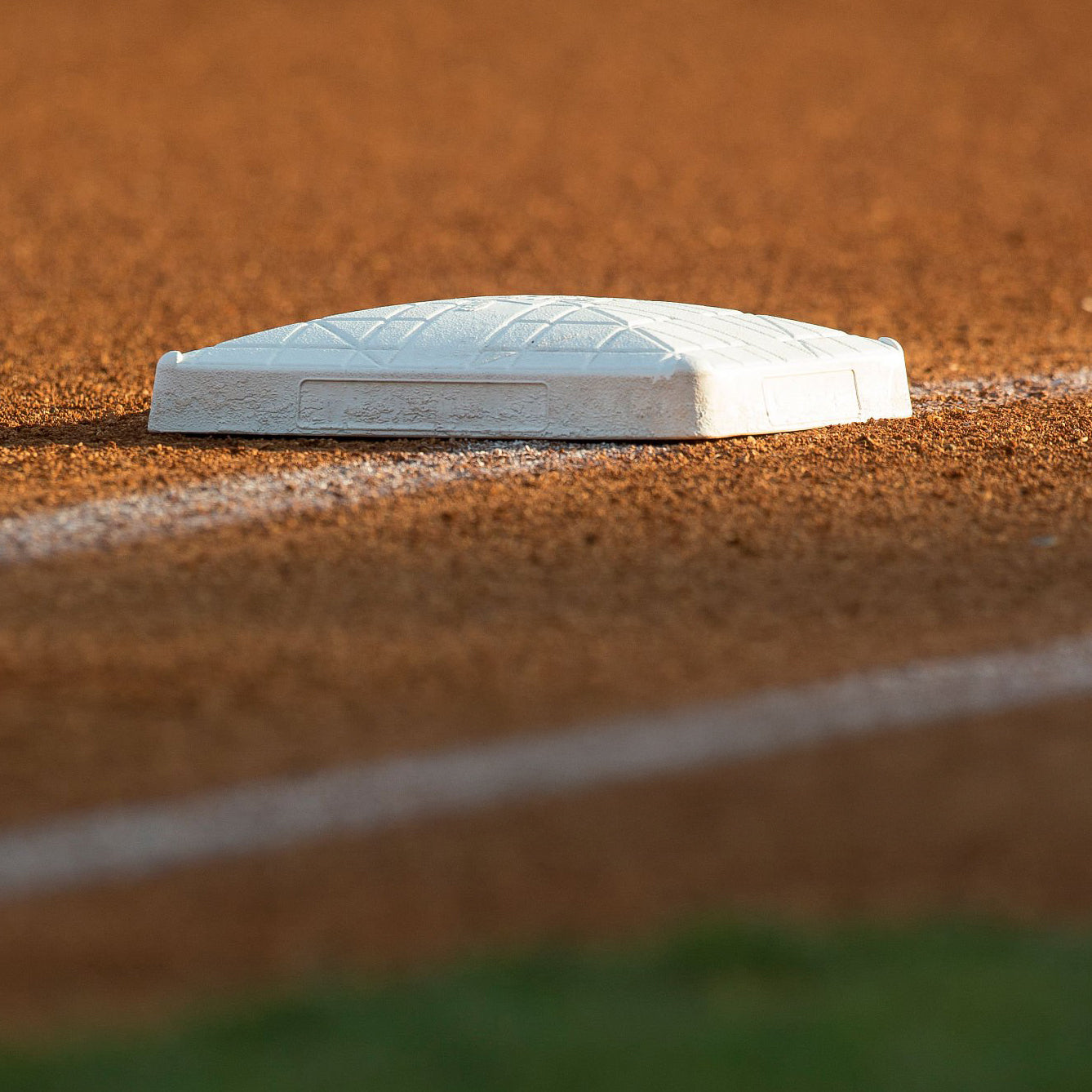
Unlike the flat rubber of home plate, the "bags" at first, second, and third base are raised platforms. As of 2026, the standard for Major League Baseball (MLB) and most professional organizations remains the 18-inch square, a significant update from the 15-inch standard that persisted for over a century.
Geometric Consistency and Orientation
First, second, and third bases are squares because this shape provides a consistent surface area for runners to tag or slide into from multiple angles. A square allows for a "leading edge" regardless of whether a player is running from the previous base or returning on a pick-off attempt.
The orientation of these squares is critical to the layout of the field:
- First and Third Base: These bases are placed entirely within fair territory. The outer edges of these bases align with the foul lines. This ensures that a ball hitting the bag is, by definition, a fair ball.
- Second Base: Unlike the corner bases, second base is centered exactly over the "point" of the 90-foot square. This means its center point aligns with the intersection of the lines from first and third base. This creates a slight asymmetry in the running lanes that players must account for when rounding the bases.
The 18-Inch Standard
In 2023, MLB increased the size of the square bases from 15 inches to 18 inches. While three inches might seem negligible, it increased the surface area of each base by nearly 44%. This change was implemented for two primary reasons:
- Safety: By making the base larger, there is more "neutral" territory for the runner and the fielder to occupy simultaneously. This significantly reduces the likelihood of a first baseman's foot being stepped on by a sprinting batter-runner.
- Stolen Base Incentives: The larger bases effectively shorten the distance between them. The distance between first and second base, and second and third base, was reduced by 4.5 inches. In a game of inches, this distance encourages more aggressive base running and athletic steals.

Technical Specifications and Materials
The construction of a baseball base involves more than just rubber and stuffing. Modern bases are highly engineered pieces of equipment designed to withstand the impact of a 200-pound athlete sliding at full speed.
Material Composition
Most professional bases are made from a heavy-duty, UV-resistant synthetic rubber or a high-density polyurethane. The interior is typically a "poly-foam" core that provides the necessary cushioning. This "squish" factor is vital; it absorbs the kinetic energy of a slide, preventing ankle and knee injuries that would occur if the base were a rigid, unyielding block of wood or stone.
The Anchor System
Bases are held in place by a steel stanchion (a post) that fits into a metal sleeve buried in the ground. This system ensures the base stays perfectly square and does not shift during play. However, in many youth and recreational leagues, "breakaway" bases are used. These are designed to detach from their anchors if a certain amount of lateral force is applied, preventing the base from acting as a fixed trip hazard during a poorly executed slide.
Dimensional Comparison Table
| Feature | Home Plate | First, Second, & Third Base |
|---|---|---|
| Shape | Pentagon (5-sided) | Square (4-sided) |
| Material | Flat Whitened Rubber | Padded Rubber/Foam Bag |
| Primary Width | 17 Inches | 18 Inches |
| Height | Flush with ground | 3 to 5 Inches |
| Placement | Intersection of foul lines | Fair territory (1st/3rd); Centered (2nd) |
| Purpose | Define Strike Zone / Scoring | Safety / Visual target for runners |
Field Layout and the "Diamond" Geometry
While we call the infield a "diamond," it is technically a square rotated 45 degrees. The shape of the bases plays a fundamental role in the mathematical precision of the field.
The 90-Foot Square
The distance between the back point of home plate and the back point of first base is exactly 90 feet. The same applies to the distance between the back point of first and the center of second, and so on. Because the bases have specific shapes and thicknesses, the "running path" is not a perfect 360-foot circle.
The shape of the square bags means that the "inner" corner of the base is the closest point to the next station. Professional runners are taught to hit the inside corner of the square bag to minimize the distance traveled while rounding. If the bases were circular, this "corner-clipping" technique would be less effective, as there would be no specific point to target for the shortest possible path.
Verticality and the Strike Zone
Home plate’s shape extends upward into a virtual pentagonal prism. When a pitcher throws a ball, the umpire is not just looking at the front of the plate; they are judging if the ball crossed any part of that five-sided area at a height between the batter’s knees and the midpoint of their torso. The flat, pentagonal shape on the ground is the "map" for this three-dimensional target.
Strategic Impact of Base Shape and Size
The geometry of the bases dictates much of the strategy in the modern game. From the "neighborhood play" (historically) to the mechanics of a head-first slide, the physical properties of the 18-inch square and the 17-inch pentagon are always at play.
The "Double Base" in Softball and Youth Leagues
It is worth noting that in many softball leagues and some youth baseball divisions, first base is actually a rectangle—a "double base." One half is the standard white bag (in fair territory), and the other half is bright orange (in foul territory). This shape is specifically designed to separate the fielder and the runner entirely. While MLB has resisted this specific shape in favor of simply enlarging the standard square, the goal remains the same: using shape to manage the traffic at the most dangerous bag on the field.
Sliding Techniques
The square shape of the bags allows for the "hook slide." Because the base has four distinct corners, a runner can target the outer corner while their body remains in foul territory, making it harder for a fielder to apply a tag. The height of the square bag (usually 3 to 5 inches) provides a physical "stop" for the runner’s foot or hand, which is why players prefer the raised bags over the flat rubber of home plate. Sliding into home plate requires different mechanics because there is no raised edge to catch the runner's momentum; instead, they must slide "over" or "across" the rubber.
Maintenance and Visibility
For a base to serve its geometric purpose, it must remain visible and properly aligned. Groundskeepers spend hours ensuring that the white of the bases contrasts sharply with the green of the grass and the brown of the "infield skin" (the dirt).
Cleaning and Chalking
During a game, umpires frequently use a small brush to sweep dirt off home plate. This is not just for aesthetics; if the five-sided shape of home plate is obscured, the pitcher loses their target and the umpire loses their reference for the strike zone. Similarly, the foul lines are chalked to meet the exact points of the home plate pentagon and the edges of the first and third-base squares. Any misalignment in these shapes can lead to disputed calls on "fair or foul" balls down the lines.
Modern Technology
In 2026, many stadiums utilize automated ball-strike systems (ABS). These systems use high-speed cameras to track the ball relative to the pentagonal geometry of home plate. Even with computer assistance, the physical plate remains the "ground truth" for the system's calibration. The cameras are synced to the exact coordinates of those 17-inch and 12-inch edges.
Frequently Asked Questions
Why is home plate a pentagon instead of a square?
Home plate is a pentagon to assist umpires in visualizing the strike zone and to provide a "point" that aligns perfectly with the first and third-base foul lines. The 17-inch width defines the horizontal limit of the strike zone, while the angled back edges help the umpire track the ball's path more effectively than a flat square would.
When did MLB change the size of the bases?
Major League Baseball officially increased the size of first, second, and third base from 15 inches square to 18 inches square starting in the 2023 season. This standard remains in place as of 2026, aimed at improving player safety and encouraging more action on the basepaths.
Are the bases in softball the same shape as in baseball?
Generally, yes, but many softball leagues utilize a "double base" at first. This is a 15x30 inch rectangle (essentially two square bases joined together). One side is white for the fielder, and the other is orange for the runner to prevent collisions. Home plate in softball follows the same 17-inch pentagon shape used in baseball.
Does the shape of the base affect the distance between them?
The shape itself doesn't change the 90-foot specification, but the size does. When MLB moved to 18-inch bases, the physical distance between the edges of the bags decreased. Between first and second base, the gap was reduced by 4.5 inches, making it slightly easier for runners to reach the bag safely on steals or close plays.
Why is home plate flat while the other bases are raised?
Home plate is flat because it is located in the middle of the most high-traffic area of the field—the batter's box and the catcher's station. A raised bag at home would cause constant tripping for batters, catchers, and umpires. Furthermore, runners must be able to slide over home plate safely without their momentum being abruptly stopped by a vertical edge.
Expert Recommendation
For coaches and players at the amateur level, it is essential to ensure that your field equipment matches current standards for safety and competitive consistency. If you are upgrading your facility, prioritize bolted-stanchion 18-inch bases for the infield to mirror the professional standard and improve safety. For home plate, always ensure the "point" is perfectly aligned with the apex of your foul lines; even a one-inch misalignment can drastically alter the strike zone and the accuracy of fair/foul calls.
Image Gallery
Select an image to open it in a new tab.




Declan O'Connor
Higher Education and Campus Culture Reporter
