
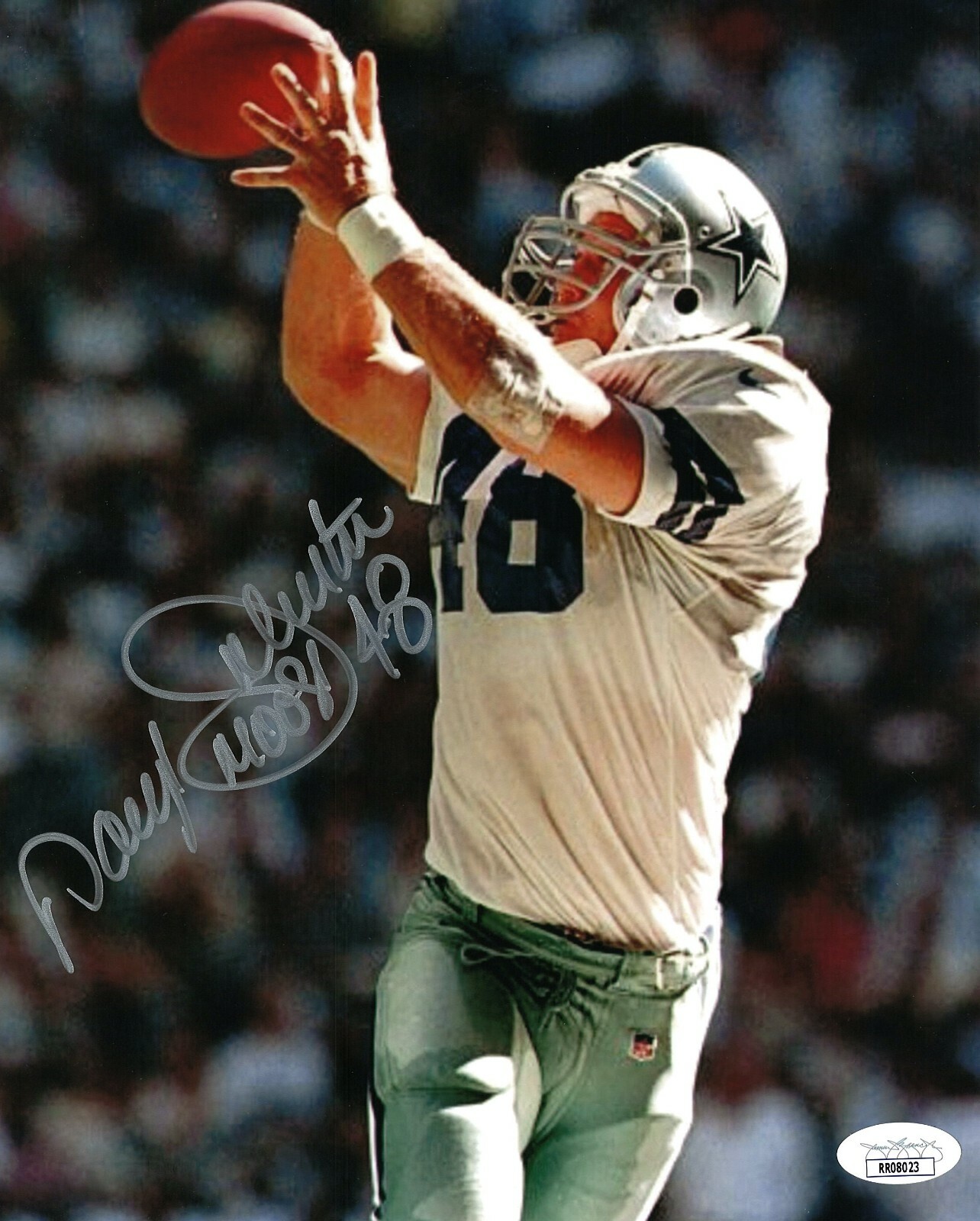
Daryl "Moose" Johnston was the premier fullback for the Dallas Cowboys from 1989 to 1999, serving as a vital component of the team’s three Super Bowl titles in the 1990s. Renowned for his exceptional lead-blocking for Emmitt Smith, Johnston redefined the fullback position, eventually forcing the NFL to create a specific Pro Bowl roster spot for the role.
The Arrival of "Moose": Drafting a Dynasty Foundation
In 1989, the Dallas Cowboys were a franchise in the midst of a seismic transformation. New owner Jerry Jones and head coach Jimmy Johnson were tasked with rebuilding a once-proud organization that had fallen into mediocrity. With the 39th overall pick in the second round of the 1989 NFL Draft, the Cowboys selected Daryl Johnston, a powerhouse fullback out of Syracuse University. At the time, few realized that this pick would become one of the most significant "glue" pieces of a championship roster.
Johnston arrived in Dallas during a bleak 1-15 season, but his individual potential was immediately evident. Standing 6'2" and weighing approximately 240 pounds, he possessed the physical frame of a linebacker but the hands of a tight end. His nickname, "Moose," was bestowed upon him by backup quarterback Babe Laufenberg during his rookie training camp. Laufenberg noted that Johnston looked like a giant moose among the smaller players during drills. The moniker stuck, and for the next decade, "MOOOOSE" would become the signature chant of the Dallas faithful whenever he touched the ball or leveled a defender.
His rookie season was a trial by fire. While the team struggled, Johnston proved his durability and versatility. He was not merely a ball carrier; he was a tactical weapon in Jimmy Johnson’s evolving offensive scheme. In an era where the NFL was still heavily reliant on the "I-formation," having a fullback who could both punish linebackers and catch passes out of the backfield gave the Cowboys a strategic advantage that few other teams could replicate.
Redefining the Fullback Position in the Modern Era
Before Daryl Johnston, the fullback was often viewed as a "failed" tailback or a smaller offensive lineman. Johnston changed the perception of the position by turning lead-blocking into a specialized art form. His primary responsibility was to clear a path for Emmitt Smith, the NFL’s all-time leading rusher. The synergy between Johnston and Smith is widely regarded as the gold standard for backfield partnerships in professional football history.
Johnston’s technique was grounded in leverage and anticipation. He had an uncanny ability to identify the "Mike" (middle) linebacker before the snap and neutralize him at the point of attack. By consistently winning these physical confrontations, he allowed Smith to reach the second level of the defense without being touched. Smith has frequently credited Johnston for his success, famously stating that he wouldn't have reached the rushing record without "Moose" leading the way.
The impact of his play was so profound that it led to a significant change in the NFL’s postseason honors. Prior to the early 1990s, the Pro Bowl did not have a dedicated slot for fullbacks; they were grouped with "running backs," which meant they were rarely selected over high-stat tailbacks. In 1993, Johnston’s excellence was so undeniable that the NFL officially added a fullback position to the Pro Bowl ballot. Johnston was subsequently selected for the Pro Bowl in 1993 and 1994, cementing his status as the best at his craft.
The Three-Ring Legacy: Super Bowl Success in the 1990s
The true measure of Daryl Johnston’s career is found in the hardware. He was an integral part of the Dallas Cowboys teams that won Super Bowls XXVII, XXVIII, and XXX. During this span, the Cowboys were the most dominant force in professional sports, and the "Triplets"—Troy Aikman, Emmitt Smith, and Michael Irvin—received the lion's share of the credit. However, those within the organization knew that Johnston was the engine that made the run game hum.
Super Bowl XXVII and XXVIII: Dominance over Buffalo
In the back-to-back championships against the Buffalo Bills, Johnston’s versatility was on full display. In Super Bowl XXVII, he recorded two receptions for 15 yards and provided the foundational blocks that allowed Emmitt Smith to rush for 108 yards. By Super Bowl XXVIII, Johnston had become a reliable check-down option for Troy Aikman. His ability to catch passes in the flat forced defenses to respect him as more than just a blocker, which in turn opened up the middle of the field for Michael Irvin and Jay Novacek.
Super Bowl XXX: The Dynasty's Peak
Against the Pittsburgh Steelers in January 1996, Johnston once again proved his value. While the game is often remembered for Larry Brown’s interceptions, Johnston’s role in managing the clock through the ground game was essential. He played a total of 149 consecutive games between 1989 and 1997, a testament to his toughness and reliability during the most grueling decade of NFL physical play.
Statistical Analysis of a Utility Master
While Daryl Johnston’s statistics do not jump off the page like those of a primary ball carrier, they reveal a player who was deeply involved in every facet of the offense. He was a "dual-threat" fullback who could be relied upon in short-yardage situations and as a safety valve in the passing game.
| Category | Career Total (1989-1999) | Notes |
|---|---|---|
| Games Played | 149 | Known for extreme durability and consecutive starts. |
| Rushing Yards | 753 | Primarily used in short-yardage and goal-line sets. |
| Rushing Touchdowns | 8 | Often the "decoy" for Emmitt Smith in the red zone. |
| Receptions | 294 | One of the most prolific pass-catching FBs of his era. |
| Receiving Yards | 2,227 | Averaged 7.6 yards per catch. |
| Receiving Touchdowns | 14 | A frequent target in play-action scenarios. |
| Pro Bowl Selections | 2 | 1993, 1994 (Directly influenced the creation of the FB slot). |
These numbers highlight his role as a "safety valve." In the 1990s Cowboys offense, if the primary receivers were covered, Troy Aikman knew he could dump the ball to Johnston for a reliable five-to-seven-yard gain. His 294 career receptions are particularly impressive for a player whose primary job was to collide with 250-pound linebackers on every play.
Challenges, Injuries, and Retirement
The physical toll of being a lead blocker in the NFL is immense. Johnston’s style of play—leading with his head and shoulders to take the brunt of the impact—eventually led to serious health challenges. In 1997, he suffered a severe neck injury that sidelined him for much of the season and threatened his career. Despite a valiant attempt to return, the injury proved to be a turning point.
Johnston played only one game in 1999 before the recurring neck issues forced him into retirement. He finished his career having played 149 games, which at the time of his retirement was among the most in franchise history for an offensive back. His departure marked the symbolic end of the 1990s dynasty era, as the core players of those championship teams began to age out or move on.
The transition from the field to the broadcast booth was seamless for Johnston. His deep understanding of the game’s technical aspects made him a natural fit for television. He joined FOX Sports in 2000 and quickly rose to the "A-team" of announcers, partnering with Kevin Burkhardt and others to provide some of the most insightful color commentary in the business. As of 2026, he remains a respected voice in NFL media, known for his ability to explain complex blocking schemes and defensive rotations to the average viewer.
Impact on the Modern NFL and the Fullback Position
By 2026, the traditional fullback position has largely vanished from the NFL, replaced by "H-backs" and versatile tight ends. However, the "Johnston Blueprint" is still studied by coaches who value a physical run game. Teams like the San Francisco 49ers and Baltimore Ravens have utilized modern iterations of the fullback that mirror Johnston's versatility—players who can block like a lineman, run like a back, and catch like a receiver.
Johnston’s legacy is also found in his leadership off the field. In recent years, he has served as the President of Football Operations for the United Football League (UFL), applying his decades of experience to help build a sustainable spring football ecosystem. His commitment to the game extends beyond his playing days, focusing on player development and the preservation of football's strategic depth.
Within the Dallas Cowboys organization, Johnston remains a beloved figure. While he has not yet been inducted into the Pro Football Hall of Fame—a common hurdle for fullbacks whose impact isn't reflected in traditional stats—his inclusion in the Cowboys' culture is permanent. He is frequently cited by current players as a model for professional conduct and team-first mentality.
Frequently Asked Questions
Why was Daryl Johnston called "Moose"?
The nickname was given to him by backup quarterback Babe Laufenberg during his rookie season in 1989. Laufenberg remarked that Johnston’s large stature and powerful running style made him look like a moose compared to the other players on the field. The name became so popular that Cowboys fans began chanting "MOOOOSE" every time he touched the ball, a tradition that lasted his entire career.
How many Super Bowls did Daryl Johnston win with the Cowboys?
Johnston won three Super Bowl championships with the Dallas Cowboys: Super Bowl XXVII (1992 season), Super Bowl XXVIII (1993 season), and Super Bowl XXX (1995 season). He was a starter and key contributor in all three games, primarily serving as the lead blocker for Hall of Fame running back Emmitt Smith.
Did Daryl Johnston ever make the Pro Bowl?
Yes, Johnston was selected to the Pro Bowl twice, in 1993 and 1994. Interestingly, his play was so dominant that it prompted the NFL to change the Pro Bowl voting structure. Before Johnston, fullbacks had to compete with tailbacks for spots; his excellence led the league to create a dedicated Pro Bowl position specifically for fullbacks.
What caused Daryl Johnston to retire?
Johnston was forced to retire due to a chronic neck injury. The injury first became serious in 1997 and despite surgery and rehabilitation, he continued to experience issues. After playing only one game in the 1999 season, he decided to retire to prevent permanent neurological damage.
What is Daryl Johnston’s role in football today (2026)?
As of 2026, Daryl Johnston serves as a high-level executive in professional football management, notably with the UFL (United Football League). He also continues his long-standing career as a premier color commentator for NFL games on FOX Sports, where he has been a fixture since 2000.
Final Recommendation for Fans and Historians
To truly appreciate the career of Daryl Johnston, one should look past the rushing statistics and study film of the Cowboys' championship seasons. Observe the "isolation" blocks he performed against Hall of Fame linebackers and his reliability as a pass-catcher on third downs. For those interested in the tactical evolution of the NFL, Johnston’s career serves as the definitive study of the fullback position's peak. His contribution to the Dallas Cowboys' 1990s dynasty was not just supplementary; it was foundational. Fans should view his legacy as a reminder that the most valuable players on a roster are often those who prioritize the success of their teammates over their own individual box score.
Image Gallery
Select an image to open it in a new tab.
Vivian Cho
Executive IT and Emerging Technologies Reporter
