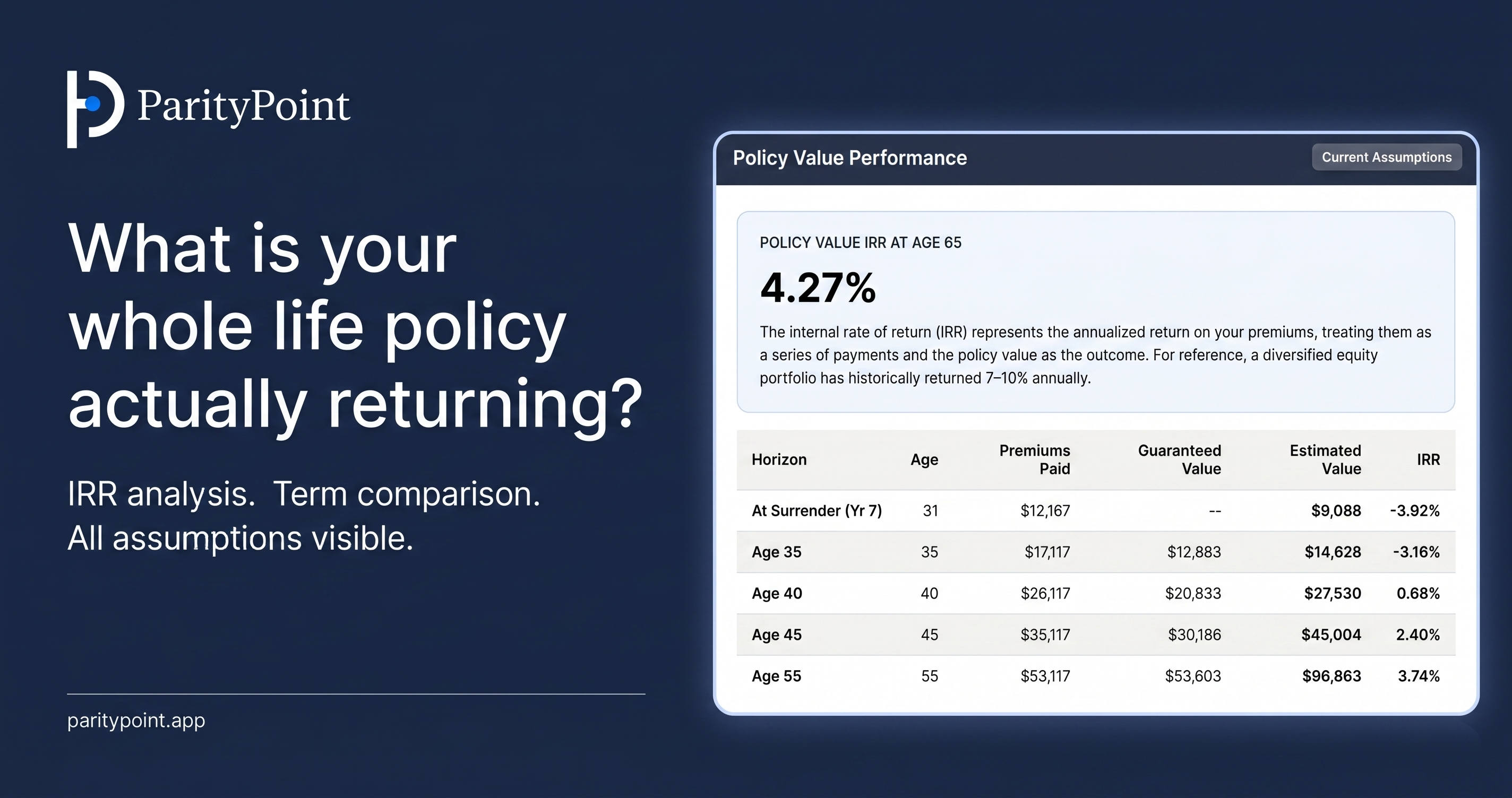
The Internal Rate of Return (IRR) in whole life insurance is the annualized, compounded rate of return on the premiums paid into a policy relative to its cash value or death benefit. Unlike a simple percentage gain, IRR accounts for the specific timing of premium payments and the impact of policy costs over decades.
Understanding the Internal Rate of Return (IRR) is essential for any policyholder or prospective buyer who views whole life insurance as a component of a broader financial strategy. While insurance companies often advertise a "Dividend Interest Rate," that figure is not the same as your actual return. The IRR provides a more transparent look at the efficiency of your capital within the policy, net of all fees, mortality costs, and administrative expenses. As of 2026, with a more stabilized interest rate environment compared to the previous decade, understanding these metrics is vital for accurate long-term wealth planning.
What is Whole Life Insurance IRR?
Internal Rate of Return is a financial metric used to estimate the profitability of potential investments. In the context of whole life insurance, it functions as a "discount rate" that makes the net present value (NPV) of all cash flows (premiums paid in and cash values or death benefits received) equal to zero.
When you look at a whole life insurance illustration, you are typically presented with three different types of IRR:
- IRR on Cash Value: This measures the return if you were to surrender the policy or access the cash. It reflects the growth of your "living benefits."
- IRR on Death Benefit: This measures the return provided to beneficiaries upon the insured's passing. This figure is exceptionally high in the early years and trends downward as the policy matures.
- Tax-Equivalent IRR: This is a calculated figure that demonstrates what interest rate a taxable investment (like a CD or brokerage account) would need to earn to match the tax-free growth of the insurance policy.
For most investors, the IRR on Cash Value is the most critical metric. It represents the actual "yield" on the dollars parked within the policy. Because whole life insurance involves high upfront costs—including agent commissions, state premium taxes, and the cost of the death benefit—the IRR is almost always negative in the first few years.
The Evolution of IRR Over the Policy Lifecycle
One of the most misunderstood aspects of whole life insurance is how the return develops over time. It does not behave like a high-yield savings account where you earn a consistent 4% from day one. Instead, it follows a "J-curve."
The Early Years (Years 1–10)
In the first several years of a whole life policy, the IRR is usually negative. This is because the insurance company must recoup the costs of underwriting the policy and paying the initial acquisition expenses. If you pay $10,000 in premium in Year 1, your cash value might only be $2,000. This results in a significant negative IRR. By Year 7 to Year 10, many well-designed policies reach a "break-even" point where the cash value equals the total premiums paid, bringing the IRR to 0%.
The Intermediate Years (Years 11–25)
Once the policy passes the break-even point, the IRR begins to climb into positive territory. During this phase, the compounding effect of dividends and the growth of the cash value begin to outpace the annual mortality charges. As of 2026, a competitive whole life policy from a major mutual carrier typically sees its IRR climb toward the 3.0% to 4.0% range during this period.
The Maturity Phase (Year 25+)
In the long term, the IRR on cash value tends to stabilize. For policies held for 30 or 40 years, the IRR often levels out between 4% and 5%, depending on the company's dividend performance and the prevailing interest rates. While this may seem lower than the historical returns of the S&P 500, it is important to remember that this return is generally tax-advantaged and carries significantly lower volatility than equities.

Factors That Influence Your Policy’s IRR
Several variables dictate whether your IRR will be at the high or low end of the industry average. Understanding these helps in selecting the right product and carrier.
Policy Design and Paid-Up Additions (PUAs)
The way a policy is structured is the single most important factor for IRR. A "base-heavy" policy, where most of the premium goes toward the base death benefit, will have a very slow IRR growth. Conversely, a policy that utilizes a Paid-Up Additions (PUA) rider allows the policyholder to overfund the policy. These PUA dollars have very low overhead and start earning dividends almost immediately, significantly accelerating the IRR and shortening the time to the break-even point.
Dividend Scales
Whole life insurance from mutual companies pays dividends, which are technically a return of premium but function like a share of the company's profits. These dividends are not guaranteed, but many major carriers have paid them every year for over 150 years. The Dividend Interest Rate (DIR) announced by the company is the gross rate applied to the cash value after the company takes its cut for expenses. Therefore, if a company announces a 6% dividend, the net IRR for the policyholder might be closer to 4.5%.
Mortality Charges and Underwriting
The cost of insurance (mortality charge) is deducted from the policy's cash value. A younger, healthier individual (Preferred Best rating) will have lower mortality charges than an older or less healthy individual. Lower internal costs directly translate to a higher IRR on cash value.
Comparing Whole Life IRR to Other Assets
To understand the value of whole life insurance, one must compare its IRR against other asset classes. In a 2026 financial context, whole life is often positioned as a "volatility buffer" or a replacement for the fixed-income portion of a portfolio.
| Asset Class | Typical 2026 Long-Term IRR (Estimated) | Risk Profile | Tax Treatment |
|---|---|---|---|
| Whole Life (Cash Value) | 3.5% – 5.0% | Low (Guaranteed floor) | Tax-deferred/Tax-free loans |
| High-Yield Savings | 3.0% – 4.0% | Very Low (FDIC Insured) | Taxable as ordinary income |
| Municipal Bonds | 3.0% – 4.5% | Low to Moderate | Federal tax-free |
| S&P 500 Index | 7.0% – 10.0% | High (Market volatility) | Capital gains taxes apply |
| Corporate Bonds (A-rated) | 4.5% – 5.5% | Moderate | Taxable as ordinary income |
This table illustrates that whole life IRR is competitive with other low-risk, fixed-income instruments, especially when factoring in the tax-equivalent yield. For an individual in a 35% combined federal and state tax bracket, a 4% tax-free IRR is equivalent to earning roughly 6.15% in a taxable account.
The Impact of Taxes on the IRR Calculation
The primary advantage of whole life insurance is its treatment under the Internal Revenue Code, specifically 26 U.S. Code § 7702. The cash value grows on a tax-deferred basis, and if managed correctly, can be accessed tax-free.
Tax-Free Access via Loans
If a policyholder needs to access their cash value, they can take a policy loan. Unlike a withdrawal from a 401(k) or an IRA, a policy loan is not considered taxable income by the IRS. This allows the "effective" IRR to remain high because no "tax drag" is applied to the distributions.
Surrender and the Cost Basis
If a policy is surrendered (canceled) for its cash value, any amount received above the "cost basis" (the total premiums paid) is taxable as ordinary income. This can significantly reduce the realized IRR. Therefore, the IRR is most favorable for those who intend to keep the policy for life or use loans for cash flow.
Common Misconceptions About IRR
Dividend Interest Rate vs. IRR
The most common mistake is confusing the company's "Dividend Interest Rate" (DIR) with the "Internal Rate of Return" (IRR). If a company like MassMutual or Northwestern Mutual announces a dividend of 5.8%, that does not mean your account grew by 5.8%. The DIR is a gross rate applied to a net value. Always ask for the "IRR column" on a policy illustration to see the real number.
The "Death Benefit IRR" Illusion
In the first year of a policy, the IRR on the death benefit might be 5,000% or more. While factually true, it is only relevant if the insured passes away immediately. When evaluating the policy as a financial asset, the cash value IRR is the more sober and useful metric.
Average Return vs. Compounded Return
Insurance agents sometimes show "average annual returns." This can be misleading because it ignores the negative returns in the early years. IRR is the only mathematically sound way to account for the time value of money and the sequence of premium payments.
How to Request and Analyze an IRR Report
When considering a whole life policy, you should never rely on a summary page. Instead, request a Full In-Force Illustration (if you already own a policy) or a Full Basic Illustration (if you are buying one).
Look for the following:
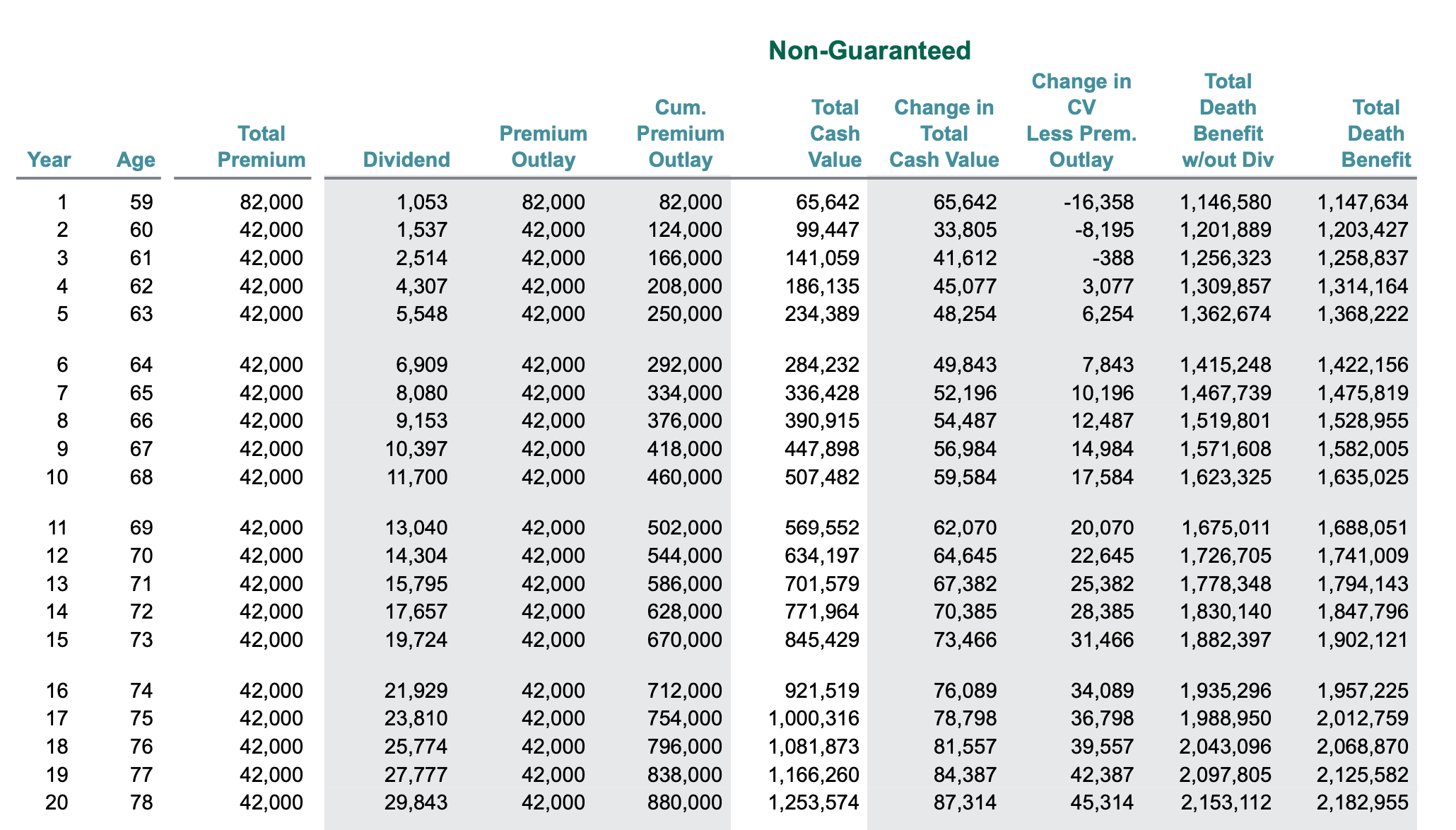
- Year-by-Year IRR: Most modern illustration software can generate a column specifically labeled "IRR on Equity" or "IRR on Cash Value."
- Guaranteed vs. Non-Guaranteed: Every illustration will show a "Guaranteed" side (the absolute minimum the policy will perform) and a "Non-Guaranteed" side (based on current dividend scales). The real IRR will likely fall somewhere in between, but historically, major mutuals have stayed close to their illustrated non-guaranteed values over long periods.
- Expense Ratios: While not always explicitly listed, you can deduce the internal costs by comparing the total premium to the cash value increase in a given year.
For independent verification of insurance company financial strength, which correlates with long-term dividend stability, consult ratings from agencies like A.M. Best or Fitch Ratings.
FAQs
Why is my whole life IRR negative for the first few years?
Whole life insurance is a front-loaded product. The initial premiums cover the cost of medical underwriting, administrative setup, state premium taxes, and agent commissions. Additionally, the company must establish a legal reserve to ensure it can pay future death claims. Because these costs are deducted from your early premiums, your cash value is initially lower than your total contributions, resulting in a negative IRR.
Is a 4% IRR good compared to the stock market?
A 4% IRR is not "better" or "worse" than the stock market; it serves a different purpose. The stock market offers higher potential returns but with significant volatility and the risk of principal loss. Whole life insurance provides a guaranteed floor, contractually protected growth, and a death benefit. Most financial experts view whole life as a substitute for the "safe" portion of a portfolio (bonds/cash) rather than a substitute for equities.
How do interest rates in 2026 affect whole life IRR?
Whole life dividends are largely derived from the insurance company's general account, which is primarily invested in long-term corporate and government bonds. As interest rates rise or stabilize at higher levels, the yield on the company's portfolio increases. This eventually leads to higher dividend scales. In 2026, policies are benefiting from the higher-yielding bonds purchased by carriers during the mid-2020s.
Can I improve the IRR of an existing policy?
The most effective way to improve an existing policy's IRR is to ensure you are maximizing the Paid-Up Additions (PUA) rider if your policy has one. Adding PUA payments increases the cash value without significantly increasing the mortality costs, which boosts the overall efficiency of the policy. You should also check if your dividends are being "reinvested" to purchase more paid-up insurance rather than being taken as cash or used to reduce premiums.
What is a "Tax-Equivalent" IRR?
A tax-equivalent IRR adjusts the policy's return to show what a taxable investment would need to earn to provide the same after-tax result. Since life insurance cash value grows tax-deferred and can be accessed tax-free via loans, its 4% return is often more valuable than a 5.5% return in a taxable brokerage account where federal and state taxes eat into the annual gains.
Final Recommendation
When evaluating whole life insurance IRR, focus on the long-term horizon. This is not a short-term savings vehicle. If you do not intend to keep the policy for at least 15 to 20 years, the IRR will likely be disappointing compared to simpler savings products.
To maximize your IRR, work with an agent who specializes in "high cash value" or "maximum overfunded" policy designs. Ensure that at least 50% to 70% of your total premium is directed toward Paid-Up Additions (PUA) rather than the base premium. Finally, always verify the financial strength of the carrier; a high illustrated IRR is meaningless if the company lacks the surplus to pay dividends consistently over the next 50 years.
Image Gallery
Select an image to open it in a new tab.






Zara El-Hashem
Sociocultural Dynamics and Academics Writer
