Alternatives to Prisma Cloud for Security Posture Management

Top alternatives to Palo Alto Networks Prisma Cloud for Cloud Security Posture Management (CSPM) include Wiz, Orca Security, CrowdStrike Falcon Cloud Security, Microsoft Defender for Cloud, Sysdig Secure, and Check Point CloudGuard. These platforms offer alternatives ranging from agentless, graph-based multi-cloud risk visualization to deeply integrated runtime container protection and enterprise ecosystem solutions.
Understanding Prisma Cloud and Why Enterprises Seek Alternatives
Palo Alto Networks Prisma Cloud established itself as a dominant Cloud Native Application Protection Platform (CNAPP) by combining several acquired technologies—including Evident.io, RedLock, Twistlock, PureSec, and Bridgecrew—into a single suite. It integrates Cloud Security Posture Management (CSPM), Cloud Workload Protection Platform (CWPP), Cloud Infrastructure Entitlement Management (CIEM), and Cloud Code Security into one framework.
Despite its comprehensive suite of security features, enterprise security teams frequently explore alternatives due to operational friction and architectural complexity. Because Prisma Cloud evolved through acquisitions, its administrative console, policy engine, and alert structures can feel fragmented across different modules.
The primary operational drivers for seeking alternatives include:
- Deployment and Maintenance Complexity: Deploying and managing agents across container clusters, virtual machines, and serverless environments requires continuous operational effort, image updates, and resource allocation.
- Complex Pricing Models: Prisma Cloud utilizes a credit-based licensing system. Estimating monthly credit consumption across volatile workloads, cloud resources, and microservices often introduces billing unpredictability for finance and SecOps teams.
- Alert Fatigue and Prioritization Noise: Traditional rule-based engine outputs often lack deep contextual risk scoring, presenting security analysts with thousands of isolated alerts without showing clear attack paths.
- Resource Overhead: Running continuous runtime protection agents can consume CPU and memory overhead on host compute instances, requiring tuned capacity planning.
As enterprise cloud architectures adopt multi-cloud deployments across Amazon Web Services (AWS), Microsoft Azure, Google Cloud Platform (GCP), and Kubernetes, organizations often seek platforms that offer faster time-to-value, unified graph analysis, or simpler agentless deployment models.
Key Factors to Evaluate in CSPM and CNAPP Platforms
When evaluating alternative Security Posture Management tools against Prisma Cloud, cloud security architects and CISOs must balance deep runtime visibility against deployment friction. Modern security posture management has evolved from passive compliance checking to proactive posture management and threat prevention.
- Cloud Account Onboarding
- Agentless Snapshot/API
- Agent-Based eBPF Runtime
- Contextual Security Graph (Misconfigurations + Identity + Vulnerabilities)
- Risk Prioritization & Remediation
1. Scanning Architecture: Agentless vs. Agent-Based vs. Hybrid
Agentless tools connect via read-only cloud provider APIs and disk snapshotting mechanisms to audit cloud configurations, identity permissions, network routes, and disk image vulnerabilities. This architecture deploys in minutes without modifying cloud workloads or introducing runtime performance overhead. Conversely, agent-based solutions use eBPF (Extended Berkeley Packet Filter) kernel modules or OS daemons to provide real-time runtime threat detection, process monitoring, and file integrity monitoring. High-maturity organizations often select hybrid models tailored to specific operational requirements.
2. Contextual Risk Graphs and Attack Path Analysis
Modern CSPM tools must go beyond isolated risk checks (such as flagging an unencrypted S3 bucket). Leading platforms use graph databases to correlate misconfigurations, overly permissive IAM roles, publicly exposed endpoints, unpatched vulnerabilities, and sensitive data locations. This graph-based correlation pinpoints critical vector combinations that could lead to data exfiltration or system compromise.
3. Developer Workflow and Infrastructure as Code (IaC) Integration
Shift-left security requires scanning IaC templates (Terraform, CloudFormation, Bicep, Helm charts) directly within CI/CD pipelines, repository pull requests, and IDEs. An effective alternative must provide developers with context-aware remediation code snippets to fix security flaws before deployment.
4. Regulatory Compliance Framework Mapping
Security operations must maintain continuous compliance visibility against industry frameworks such as CIS Benchmarks, NIST SP 800-53, SOC 2 Type II, ISO/IEC 27001, PCI DSS 4.0, and HIPAA. Platforms should support custom policy creation alongside automated evidence collection for audit reporting.
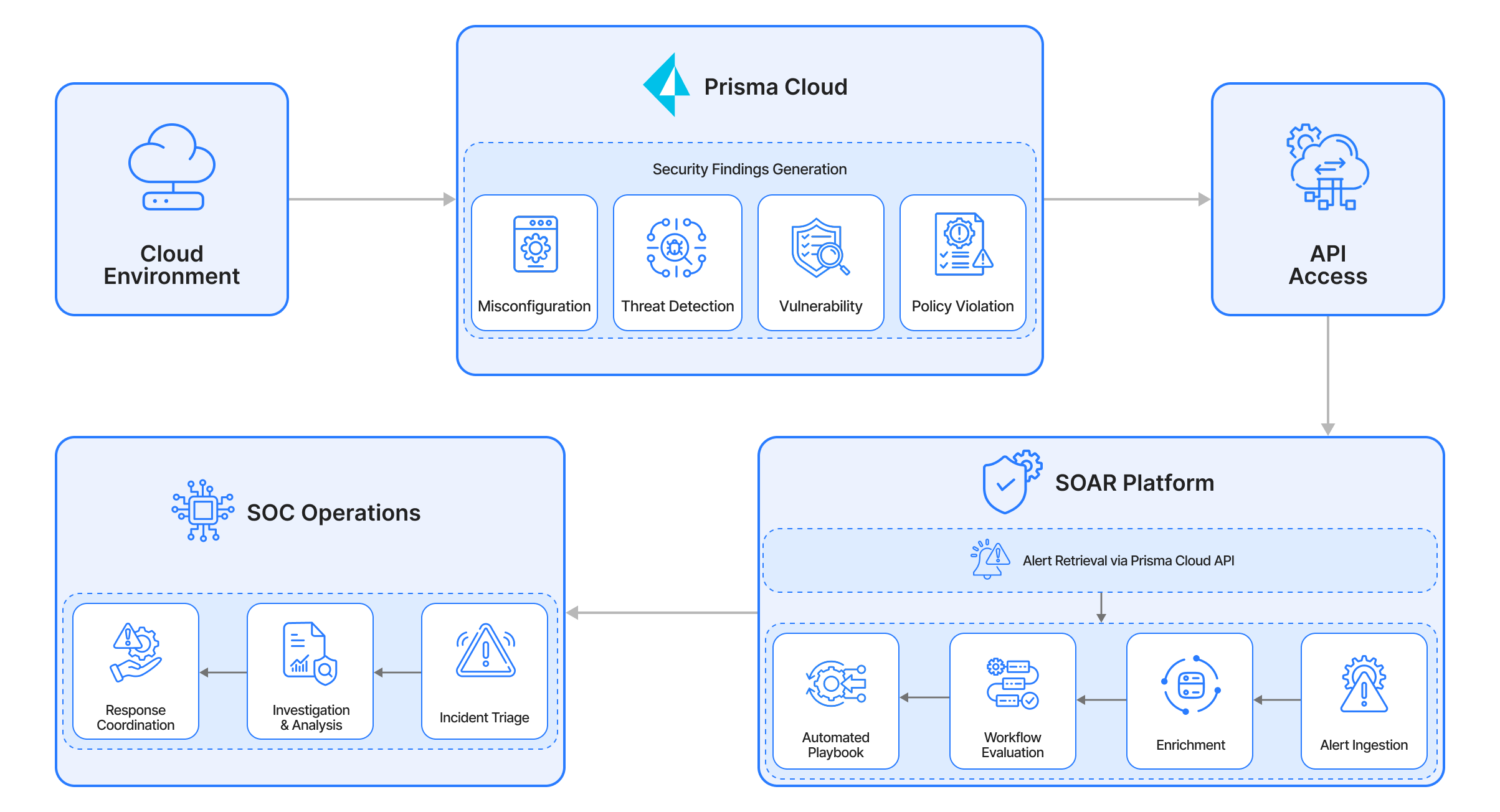
Top Alternatives to Prisma Cloud for CSPM
1. Wiz
Wiz is an agentless Cloud Native Application Protection Platform known for rapid deployment and intuitive interface design. Using cloud service provider APIs and out-of-band disk snapshotting, Wiz builds an interactive Security Graph that visualizes risk relationships across multi-cloud environments.
Core Capabilities
- Wiz Security Graph: Automatically correlates cloud configuration, IAM exposure, software vulnerabilities, secrets, malware, and data sensitivity without deploying host agents.
- Out-of-Band Scanning: Scans virtual machine disks, container registries, and serverless functions via cloud snapshots without impacting production workload performance or stability.
- IaC and Code Security: Integrates scanning into developer IDEs, Git repositories, and CI/CD tools to identify IaC misconfigurations and hardcoded secrets.
Pros and Cons
- Pros: Deploys across multi-cloud enterprise accounts in under an hour; delivers low false-positive rates due to graph contextualization; intuitive user experience for cross-functional teams.
- Cons: Premium enterprise pricing; deep runtime process protection and real-time network packet inspection require optional runtime components compared to full eBPF agents.
2. Orca Security
Orca Security pioneered agentless cloud security using its patented SideScanning™ technology. Orca retrieves data directly from cloud provider control planes and out-of-band block storage snapshots to audit virtual machines, containers, serverless assets, and database instances.
Core Capabilities
- SideScanning Technology: Reads cloud storage volumes directly to assess OS patches, vulnerable packages, malware, exposures, and plain-text credentials without host agent management.
- Unified Data Model: Analyzes identity exposure, storage configuration, networking, and application vulnerabilities within a single consolidated dashboard.
- Shift Left Security: Evaluates IaC code, container images, and deployment manifests within CI/CD pipelines to prevent misconfigurations from reaching production.
Pros and Cons
- Pros: Zero operational impact on running instances; full coverage of legacy or unmanaged OS instances; simple pricing structured around cloud resource count.
- Cons: Less tailored for real-time kernel-level threat blocking than specialized agent-based runtime defense tools.
3. CrowdStrike Falcon Cloud Security
CrowdStrike Falcon Cloud Security expands CrowdStrike's unified endpoint platform into multi-cloud posture management and workload protection. It offers flexible protection through agentless cloud posture scanning and unified Falcon agent runtime monitoring.
Core Capabilities
- Unified Agent and Agentless Architecture: Combines fast agentless asset discovery and CSPM with optional Falcon agent runtime defense for real-time containment.
- 1-Click Threat Hunting: Integrates cloud posture findings directly into the Falcon Threat Graph, allowing SOC analysts to correlate cloud infrastructure alerts with endpoint, identity, and network telemetry.
- Container and Kubernetes Security: Audits cluster configurations, API servers, ingress rules, and runtime container processes across managed Kubernetes distributions (EKS, AKS, GKE).
Pros and Cons
- Pros: Excellent single-pane-of-glass operational efficiency for enterprises already utilizing CrowdStrike for endpoint security; top-tier threat intelligence integration.
- Cons: Higher complexity when configuring dual agentless and agent-based operational policies across hybrid architectures.
4. Microsoft Defender for Cloud
Microsoft Defender for Cloud is an enterprise multi-cloud security platform built directly into Azure while providing native monitoring connectors for AWS and GCP environments. It unifies Cloud Security Posture Management (CSPM) and Cloud Workload Protection (CWP).
Core Capabilities
- Native Azure Governance: Seamlessly integrates with Azure Policy, Azure Resource Manager (ARM), and Azure Sentinel SIEM/SOAR platforms.
- Multi-Cloud Contextual CSPM: Audits AWS accounts and GCP projects against security benchmarks alongside native Azure resources.
- DevOps Security: Consolidates security insights from GitHub Actions, GitLab, and Azure DevOps to expose code-to-cloud security vulnerabilities within unified dashboards.
Pros and Cons
- Pros: Deep Azure integration; native licensing options embedded within Microsoft enterprise agreements; straightforward onboarding for Azure-centric organizations.
- Cons: AWS and GCP feature depth can require additional configuration compared to specialized multi-cloud platforms.
5. Sysdig Secure
Sysdig Secure is built on the open-source Falco runtime engine, prioritizing container, Kubernetes, and cloud runtime security. It offers specialized visibility for modern microservice architectures, enterprise open-source stacks, and containerized cloud environments.
Core Capabilities
- Falco-Driven Runtime Threat Detection: Monitors system calls, file access, kernel events, and network connections in real time to intercept zero-day attacks and container break-outs.
- Kubernetes Posture & Vulnerability Management: Performs deep inspection of API server configurations, RBAC permissions, network policies, and running image registries.
- Cost & Usage Insights: Provides cloud resource optimization recommendations alongside security posture assessments.
Pros and Cons
- Pros: Industry standard for deep Kubernetes and container runtime threat detection; granular eBPF instrumentation; native Falco rule engine customization.
- Cons: Higher management footprint required for maintaining eBPF driver agents across diverse node operating systems.
6. Check Point CloudGuard
Check Point CloudGuard Network & Posture Management delivers unified enterprise multi-cloud posture control, automated compliance, and advanced cloud network threat prevention.
Core Capabilities
- High-Fidelity Posture Management: Continuously audits multi-cloud assets using auto-remediation engine scripts and real-time compliance mapping.
- Network Security Integration: Connects cloud security posture findings directly into Check Point's enterprise network firewalls and threat prevention systems.
- Identity & Entitlement Management (CIEM): Analyzes IAM roles, effective permissions, and identity access paths to identify over-privileged accounts.
Pros and Cons
- Pros: Comprehensive integration with existing Check Point enterprise security architecture; robust network security rule controls.
- Cons: Steeper learning curve for administrative teams lacking existing familiarity with Check Point management platforms.
Technical Comparison Matrix
The following table evaluates key operational criteria across the top Prisma Cloud alternatives:
| Alternative Platform | Deployment Architecture | Key Focus & Primary Strength | Kubernetes & Container Depth | Primary Target Audience |
|---|---|---|---|---|
| Wiz | Agentless (API & Snapshot) | Contextual Security Graph & fast time-to-value | High (Agentless image & cluster scanning) | Enterprise Multi-Cloud, SecOps & DevOps teams |
| Orca Security | Agentless (SideScanning™) | Full-stack agentless visibility & zero host friction | High (SideScanning container images) | Mid-Market to Enterprise Cloud Security teams |
| CrowdStrike Falcon Cloud Security | Hybrid (Agentless + Falcon Agent) | Unified Endpoint & Cloud Workload Protection | High (Runtime agent + Agentless CSPM) | Enterprise SOCs & Threat Hunting teams |
| Microsoft Defender for Cloud | Native Hybrid | Azure Ecosystem integration & multi-cloud posture | Medium to High (Defender for Containers) | Microsoft-centric enterprise IT & Cloud Engineers |
| Sysdig Secure | Agent-Focused (eBPF / Falco) | Deep Container & Kubernetes Runtime Defense | Very High (Native Falco runtime monitoring) | Platform Engineers, DevSecOps & K8s Administrators |
| Check Point CloudGuard | Hybrid | Network-centric security & automated compliance | Medium to High | Enterprise Network Security & Compliance Leads |
Step-by-Step Migration Strategy from Prisma Cloud
Transitioning from Prisma Cloud to an alternative platform requires a structured approach to maintain continuous compliance visibility and avoid security gaps.
- Step 1: Inventory Assets and Policy Audit
- Map all AWS/GCP/Azure accounts, clusters, and policies
- Step 2: Establish Parallel Onboarding (Dual-Run Phase)
- Deploy new agentless connectors via cloud IAM roles
- Step 3: Align Policies & Alert Routing
- Map custom Prisma RQL queries to new platform rules
- Direct telemetry to SIEM/SOAR (Splink/Datadog/Jira)
- Step 4: Decommission & Validate
- Remove Prisma Cloud compute agents & API role access
Step 1: Inventory Assets and Policy Audit
Identify all active cloud accounts, subscriptions, projects, container clusters, and CI/CD pipelines configured within Prisma Cloud. Audit custom Resource Query Language (RQL) rules, policy overrides, and compliance frameworks currently enforced.
Step 2: Establish Parallel Onboarding (Dual-Run Phase)
Deploy the replacement solution alongside Prisma Cloud. For agentless platforms like Wiz or Orca, onboard root-level enterprise accounts using CloudFormation stack sets, Azure Management Group scripts, or GCP Terraform modules. Validate that initial asset discovery completes across all cloud regions.
Step 3: Align Policies and Alert Routing
Translate custom RQL queries and compliance policies into the replacement platform’s rule structure. Connect alerting integrations to enterprise communication and ticketing infrastructure (e.g., Jira, ServiceNow, Slack, PagerDuty, Microsoft Teams) and SIEM systems (e.g., Splunk, Microsoft Sentinel, Datadog).
Step 4: Decommission Prisma Cloud Components
Once the alternative platform reaches operational parity:
- Revoke Prisma Cloud API integrations and service principal roles across cloud provider consoles.
- Uninstall Prisma Cloud Defenders (agents) from virtual machine instances and Kubernetes DaemonSets.
- Validate that workload performance returns to baseline and audit logs reflect clean teardowns.
Frequently Asked Questions
What is the difference between CSPM and CNAPP?
Cloud Security Posture Management (CSPM) focuses on monitoring cloud resource configurations, detecting misconfigurations, and validating compliance against security frameworks. Cloud Native Application Protection Platform (CNAPP) is a broader category that combines CSPM with Cloud Workload Protection (CWPP), Cloud Infrastructure Entitlement Management (CIEM), Infrastructure as Code (IaC) security, and runtime threat detection within a single ecosystem.
Can agentless CSPM alternatives fully replace agent-based security platforms?
Agentless CSPM tools excel at auditing cloud configurations, finding unpatched vulnerabilities, detecting exposed storage, and mapping identity risks without operational friction. However, real-time prevention of kernel exploitation, active memory attacks, dynamic file integrity monitoring, and process execution blocking typically require an agent-based runtime security mechanism (such as eBPF-based agents).
How do pricing models differ between Prisma Cloud and alternatives like Wiz or Orca?
Prisma Cloud uses a flexible credit system where consumption varies based on the specific modules enabled (e.g., CSPM vs. CWPP vs. Code Security) and resource volume. Alternatives like Wiz and Orca typically price based on the total number of active cloud compute workloads (Virtual Machines, database instances, Kubernetes nodes), providing a predictable pricing structure without variable module billing logic.
Is Microsoft Defender for Cloud effective for non-Azure cloud environments?
Yes. Microsoft Defender for Cloud supports native AWS and GCP API connectors. It scans multi-cloud assets for configuration risks, missing patches, and compliance frameworks. While native Azure capabilities remain its deepest focus, it serves as a viable multi-cloud CSPM engine for organizations standardizing on Microsoft enterprise licensing.
How does eBPF technology impact cloud security posture monitoring?
Extended Berkeley Packet Filter (eBPF) allows security agents to run sandboxed programs inside the Linux kernel without modifying kernel source code or loading kernel modules. Platforms like Sysdig and CrowdStrike use eBPF to observe system calls, file access, and network events with minimal performance overhead compared to traditional user-space host agents.
Strategic Recommendation and Next Actions
Selecting the right alternative to Prisma Cloud depends on your team's operational capabilities, existing security software stack, and architecture priorities:
- Select Wiz or Orca Security if your goal is rapid multi-cloud onboarding, fast time-to-value, zero host performance impact, and intuitive attack path visualization.
- Select CrowdStrike Falcon Cloud Security if you want to consolidate endpoint protection (EDR/EPP) and cloud workload security into a single operational interface.
- Select Sysdig Secure if your operations center around Kubernetes clusters, microservices, and deep container runtime threat prevention powered by open-source Falco standards.
- Select Microsoft Defender for Cloud if your enterprise operates under a Microsoft licensing agreement and prioritizes Azure workloads alongside multi-cloud monitoring.
To begin an evaluation, initiate a Proof of Concept (POC) by deploying candidate solutions across a non-production cloud account. Compare asset discovery speed, context graph accuracy, signal-to-noise ratio, and operational usability to choose the platform that best fits your enterprise cloud strategy.
Image Gallery
Select an image to open it in a new tab.


Celine Dubois
Contemporary Living and Global Arts Columnist
