Understanding Workers Compensation in NJ: A Comprehensive Guide for Employees and Employers

Workers compensation in New Jersey is a "no-fault" insurance system designed to provide medical treatment, wage replacement, and permanent disability benefits to employees who suffer work-related injuries or illnesses. Employers in the state are required by law to carry coverage to ensure that injured workers receive necessary care without the need to prove employer negligence, provided the injury arose out of and in the course of employment.
The Foundation of the New Jersey Workers Compensation System
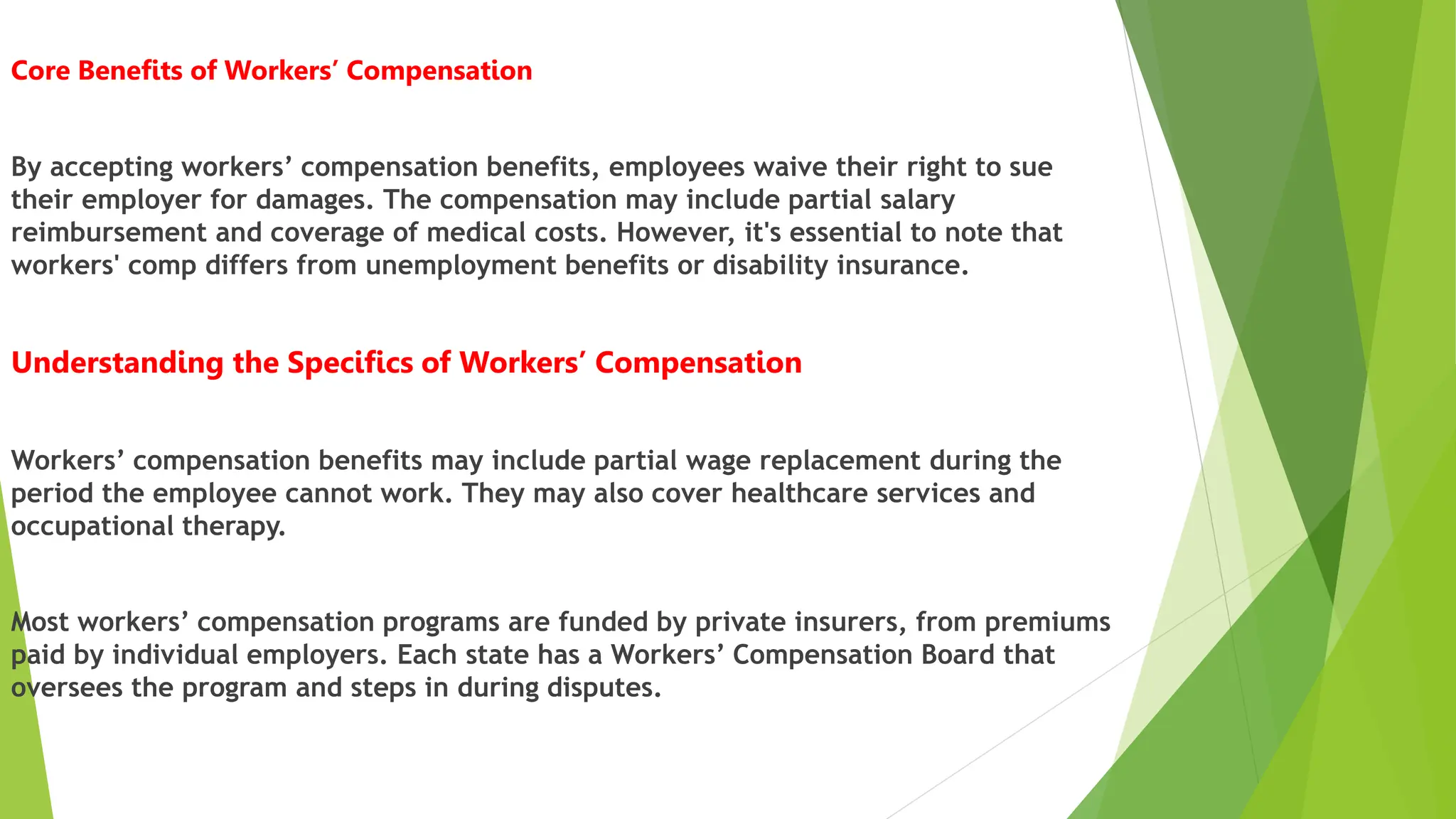
In New Jersey, the workers compensation system is governed by the New Jersey Workers' Compensation Law, which is administered by the Department of Labor and Workforce Development (DOLWD), Division of Workers' Compensation. The fundamental principle of this system is the trade-off between the employer and the employee: the employee gives up the right to sue the employer for damages in a civil court, and in exchange, the employee receives guaranteed, defined benefits regardless of who caused the accident.
This no-fault nature means that even if an employee was partially responsible for their own injury—through simple carelessness—they remain eligible for benefits. However, this protection is not absolute. Injuries must be "arising out of and in the course of employment." This implies a dual requirement: the accident must be related to the work activities, and it must occur during the timeframe and geographical location where the employee is expected to be performing those duties.
Eligibility and Mandatory Coverage
New Jersey law is stringent regarding employer obligations. Nearly every employer operating in New Jersey must maintain workers compensation insurance or be approved for self-insurance. There are no size exemptions based on the number of employees; even a business with a single part-time employee is generally required to provide coverage.
For employees, eligibility is generally straightforward but requires specific status verification:
- Employees: Individuals categorized as W-2 employees are covered.
- Independent Contractors: These individuals are generally not covered by an employer’s workers compensation policy. However, the distinction between an employee and an independent contractor is a frequent point of contention. The DOLWD uses the "ABC Test" to determine worker status, focusing on the degree of control the employer exercises over the work, whether the work is outside the usual course of the employer's business, and whether the worker is independently established in that trade.
- Corporate Officers: In many cases, corporate officers are considered employees. However, certain exemptions exist for officers of closely held corporations, provided they meet specific statutory filing requirements.
Categories of Benefits
When a work-related injury occurs, the New Jersey workers compensation system provides four primary categories of benefits. Understanding these is essential for managing expectations during a claim.
1. Medical Benefits
This is the most fundamental benefit. The employer (or their insurance carrier) is responsible for 100% of the cost of reasonable and necessary medical treatment related to the work injury. This includes hospital services, doctor visits, diagnostic tests, surgeries, prescription medications, and physical therapy. Crucially, the employer or their insurance carrier has the right to select the medical providers. If an employee seeks treatment outside of this directed care without authorization, they may be personally responsible for those costs.
2. Temporary Total Disability (TTD)
If an injury requires the employee to miss more than seven days of work, TTD benefits are triggered. These benefits are designed to replace a portion of the lost wages while the employee is recovering. As of 2026, the rate is generally 70% of the employee’s average weekly wage, subject to established state maximums and minimums set annually by the Commissioner of Labor and Workforce Development.
3. Permanent Partial Disability (PPD)
Once an employee reaches "maximum medical improvement" (MMI)—the point at which their condition is stable and not expected to improve further—they may be entitled to PPD benefits. These are intended to compensate for the loss of function or the partial loss of use of a body part. The amount is determined based on a medical evaluation that assigns a percentage of impairment to the affected body part or system, using the statutory schedule of disabilities.
4. Permanent Total Disability (PTD)
In catastrophic cases where an injury is so severe that it prevents the employee from ever returning to gainful employment, PTD benefits may be awarded. These benefits are paid for as long as the disability persists and are subject to periodic reviews of the employee's physical and vocational status.
The Claims Process: Steps to Take
Following a work-related injury, the timeline of actions is critical to ensuring a claim is processed efficiently.
- Reporting: The employee must provide notice to the employer immediately. Under New Jersey law, notice should ideally be given within 14 days, though it can be extended up to 90 days. Failure to report the injury in a timely manner can jeopardize the right to benefits.
- Employer Notification: Once notified, the employer is legally obligated to report the injury to their insurance carrier and, if necessary, the state.
- Medical Evaluation: The employer’s insurance carrier will authorize medical treatment. The employee must attend all scheduled appointments.
- Claim Filing: If the insurance company denies the claim, or if there is a dispute regarding the extent of the injury or the benefits owed, the employee may need to file a "Claim Petition" with the Division of Workers' Compensation. This initiates a formal legal process.
Summary of Benefits and Limitations
| Benefit Type | Primary Purpose | Key Limitation |
|---|---|---|
| Medical | Covers 100% of authorized care | Employer chooses the doctor |
| TTD | Wage replacement during recovery | Requires >7 days off work; subject to caps |
| PPD | Compensation for permanent loss | Requires medical determination of impairment |
| PTD | Support for total inability to work | Subject to periodic vocational assessment |
Common Challenges and Troubleshooting
One of the most common issues employees encounter is the "denial of claim." An insurance carrier might deny a claim based on the assertion that the injury did not arise out of employment, or that it was a pre-existing condition. If a claim is denied, the employee has the right to seek a formal hearing. In such instances, legal representation is often beneficial, as the employer will typically be represented by counsel to defend the denial.
Another common point of friction is the dispute over medical necessity. If the insurance company’s doctor states that a specific surgery or test is not necessary, but the employee’s physician disagrees, this often leads to a "Motion for Medical and/or Temporary Benefits." This is a mechanism to bring the dispute before a Judge of Compensation for an expedited ruling.
For employers, a common mistake is failing to keep adequate records. Under New Jersey regulation, employers must maintain records of all work-related accidents for at least five years. Failure to carry the required insurance can result in severe penalties, including "stop-work" orders, heavy fines, and even personal liability for the owners of the business if an uninsured injury occurs.
Understanding Jurisdictional Limits and Professional Advice
The information provided herein is based on the general statutory framework of New Jersey Workers' Compensation Law as of 2026. However, every case is fact-specific. Legal and medical variables—such as the specific nature of a repetitive stress injury versus an acute trauma—can change the trajectory of a claim significantly.
This guide does not constitute legal advice. Workers compensation matters involve complex administrative rules and strict deadlines known as "statutes of limitations." For example, a claim for compensation must generally be filed within two years of the date of the injury or the date of the last authorized medical payment. If you are involved in a dispute with an insurance carrier, or if your employer is refusing to provide necessary medical care, consult with an attorney specializing in New Jersey workers compensation or contact the New Jersey Division of Workers' Compensation directly for assistance with the filing process.
Frequently Asked Questions
1. Can I see my own doctor for a work-related injury? Generally, no. In New Jersey, the employer or their insurance carrier has the exclusive right to choose the medical provider. If you see your own doctor without authorization, the employer may not be responsible for the bills. If you are dissatisfied with the treatment, you should discuss this with the insurance carrier or your attorney.
2. Is stress or mental health covered under workers compensation? Psychiatric or stress-related claims are significantly more difficult to prove than physical injuries. In New Jersey, to succeed, a mental health claim typically must be related to a specific, traumatic work-related event or a series of events that objectively resulted in a diagnosable psychiatric condition, rather than general workplace stress.
3. What happens if I return to work but have to take time off again for the same injury? If your doctor confirms that your absence is due to the original, authorized work injury, you may be eligible to resume Temporary Total Disability benefits, provided you are still within the applicable statutory limits for the duration of such payments.
4. Can my employer fire me for filing a workers compensation claim? New Jersey is a "retaliatory discharge" sensitive state. It is illegal for an employer to fire or discriminate against an employee specifically because they filed a workers compensation claim. If you suspect you have been terminated for this reason, you may have grounds for a separate civil lawsuit.
5. How are the weekly benefit rates calculated? The rates are calculated based on your average weekly wage in the 26 weeks prior to the injury. The state sets a Maximum Compensation Rate and a Minimum Compensation Rate every January. Your specific benefit will be 70% of your average weekly wage, provided that number falls between the state-mandated minimums and maximums.
Next Actions
If you are an employee who has sustained an injury, document the time, place, and witnesses of the incident immediately and ensure your supervisor has received written notice. Retain copies of all medical reports. If you are an employer, conduct a routine audit of your current workers compensation policy to ensure it remains active and accurately reflects your current payroll and number of employees for the 2026 coverage period.

Image Gallery
Select an image to open it in a new tab.





Zara El-Hashem
Sociocultural Dynamics and Academics Writer
