Navigating Out-of-State Rules for Workers' Compensation: A Multi-State Employer Guide
When employees work in states outside your primary business location, workers' compensation obligations depend on state extraterritorial provisions, reciprocal agreements, temporary work thresholds, and local insurance market structures. Employers must secure appropriate coverage—such as an "Other States" policy endorsement or separate state fund policies—to meet destination state laws and avoid strict statutory non-compliance penalties.
Understanding Multi-State Workers' Compensation Rules
Workers' compensation laws in the United States operate strictly at the state level. There is no unified federal mandate governing private commercial workers' compensation across state lines, except under specific maritime or federal statutes like the Longshore and Harbor Workers' Compensation Act (LHWCA) or the Federal Employers Liability Act (FELA). Consequently, every state enforces distinct statutory requirements regarding when, where, and how an employer must insure workers operating within its borders.
When an employee performs duties outside their home state, two major legal frameworks come into play: extraterritorial jurisdiction and state reciprocity.
Extraterritorial Provisions
Extraterritoriality refers to a state's statutory authority to extend its workers' compensation benefits to an employee who suffers an injury while working outside their home state. If a business located in Illinois sends an employee to Indiana for a three-day equipment installation, Illinois extraterritorial provisions may allow the employee to claim Illinois workers' compensation benefits if injured in Indiana.
However, extraterritoriality only addresses one side of the legal obligation: the home state's willingness to cover the worker. It does not automatically exempt the employer from destination state laws. If Indiana statutory law requires an employer operating within its borders to carry Indiana-specific workers' compensation insurance from day one, the employer could still face civil administrative penalties in Indiana, even if the worker receives Illinois benefits.
Reciprocal Agreements
To prevent double taxation and burdensome duplicate coverage requirements for temporary work travel, several states have established formal reciprocity agreements. A reciprocal agreement between State A and State B provides that as long as an employer maintains valid workers' compensation coverage in State A, State B will recognize that coverage for temporary, short-term work performed within State B's borders.
Reciprocal agreements are geographically limited and conditional. Many western states—such as Washington, Oregon, Idaho, Montana, Nevada, Wyoming, Utah, and North Dakota—maintain specific statutory provisions regarding cross-border work, but conditions, time limits, and registration requirements vary substantially.
The Four Monopolistic States vs. Competitive Markets
A fundamental distinction in multi-state workers' compensation management is the difference between competitive private market states and monopolistic state funds.
| COMPETITIVE STATES (46 States + DC) | MONOPOLISTIC STATES (4) |
|---|---|
| - Coverage purchased from private commercial insurance carriers - Broad flexibility with NCCI Item 3C policy endorsements - Multi-state coverage on 1 policy | - Ohio - Washington - North Dakota - Wyoming - Requires dedicated state fund registration |
In 46 states, the District of Columbia, and U.S. territories, employers purchase workers' compensation policies through competitive commercial insurance markets or authorized self-insurance programs. Most of these jurisdictions utilize classification guidelines set by the National Council on Compensation Insurance (NCCI) or independent state rating bureaus (such as the WCIRB in California or the NYSIF in New York).
In contrast, four states operate as monopolistic state funds:
- Ohio (Ohio Bureau of Workers' Compensation - BWC)
- Washington (Washington State Department of Labor & Industries - L&I)
- North Dakota (North Dakota Workforce Safety & Insurance - WSI)
- Wyoming (Wyoming Department of Workforce Services)
In monopolistic states, private insurance carriers are prohibited from writing primary statutory workers' compensation policies. If your employee steps foot in a monopolistic state to perform work that exceeds temporary exemption limits, you cannot simply add that state to a standard commercial policy. You must open an account directly with the state's government fund and pay premiums directly to that jurisdiction.

Key Triggers That Require Out-of-State Coverage
Employers frequently incur severe financial penalties because they fail to identify when an employee's activities cross legal thresholds. Out-of-state workers' compensation requirements are generally triggered by four common operational scenarios:
1. Remote and Hybrid Workers
The rise of remote work creates implicit cross-border liability. Under state labor codes, an employee is generally subject to the workers' compensation laws of the state in which they physically perform work, not where the corporate headquarters is located. If a business headquartered in Texas hires a full-time remote worker residing in Pennsylvania, Pennsylvania law applies to that employee. The employer must secure Pennsylvania workers' compensation coverage immediately upon the employee's first day of remote labor.
2. Temporary Out-of-State Assignments and Travel
When employees travel for short durations—such as attending trade shows, conducting client visits, or completing short-term field servicing—out-of-state rules depend on duration thresholds. Some states enforce a strict "first-minute" rule, requiring coverage immediately upon entry. Others provide grace periods ranging from 10 to 30 days, or evaluate factors such as:
- Where the primary contract of hire was executed.
- Whether the employment in the host state is temporary or permanent.
- Where the employee regularly resides and receives wage payments.
3. Construction, Contracting, and High-Hazard Field Work
States enforce stringent laws for construction, trades, and hazardous field labor. Many jurisdictions explicitly exclude construction activities from temporary extraterritorial exemptions or reciprocity agreements. A general contractor or subcontractor crossing state lines to perform a two-day roofing or electrical job is usually required to hold local state coverage or present a specific certificate of insurance verified by the destination state's workers' compensation board prior to commencing work.
4. Opening Physical Outposts or Hiring Local Residents
Establishing a permanent branch office, warehouse, retail location, or hiring local residents automatically establishes a business presence (nexus) in that state. In these circumstances, extraterritorial provisions do not apply, and host state insurance must be bound prior to commencing operations.
How "Other States Insurance" (Item 3C) Works
For competitive market states, standard commercial workers' compensation insurance forms issued by the Workers Compensation Insurance Plan or private insurers contain a section known as Information Page Item 3. Understanding this section is critical for multi-state risk management.
- Item 3.A. (States Covered): Lists the specific states where the employer has existing, known operational payroll at the inception of the policy. Full statutory coverage applies immediately in these listed states.
- Item 3.C. (Other States Insurance): Designates states where work might occur during the policy period. If an unlisted, non-monopolistic state is properly included under Item 3.C, and the employer unexpectedly begins operations there during the policy term, the insurance policy automatically extends coverage to that new state.
Important Limitations of Item 3C Endorsements
Employers must avoid common misinterpretations regarding Item 3C coverage:
- Notification Requirements: Insurers require prompt notification when operations begin in an Item 3.C state. Failure to report payroll in a timely fashion can lead to back-audits, premium adjustments, or claim denial.
- Exclusion of Known States: If an employer already has active operations in a state at the time of policy renewal, that state cannot be left under Item 3.C. It must be explicitly listed under Item 3.A.
- Monopolistic States Excluded: Monopolistic states (OH, WA, ND, WY) can never be covered via Item 3.C. Attempting to use Item 3.C to satisfy coverage requirements in a monopolistic state leaves the employer entirely uninsured under that state's statutes.
State-by-State Rules Comparison
The table below illustrates comparative statutory rules, reciprocity allowances, and operational mechanics across representative states:
| State | Bureau / Regulatory Type | Extraterritorial / Reciprocity Rules | Out-of-State Thresholds & Rules |
|---|---|---|---|
| California | Independent (WCIRB) | Recognizes temporary extraterritoriality if home state extends similar reciprocity. | Strict enforcement for out-of-state employers. Out-of-state contractors require active CA coverage prior to starting work. |
| Florida | NCCI Member | Limited extraterritorial exceptions. Construction industry has zero threshold. | Non-construction employers have short travel exemptions; construction workers must be insured under FL policy immediately. |
| New York | Independent (NYSIF / NYCIRB) | Highly restrictive. Non-NY employers must list NY under Item 3.A if work occurs in NY. | Broad interpretation of NY nexus. Remote workers in NY require immediate NY statutory coverage listed under 3.A. |
| Ohio | Monopolistic State Fund (BWC) | Reciprocal agreements with select bordering/regional states for temporary travel. | Private insurance invalid for primary comp. Out-of-state employers with regular work must register account with Ohio BWC. |
| Texas | NCCI Member | Elective coverage system (employers can opt out), but mandatory for public contracts. | Out-of-state employers entering Texas are subject to standard Texas rules; non-subscribing rules apply if coverage isn't bound. |
| Washington | Monopolistic State Fund (L&I) | Reciprocal agreements with specific western states for temporary incidental labor. | Mandatory coverage through state L&I fund based on worker hours worked in Washington state; separate industrial insurance reporting required. |
Compliance Guide for Multi-State Employers
Managing cross-border risk effectively requires a structured operational compliance framework. Follow these six steps to ensure legal alignment across state lines:
- Step 1: Conduct Quarterly Employee Residency & Location Audits
- Step 2: Audit Insurance Policy Information Page (3.A vs 3.C)
- Step 3: Identify Operations in Monopolistic Jurisdictions
- Step 4: Establish Formal Travel and Relocation Protocols
- Step 5: Verify Subcontractor Certificates across Jurisdictions
- Step 6: Execute Timely Payroll Allocation Reporting
Step 1: Conduct Quarterly Employee Residency and Location Audits
Track physical working locations for all personnel. Require employees to notify HR prior to changing their primary residential address or working remotely from another state for more than 14 consecutive days.
Step 2: Audit Policy Information Page (Item 3.A vs. Item 3.C)
Review your current policy's Information Page with your insurance broker. Ensure every state where you maintain fixed physical assets, registered business entities, or permanent remote employees is listed under Item 3.A. Verify that all eligible competitive states where travel or temporary assignments might occur are listed under Item 3.C.
Step 3: Manage Monopolistic State Operations
If business trips, site visits, or temporary projects are scheduled in Ohio, Washington, North Dakota, or Wyoming, contact the respective state fund bureau before work commences. Determine whether your activities qualify for temporary reciprocity or if you must establish an employer account and purchase temporary state coverage.
Step 4: Institute Clear Out-of-State Travel Policies
Establish clear internal policies defining maximum allowable business travel durations without prior HR safety approval. Require corporate approval for inter-state reassignments, field project deployments, or extended remote work requests.
Step 5: Verify Subcontractor Compliance
If hiring subcontractors across state lines, verify that their certificate of insurance explicitly lists valid coverage for the specific jurisdiction where the project takes place. Do not accept a certificate listing an out-of-state home location without confirming valid coverage in the host state.
Step 6: Maintain Accurate Payroll Allocation Records
Workers' compensation audits require precise payroll distribution records divided by state and NCCI classification code. Ensure payroll software accurately allocates gross wages to the state where labor is physically performed, preventing dual-state premium assessments during annual insurance audits.
Common Pitfalls and Non-Compliance Penalties
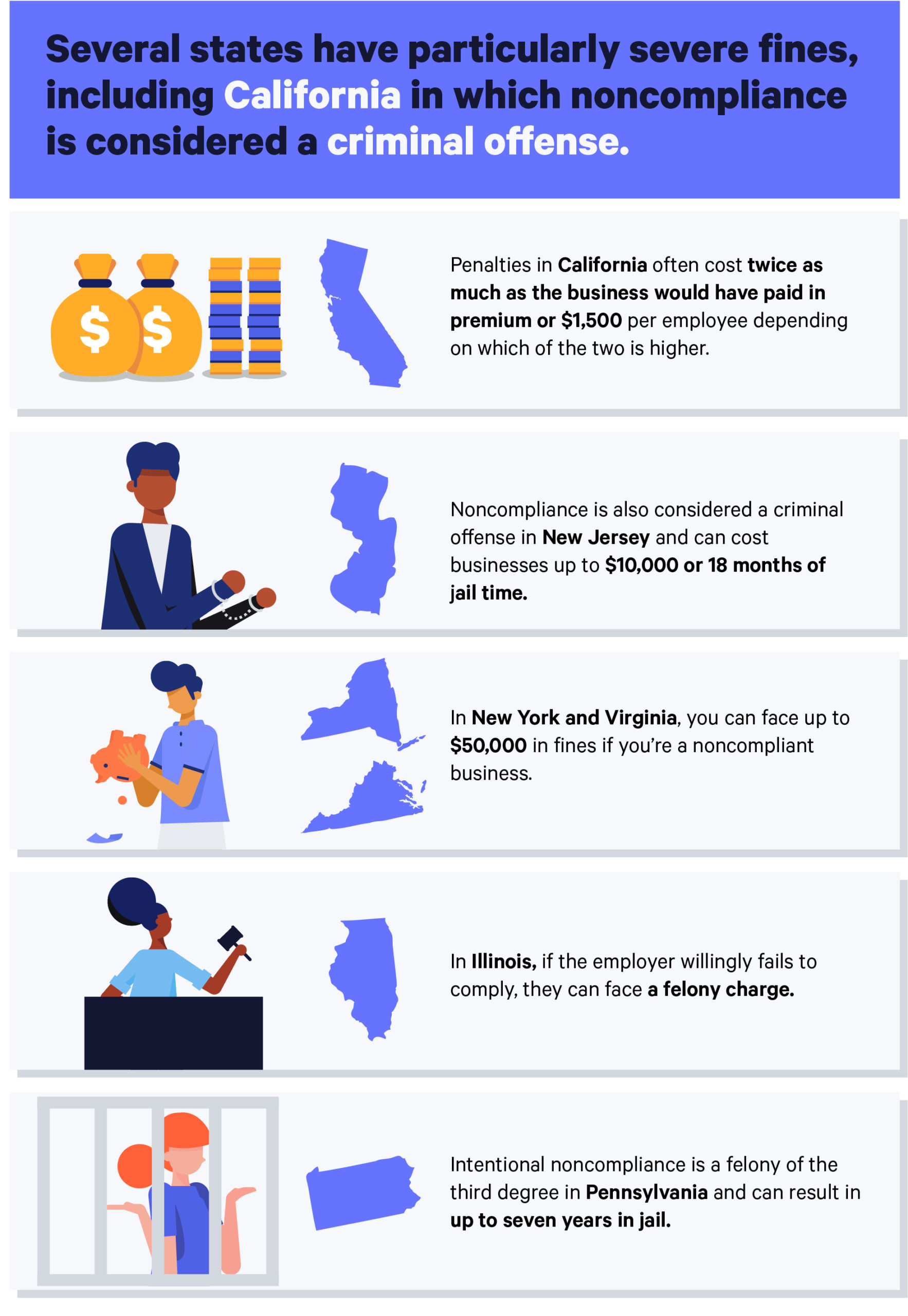
Failing to maintain compliant out-of-state workers' compensation coverage carries severe civil, financial, and criminal consequences.
- Stop-Work Orders: Immediate suspension of business operations
- Civil Fines: Statutory daily penalties ($100-$1,000/day)
- Uninsured Liability: Employer pays total medical/indemnity
- Criminal Exposure: Misdemeanor/felony charges for officers
- Tort Protection Loss: Employees may sue in civil court
Severe Financial Penalties and Stop-Work Orders
State regulatory agencies actively cross-reference state tax records, unemployment filings, and building permits against policy databases maintained by NCCI. When an un-insured employer is detected:
- Stop-Work Orders: Regulators can issue immediate stop-work orders halting all project operations until compliant coverage is bound and outstanding fines are paid.
- Daily Administrative Fines: Fines can accrue rapidly. For example, states like California and Pennsylvania assess fines ranging from $100 to over $1,000 per un-insured day, or double the amount of premium the employer would have otherwise paid.
Loss of the "Exclusive Remedy" Protection
Under statutory workers' compensation rules, the "exclusive remedy" doctrine protects employers from civil tort lawsuits filed by injured employees in exchange for guaranteed, no-fault medical and wage loss benefits. If an employer fails to secure valid workers' compensation coverage in the state where an injury occurs, the employer forfeits exclusive remedy protections in that jurisdiction. The injured employee may bring a personal injury lawsuit in civil court, exposing the employer to unrestricted liability for pain and suffering, punitive damages, and legal expenses.
Frequently Asked Questions
Can an employee file a workers' compensation claim in two states?
An injured worker cannot collect duplicate monetary benefits for the same injury, but they may file a claim in more than one state if multiple jurisdictions possess legal grounds over the injury (e.g., the state where the injury occurred versus the state where the employee was originally hired). The state providing higher benefit levels will generally determine the final net payout, crediting any benefits already paid by the initial state.
Does standard employer liability insurance cover out-of-state injuries?
Employer Liability (Part Two of a standard workers' compensation policy) protects employers against common-law suits arising from work-related injuries. However, Part Two liability coverage depends on maintaining valid primary statutory coverage under Part One. It does not replace statutory obligations in states missing from Item 3.A or 3.C.
How do monopolistic states handle temporary business trips?
Monopolistic states handle short trips through specific statutory thresholds or reciprocal agreements. For example, Ohio BWC permits short-term, temporary entries for out-of-state employees under reciprocal agreements, provided the home state provides equivalent protections to Ohio workers. However, rules vary, and employers should explicitly verify exemptions directly with the state fund.
What happens if a remote worker secretly moves to another state?
If an employee moves to another state without informing the business, the employer remains statutorily liable under the laws of the new state where work is actually performed. While the employer may face administrative penalties for un-reported state payroll, standard policy endorsements like Item 3.C can mitigate coverage gaps if activated immediately upon discovering the relocation.
Are independent contractors subject to out-of-state workers' comp rules?
Yes. State tests for classifying independent contractors versus statutory employees vary significantly across state lines (e.g., the ABC test in California, New Jersey, and Massachusetts). An individual legally classified as an independent contractor in your home state may be deemed a statutory employee under destination state laws, requiring full workers' compensation coverage.
Practical Action Items for Employers
To manage multi-state workers' compensation risks effectively:
- Map Employee Locations: Maintain an up-to-date registry detailing the precise physical working address of every employee, including remote and hybrid workers.
- Review Insurance Endorsements: Schedule an immediate policy review with your insurance broker to verify that Item 3.A contains all active operational states and Item 3.C includes all prospective non-monopolistic states.
- Address Monopolistic States: Contact state agencies directly (OH BWC, WA L&I, ND WSI, WY DWS) before deploying workers to those jurisdictions.
- Audit Subcontractor Policies: Mandate that all out-of-state contractors provide valid certificates of insurance specifying coverage in the host state prior to granting jobsite access.
Image Gallery
Select an image to open it in a new tab.

Declan O'Connor
Higher Education and Campus Culture Reporter
