Understanding the 2006 Honda Civic Gas Mileage: Specs, Real-World Data, and Efficiency Tips

The 2006 Honda Civic delivers between 23 and 42 combined MPG depending on the trim level and powertrain. The standard 1.8L engine achieves approximately 30 MPG combined, while the Hybrid variant reaches 42 MPG. Performance-focused Si models trade efficiency for power, averaging around 23 MPG combined under standard driving conditions.
The 2006 model year marked a massive shift for the Honda Civic, introducing the eighth generation of this iconic compact car. It was a complete "clean-sheet" redesign that prioritized aerodynamics, futuristic interior styling, and a new family of engines. As we look at these vehicles in 2026, two decades after their debut, understanding their fuel efficiency requires looking at both the original engineering specifications and the reality of operating a high-mileage vehicle in the modern era.
The Engineering Behind the 2006 Civic’s Efficiency
When Honda released the 2006 Civic, the primary goal was to improve fuel economy without sacrificing the "fun-to-drive" characteristics the brand was known for. This was achieved through the introduction of the R18A1 engine for the DX, LX, and EX trims. This 1.8-liter SOHC i-VTEC inline-four was a technological marvel at the time.
Unlike previous VTEC systems that focused primarily on high-RPM power, the R-series engine used i-VTEC to improve fuel economy during low-load cruising. It employed a "delayed-closure" intake valve timing strategy. Under light throttle, the intake valve stayed open longer during the compression stroke, pushing some of the air-fuel mixture back into the intake manifold. This reduced pumping losses—the energy an engine wastes trying to pull air past a nearly closed throttle plate. This allowed the 1.8L engine to behave like a 1.5L engine during highway cruising, significantly boosting its gas mileage.
The aerodynamic profile of the 2006 Civic also played a critical role. The "cab-forward" design and the steeply raked windshield resulted in a low coefficient of drag. For the 2006 sedan, the coefficient of drag was approximately 0.31, which helped it cut through the air more efficiently at highway speeds, a key factor in its 36-40 MPG highway ratings (original EPA estimates).
Breakdown of Gas Mileage by Trim and Engine
The 2006 Civic was offered in several distinct flavors, each with its own fuel economy profile. To understand the gas mileage of a 2006 Honda Civic, you must first identify which powertrain is under the hood.
The Standard 1.8L i-VTEC (DX, LX, EX)
The vast majority of 2006 Civics on the road feature the 1.8L engine. Whether paired with the five-speed manual or the five-speed automatic transmission, these models were the benchmark for the compact class in 2006.
- Automatic Transmission: The five-speed automatic was a significant upgrade over the four-speeds found in many competitors. It allowed for lower cruising RPMs on the highway.
- Manual Transmission: The five-speed manual offered slightly better engagement and a minor edge in city fuel economy, though the gear ratios were closely matched to the automatic for highway efficiency.
The Performance-Oriented Civic Si
The Civic Si used the K20Z3 2.0-liter DOHC i-VTEC engine, producing 197 horsepower. Because this engine was designed for high-RPM performance and featured a high 11.0:1 compression ratio, it required premium fuel (91 octane or higher) and returned significantly lower fuel economy. The Si was equipped exclusively with a close-ratio six-speed manual transmission and a helical limited-slip differential.
The Civic Hybrid (IMA)
The 2006 Civic Hybrid featured the second generation of Honda's Integrated Motor Assist (IMA) system. It paired a 1.3-liter i-DSI engine with an electric motor and a Continuously Variable Transmission (CVT). This model was the fuel economy champion of the lineup, specifically designed for urban commuters and those prioritizing the lowest possible carbon footprint.

2006 Honda Civic Fuel Economy Comparison Table
The following table provides the EPA-estimated fuel economy for the 2006 Honda Civic. Note that these figures reflect the adjusted EPA methodology (post-2008 standards), which provides a more realistic representation of modern driving habits than the original 2006 window stickers.
| Model / Trim | Engine | Transmission | City MPG | Highway MPG | Combined MPG |
|---|---|---|---|---|---|
| Civic DX / LX / EX | 1.8L I4 | 5-Speed Manual | 26 | 34 | 30 |
| Civic DX / LX / EX | 1.8L I4 | 5-Speed Auto | 25 | 36 | 30 |
| Civic Si | 2.0L I4 | 6-Speed Manual | 20 | 29 | 23 |
| Civic Hybrid | 1.3L I4 + Electric | CVT | 40 | 45 | 42 |
| Civic GX (Natural Gas) | 1.8L I4 | 5-Speed Auto | 24 (GGE) | 36 (GGE) | 28 (GGE) |
Note: GGE stands for Gasoline Gallon Equivalent. The GX model was primarily sold to fleets and in specific markets like California.
Factors That Influence Real-World Mileage in 2026
As of 2026, most 2006 Honda Civics have been on the road for 20 years. Age and mileage introduce several variables that can cause a significant departure from the EPA estimates listed above.
Component Wear and Maintenance
Efficiency is the first casualty of deferred maintenance. In a two-decade-old Civic, several components are likely nearing the end of their service life:
- Oxygen (O2) Sensors: The primary air-fuel ratio sensor manages the engine's fuel delivery. Over time, these sensors can become "lazy," reacting slowly to changes in exhaust gas. This often results in a rich fuel mixture, which can drop gas mileage by 10-15% before a Check Engine light even appears.
- Spark Plugs and Ignition Coils: The R18 engine uses long-life iridium spark plugs. If these haven't been changed in the last 100,000 miles, the gap can widen, leading to incomplete combustion.
- Valve Clearance: Unlike many modern engines with hydraulic lifters, the 2006 Civic's 1.8L and 2.0L engines require periodic manual valve adjustments. Tight valves can lead to poor idling and reduced efficiency.
Fuel Quality and Ethanol Content
The 2006 Civic was designed at a time when E10 (10% ethanol) was becoming the standard. However, the rise of E15 or variations in fuel quality in 2026 can impact mileage. Ethanol has lower energy density than pure gasoline; generally, for every 10% increase in ethanol content, fuel economy drops by about 3%. Owners of the Civic Si must be especially careful to continue using high-octane fuel to prevent the engine's knock sensor from retarding ignition timing, which kills both power and efficiency.
The Hybrid Battery Factor
For those driving the 2006 Civic Hybrid in 2026, the condition of the Nickel-Metal Hydride (NiMH) battery pack is the single most important factor for fuel economy. These batteries typically last 8 to 12 years. If the battery is original, it is likely "deteriorated," meaning the IMA system will rely more heavily on the gasoline engine, often causing the MPG to plummet into the low 30s rather than the rated 42 combined.
Common Issues Affecting Efficiency in the 8th Gen Civic
The eighth-generation Civic is remarkably reliable, but it does have specific "weak points" that can indirectly affect your fuel budget.
- Cracked Engine Blocks: Early 2006–2009 models were prone to a casting defect that could cause the engine block to leak coolant. While this is primarily a reliability issue, an overheating engine will run significantly less efficiently as the ECU tries to compensate for the heat.
- Stuck Brake Calipers: This is a common aging car issue. A "draggy" rear brake caliper on a 2006 Civic can easily rob you of 2–4 MPG without being immediately obvious to the driver.
- VTEC Solenoid Gasket Leaks: Oil leaks near the VTEC solenoid can lead to low oil pressure in the VTEC system. If the i-VTEC system cannot engage the economy cam profile on the 1.8L engine, highway fuel economy will suffer.
How to Maximize Your 2006 Civic’s Gas Mileage
If you are looking to get the best possible numbers out of your 2006 Civic today, a proactive approach to maintenance and driving habits is necessary.
- Tire Pressure and Selection: Ensure your tires are inflated to the door-jamb specification (usually 32 PSI). Furthermore, when replacing tires, look for "Low Rolling Resistance" (LRR) models. Traditional high-performance tires can increase rolling resistance and decrease mileage by up to 5%.
- Clean the Throttle Body and MAF Sensor: Over 20 years, carbon deposits build up in the throttle body. Cleaning this, along with the Mass Air Flow (MAF) sensor, ensures the engine is getting accurate data about air intake, allowing for precise fuel metering.
- Lighten the Load: The 2006 Civic is a lightweight car (approx. 2,700–2,800 lbs). Adding 100 lbs of unnecessary junk in the trunk has a more significant percentage-based impact on its fuel economy than it would on a heavy SUV.
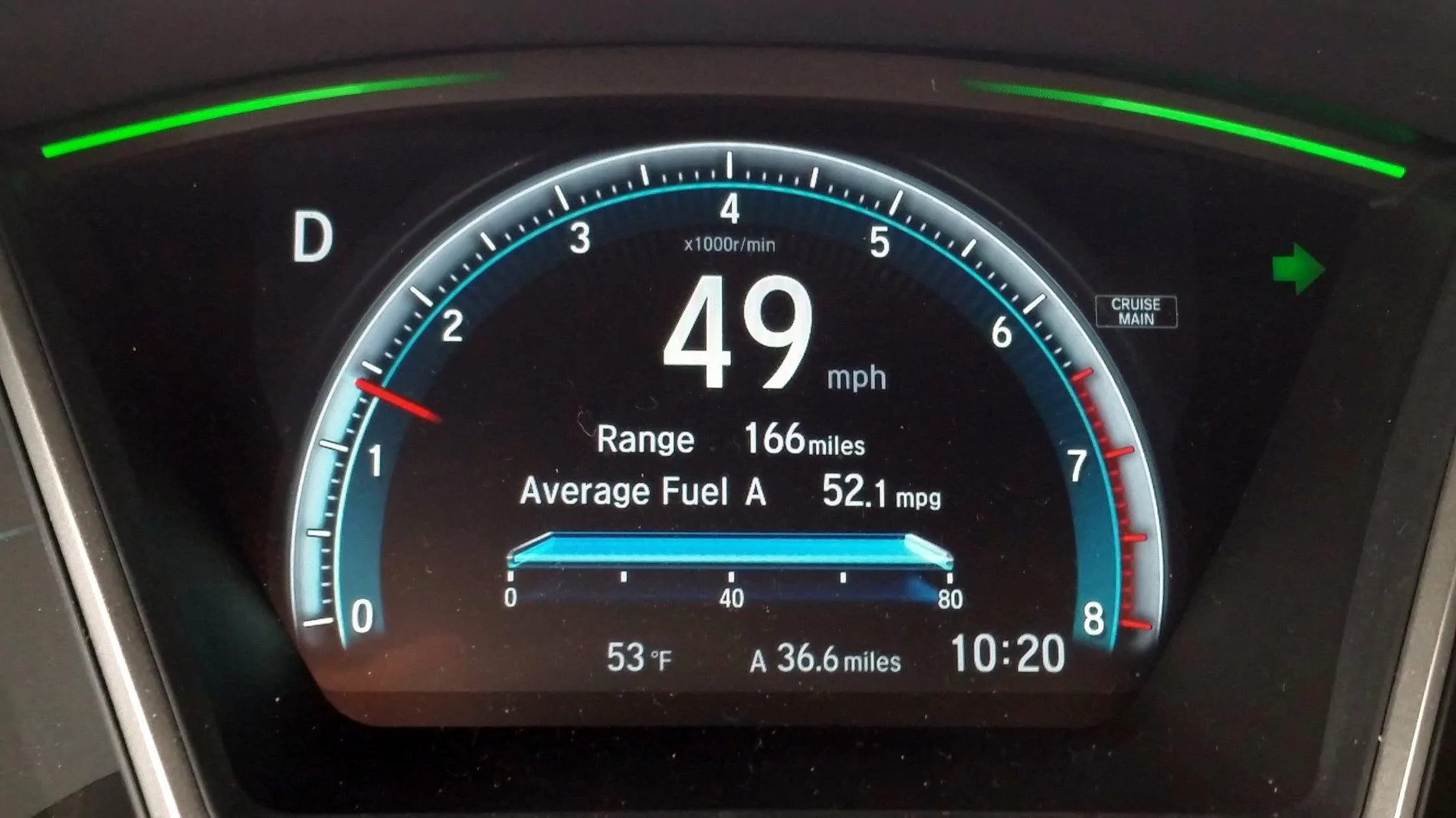
- Use the Instant Fuel Economy Gauge: The 2006 Civic (especially in higher trims) features a digital fuel economy display. Monitoring this in real-time encourages "smooth" driving—gradual acceleration and coasting to stops—which can save more fuel than any mechanical modification.
Frequently Asked Questions
Does the 2006 Honda Civic require premium gas?
Only the Civic Si (2.0L engine) requires premium 91-octane gasoline. Using regular 87-octane in an Si can lead to engine knocking and reduced fuel efficiency. For the DX, LX, EX, and Hybrid models, regular 87-octane gasoline is the recommended and most efficient choice.
Why is my 2006 Civic getting worse gas mileage than the EPA rating?
Common culprits include aging O2 sensors, clogged engine air filters, low tire pressure, or dragging brakes. On Hybrid models, the most likely cause is a degraded IMA battery pack. Additionally, winter-blend fuels and cold weather significantly reduce fuel economy due to longer engine warm-up times.
Is the manual or automatic 2006 Civic better for gas mileage?
On paper, the manual and automatic 1.8L models are virtually identical at 30 combined MPG. However, the automatic version is rated slightly higher for highway driving (36 vs 34 MPG) due to its taller 5th gear ratio. For city driving, the manual is slightly more efficient (26 vs 25 MPG) because it lacks the torque converter losses of the automatic.
How many miles can a 2006 Honda Civic go on a full tank?
The 2006 Civic has a 13.2-gallon fuel tank. For a standard 1.8L model averaging 30 MPG, the theoretical range is 396 miles. However, most drivers will see the low-fuel light illuminate after using about 10.5 to 11 gallons, providing a safe real-world driving range of approximately 315 to 330 miles per tank.
Does the 2006 Civic Hybrid get better mileage than the Prius?
In 2006, the Toyota Prius generally outperformed the Civic Hybrid in city fuel economy because the Prius is a "full hybrid" capable of electric-only propulsion at low speeds, whereas the Civic’s IMA system is a "mild hybrid" where the engine almost always turns. However, on the highway, the two were very competitive, both averaging in the mid-40s.
Final Recommendation for Owners and Buyers
For those operating a 2006 Honda Civic in 2026, the key to maintaining original gas mileage is technical vigilance. If you are buying one used, prioritize a vehicle with a documented history of transmission fluid changes and valve adjustments. For current owners, replacing the primary O2 sensor and ensuring your brakes are not dragging are the two most cost-effective ways to restore lost MPG. The 2006 Civic remains one of the most fuel-efficient non-electric vehicles ever made, and with proper care, it can continue to deliver 30+ MPG even two decades after it left the showroom floor.
For official historical data and further technical specifications, you can refer to the U.S. Department of Energy’s Fuel Economy Guide or the Honda Newsroom archives.
Image Gallery
Select an image to open it in a new tab.



Ingrid Bjornson
Global Cyber Policy and Regulation Analyst
