
SpongeBob SquarePants is an iconic American animated series created by marine science educator and animator Stephen Hillenburg for Nickelodeon. Set in the underwater city of Bikini Bottom, the show follows the surreal adventures of an eternally optimistic sea sponge and his eclectic group of aquatic friends. Since its 1999 debut, it has evolved into a multi-billion-dollar global franchise, defining children's television for multiple generations.
The Origins: From Marine Biology to Animation
To understand the phenomenon of SpongeBob SquarePants, one must look at the unique intersection of science and art that birthed it. Stephen Hillenburg was not a traditional animator; he was a marine biology teacher at the Orange County Marine Institute in California. During his tenure there in the mid-1980s, he created a comic book titled The Intertidal Zone to help educate his students about tide pool ecology. This comic featured a precursor to SpongeBob—a round, natural sea sponge wearing sunglasses named Bob the Sponge.
When Hillenburg left the institute to pursue a degree in experimental animation at the California Institute of the Arts (CalArts), he carried these characters with him. After working as a director on the hit series Rocko's Modern Life, he began developing the concept for Bikini Bottom. He chose a square kitchen sponge over a realistic round sea sponge because it emphasized the character's "square" personality—clean-cut, earnest, and somewhat rigid in his morality, yet incredibly flexible in his physical form.
The series was pitched to Nickelodeon in 1997. Legendarily, Hillenburg wore a Hawaiian shirt, brought an aquarium with models of the characters, and played Hawaiian music to set the mood. The network executives were instantly captivated by the optimism and distinct visual style, leading to the pilot episode "Help Wanted," which aired on May 1, 1999. By 2026, the show stands as the longest-running Nickelodeon series, having surpassed over 300 episodes and multiple feature films.
The World of Bikini Bottom: Setting and Lore
The primary setting of the series is Bikini Bottom, a bustling underwater metropolis located on the floor of the Pacific Ocean. According to series lore and production notes, the city is situated directly beneath the real-life Bikini Atoll. This detail has fueled decades of fan theories regarding the characters' origins, though Hillenburg consistently maintained that the show’s surrealism was driven by character comedy rather than secret backstories.
Socio-Economics and Landmarks
Bikini Bottom functions as a parody of a typical American town, complete with a diverse economy, residential districts, and fast-food rivalries. The most significant landmarks include:
- The Krusty Krab: A restaurant housed in a hollowed-out lobster trap, owned by Eugene H. Krabs. It is the workplace of SpongeBob (Fry Cook) and Squidward (Cashier).
- The Chum Bucket: A failing restaurant across the street owned by Sheldon J. Plankton, symbolizing the endless struggle between a successful small business and an unsuccessful, high-tech competitor.
- Conch Street: The residential row where SpongeBob lives in a pineapple, Squidward in an Easter Island Moai (head), and Patrick under a literal rock.
The physics of Bikini Bottom are intentionally nonsensical—characters can start fires underwater, take showers, and "sink" even deeper into pits of goo (the Goo Lagoon). This internal logic allows for a "rubber-hose" style of animation where the environment is as expressive as the characters themselves.
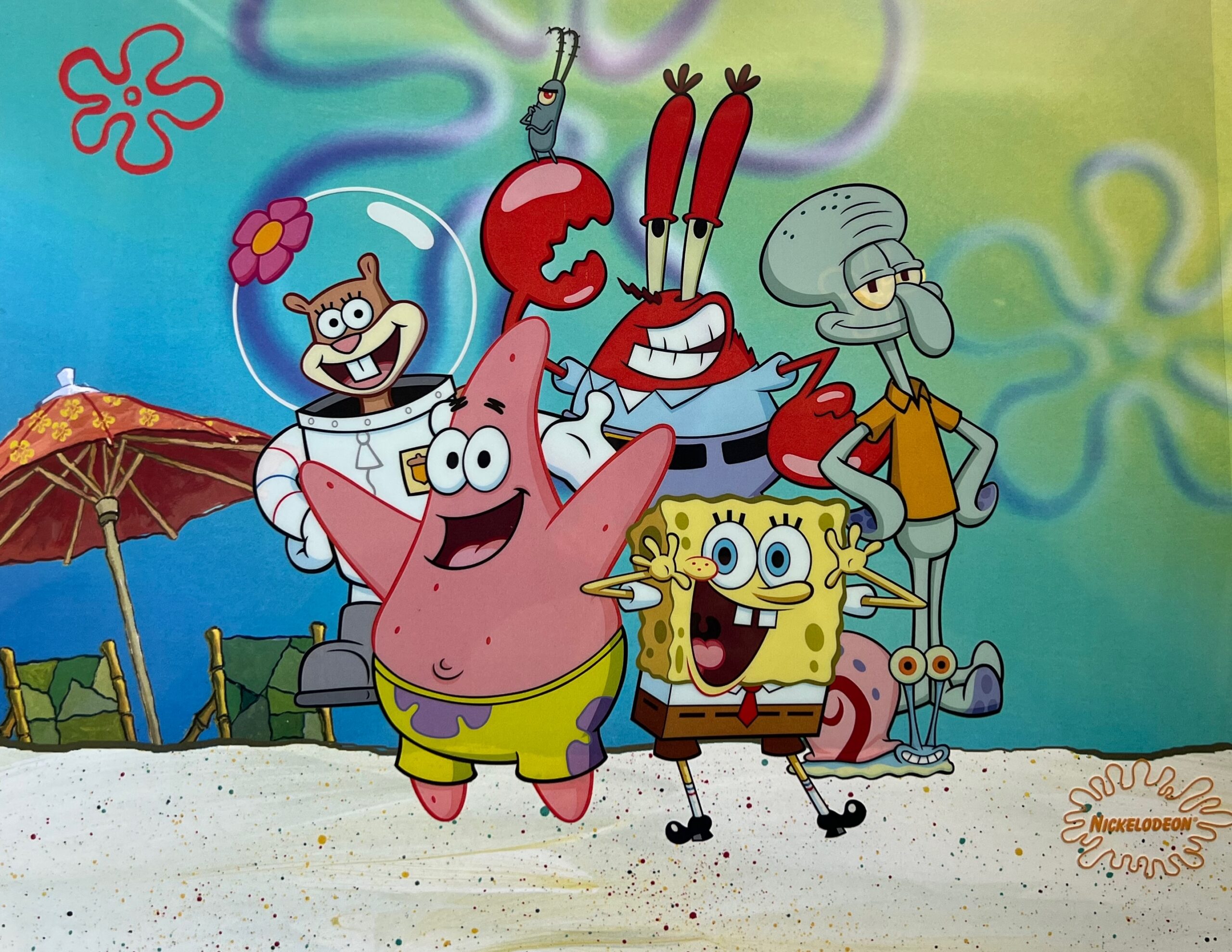
Core Character Analysis: The Dynamics of Bikini Bottom
The longevity of SpongeBob SquarePants is largely attributed to its character-driven humor. Each main character represents a specific archetype or personality trait that creates constant narrative friction.
SpongeBob SquarePants (The Eternal Optimist)
Voiced by Tom Kenny, SpongeBob is the heart of the series. He is defined by his boundless enthusiasm, professional pride in his job as a fry cook, and his "I'm Ready!" mantra. Unlike many protagonists in modern animation, SpongeBob is notably devoid of irony. His humor comes from his extreme earnestness in a world that is often cynical or indifferent to his joy.
Patrick Star (The Innocent)
Patrick, a pink starfish voiced by Bill Fagerbakke, serves as the "lovable idiot" archetype. However, Patrick’s character is more complex; his lack of intelligence is often paired with "accidental wisdom" or a complete lack of social inhibition. He acts as the ultimate enabler for SpongeBob’s wildest ideas, providing a foundation of unconditional, albeit misguided, friendship.
Squidward Tentacles (The Cynic)
Squidward is perhaps the most relatable character for adult viewers. An octopus who views himself as a misunderstood artist and intellectual, he is trapped in a low-wage job and forced to live between two neighbors he finds intolerable. His misery provides the perfect foil to SpongeBob’s happiness, creating a comedic balance that appeals to both children and adults.
Mr. Krabs and Sandy Cheeks
Mr. Krabs represents the personification of greed, though he often acts as a father figure to SpongeBob. Sandy Cheeks, a squirrel from Texas who lives in an air-locked Treedome, provides the show’s "outsider" perspective. As a scientist and martial artist, she often introduces logic and high-stakes action into the otherwise whimsical plots.
Production Evolution: Technical Shifts and Artistry
The production of SpongeBob SquarePants has undergone significant technical changes over the decades. In its early seasons, the show utilized traditional cel animation (though quickly transitioning to digital ink and paint). The aesthetic was characterized by hand-painted backgrounds that utilized a "tiki-chic" or "Polynesian kitsch" style, which gave the show a unique, grainy, and organic feel.
The Transition to Digital and HD
As the industry moved toward high-definition standards in the late 2000s, the animation became cleaner and more fluid. While some fans of the "Golden Era" (Seasons 1-3) prefer the slightly grittier look of the early episodes, the modern production pipeline allows for more complex physical comedy and "wild takes"—extreme facial expressions that have become a hallmark of the series.
The Role of Music
Music is an integral component of the show's identity. From the sea shanty opening theme to the "ukulele-heavy" incidental music composed by Sage Guyton and Jeremy Wakefield, the soundscape of Bikini Bottom is instantly recognizable. The show frequently features original songs, such as "The F.U.N. Song," "Sweet Victory," and "Best Day Ever," which have entered the broader pop culture lexicon.
Comparing the Eras of SpongeBob SquarePants
As of 2026, the series is generally divided into several distinct eras by historians and fans alike.
| Era | Timeframe | Defining Characteristics | Key Leadership |
|---|---|---|---|
| The Golden Era | 1999–2004 | Focus on character-driven logic and surrealism; Seasons 1-3. | Stephen Hillenburg |
| The Post-Movie Era | 2005–2015 | Shift toward more "slapstick" and gross-out humor; increased episode volume. | Paul Tibbitt |
| The Renaissance / Modern Era | 2015–Present | Return of Hillenburg (until 2018); more expressive, fluid animation. | Marc Ceccarelli & Vincent Waller |
| The Franchise Expansion | 2021–2026 | Launch of spin-offs (Kamp Koral, The Patrick Star Show) and Paramount+ focus. | Various |
Cultural and Economic Impact
SpongeBob SquarePants is more than a cartoon; it is a massive economic engine for Paramount Global. By the mid-2020s, the franchise had generated over $15 billion in retail merchandise sales. Its reach extends into fashion, theme parks, and even Broadway, where The SpongeBob Musical received critical acclaim and multiple Tony Award nominations.
The Meme Economy
Perhaps the most significant modern impact of the show is its dominance in internet culture. SpongeBob is arguably the most "meme-able" property in history. Images like "Mocking SpongeBob," "Confused Mr. Krabs," and "Tired SpongeBob" are used daily by millions to communicate emotions. This digital ubiquity has kept the brand relevant for Gen Z and Alpha, ensuring that the show never feels dated despite being over a quarter-century old.
Scientific Legacy
The show’s impact even reaches into the scientific community. In 2011, a new species of mushroom was named Spongiforma squarepantsii in honor of the character. Furthermore, the show has been credited with sparking interest in marine biology among young viewers, fulfilling Stephen Hillenburg’s original goal of making the ocean accessible and interesting.
Criticism and Controversies
Despite its success, the series has faced its share of scrutiny. In the early 2000s, certain conservative groups targeted the show, claiming it promoted a "pro-homosexual" agenda due to the close friendship between SpongeBob and Patrick. Nickelodeon and Hillenburg consistently refuted these claims, with Hillenburg famously stating that the characters are "asexual" and that the show is simply about friendship and humor.
Other criticisms have focused on the perceived decline in writing quality during the middle seasons, often referred to as "character flanderization," where certain traits (like Patrick’s stupidity or Mr. Krabs’ greed) were exaggerated to a point that some fans felt was detrimental to the storytelling. However, the "Renaissance Era" starting around 2015 is often cited as a return to form, balancing high-energy animation with the wit of the early years.
SpongeBob in 2026: The Legacy Continues
In 2026, SpongeBob SquarePants remains a cornerstone of the Paramount+ streaming strategy and Nickelodeon’s linear programming. The "SpongeBob Universe" has expanded to include prequel series and character-focused spin-offs, though the flagship series remains the primary draw. The brand has successfully navigated the transition from the era of Saturday morning cartoons to the age of on-demand streaming.
The show's enduring appeal lies in its fundamental kindness. At its core, SpongeBob is a character who loves his life, his job, and his friends. In a media landscape that often leans into irony, grit, or cynicism, the bright, unapologetic joy of Bikini Bottom provides a necessary escape for viewers of all ages.
Frequently Asked Questions
Who created SpongeBob SquarePants?
The series was created by Stephen Hillenburg, a marine biologist and animator. He served as the showrunner for the first three seasons and returned to a creative role for the development of the second film and subsequent seasons until his passing in 2018.
Is SpongeBob SquarePants still making new episodes in 2026?
Yes, as of 2026, the series has been renewed and continues to produce new episodes for Nickelodeon and Paramount+. It remains one of the most-watched animated programs globally.
What was the first episode ever aired?
The first episode aired was "Help Wanted," which premiered on May 1, 1999. It features SpongeBob applying for his job at the Krusty Krab while the song "Living in the Sunlight, Loving in the Moonlight" by Tiny Tim plays.
Why is the show set in Bikini Bottom?
The setting is a play on the real-life Bikini Atoll in the Marshall Islands. Stephen Hillenburg chose the underwater setting to combine his love of marine biology with surreal, character-based comedy.
What are the SpongeBob spin-offs?
As of 2026, there are several spin-offs, including Kamp Koral: SpongeBob's Under Years (a CG-animated prequel) and The Patrick Star Show (a variety-style talk show hosted by Patrick).
Is there a secret formula for the Krabby Patty?
Within the show's lore, the Krabby Patty Secret Formula is a closely guarded trade secret owned by Mr. Krabs. While various episodes tease the ingredients, the actual formula remains a "MacGuffin"—a plot device that is never fully revealed to the audience.
Final Recommendation for Viewers
Whether you are a long-time fan or a newcomer exploring the series in 2026, the best way to experience SpongeBob SquarePants is to start with the first three seasons to understand the foundational humor and character dynamics. Following that, The SpongeBob SquarePants Movie (2004) serves as a perfect "grand finale" to the original vision of the show. For those interested in the technical evolution of animation, comparing the hand-drawn aesthetic of the 1990s episodes with the high-octane, fluid digital animation of the 2020s offers a fascinating look at the history of the medium.
Image Gallery
Select an image to open it in a new tab.



Omar Farooq
EdTech Innovation and Virtual Pedagogy Journalist
