Phenylalanine Letter Code Explained: Understanding Abbreviations in Biochemistry

Phenylalanine is represented by two standard letter codes in biochemistry: a three-letter code (Phe) and a single-letter code (F). These abbreviations are universally used by scientists, researchers, and bioinformaticians to map out protein sequences, analyze genetic information, and document the primary structure of amino acids without needing to write out their full chemical names repeatedly.
The Fundamentals of Amino Acid Coding
Proteins are complex macromolecules constructed from chains of smaller building blocks known as amino acids. In molecular biology and biochemistry, shorthand notations are essential for communicating complex structural data efficiently. Without a standardized system of abbreviations, writing out the sequences of proteins containing hundreds or thousands of amino acid residues would be cumbersome, repetitive, and prone to typographical errors.
The system we use today is globally standardized by organizations such as the International Union of Pure and Applied Chemistry (IUPAC) and the International Union of Biochemistry and Molecular Biology (IUBMB). These naming conventions allow scientists across the globe to share genetic translation data, protein engineering designs, and structural models seamlessly.
When looking at any standard protein sequence database—such as UniProt or the Protein Data Bank (PDB)—amino acids are almost exclusively represented by these shorthand codes. Understanding how these codes are derived, why two different systems exist simultaneously, and how phenylalanine specifically fits into this framework is fundamental for anyone studying molecular biology, genetics, or protein chemistry.
Why Phenylalanine Has Two Letter Codes
The existence of both a three-letter code and a single-letter code for phenylalanine (and every other standard amino acid) is a matter of historical development and practical utility in data analysis. Each system serves a distinct purpose in scientific communication and computational processing.
The Three-Letter Code: Phe
The three-letter code is designed primarily for readability, clarity, and historical continuity in traditional scientific literature. For phenylalanine, the code is Phe.
- Derivation: The code is derived from the first three letters of the amino acid's English name (Phenylalanine).
- Usage: It is most commonly found in older research papers, structural biology textbooks, and detailed visual representations of protein binding sites or enzymatic active centers where human readability is paramount.
- Advantage: Because the three letters closely mirror the phonetic and literal spelling of the amino acid, it reduces the cognitive load for researchers reading complex biochemical pathways.
The Single-Letter Code: F
The single-letter code was developed later, driven by the advent of computerized bioinformatics, automated DNA and protein sequencing, and sequence alignment algorithms. For phenylalanine, the code is F.
- Derivation: Ideally, every amino acid would be represented by the first letter of its name. However, with 20 standard amino acids and only 26 letters in the Latin alphabet, direct assignment quickly leads to conflicts. For example, Alanine, Cysteine, Aspartic Acid, Glutamic Acid, Glycine, Histidine, Isoleucine, Lysine, Leucine, Methionine, Proline, Glutamine, Arginine, Serine, Threonine, Valine, Tryptophan, and Tyrosine all compete for initial letters. Because P was already assigned to Proline, and Ph could not fit a single-letter paradigm, biochemists assigned F to phenylalanine because of the phonetic sound at the beginning of the word ("Eff").
- Usage: Single-letter codes are heavily utilized in computational biology, sequence alignment tools (such as BLAST), phylogenetic trees, and FASTA format text files.
- Advantage: It allows long protein sequences to be displayed compactly in narrow windows, making it much easier to spot conserved sequence motifs, mutations, or homologous regions across different species.
Chemical Profile and Context of Phenylalanine
To fully appreciate why phenylalanine's letter code matters in structural biology, it helps to understand the chemical nature of the molecule itself. Phenylalanine is an essential alpha-amino acid, meaning the human body cannot synthesize it independently; it must be obtained through dietary sources such as meat, fish, eggs, cheese, and milk.
Chemical Structure Summary: - Formula: C9H11NO2 - Side Chain (R-group): Benzyl group (-CH2-C6H5) - Classification: Non-polar, hydrophobic, aromatic
Because its side chain contains a benzyl ring, phenylalanine is classified as an aromatic amino acid (along with tyrosine and tryptophan). This hydrophobic ring structure plays a critical role in how proteins fold into their functional three-dimensional shapes. Typically, hydrophobic residues like phenylalanine are buried deep within the core of a globular protein, away from the surrounding water molecules, stabilizing the overall structure through hydrophobic interactions.
When bioinformaticians run algorithms to predict protein folding or stability based on sequence data (using the single-letter code F or the three-letter code Phe), the computer program recognizes the physicochemical properties tied to that specific letter. A string of letters is thus translated into a physical map of forces, charges, and spatial constraints.
Comparison of Standard Amino Acid Codes
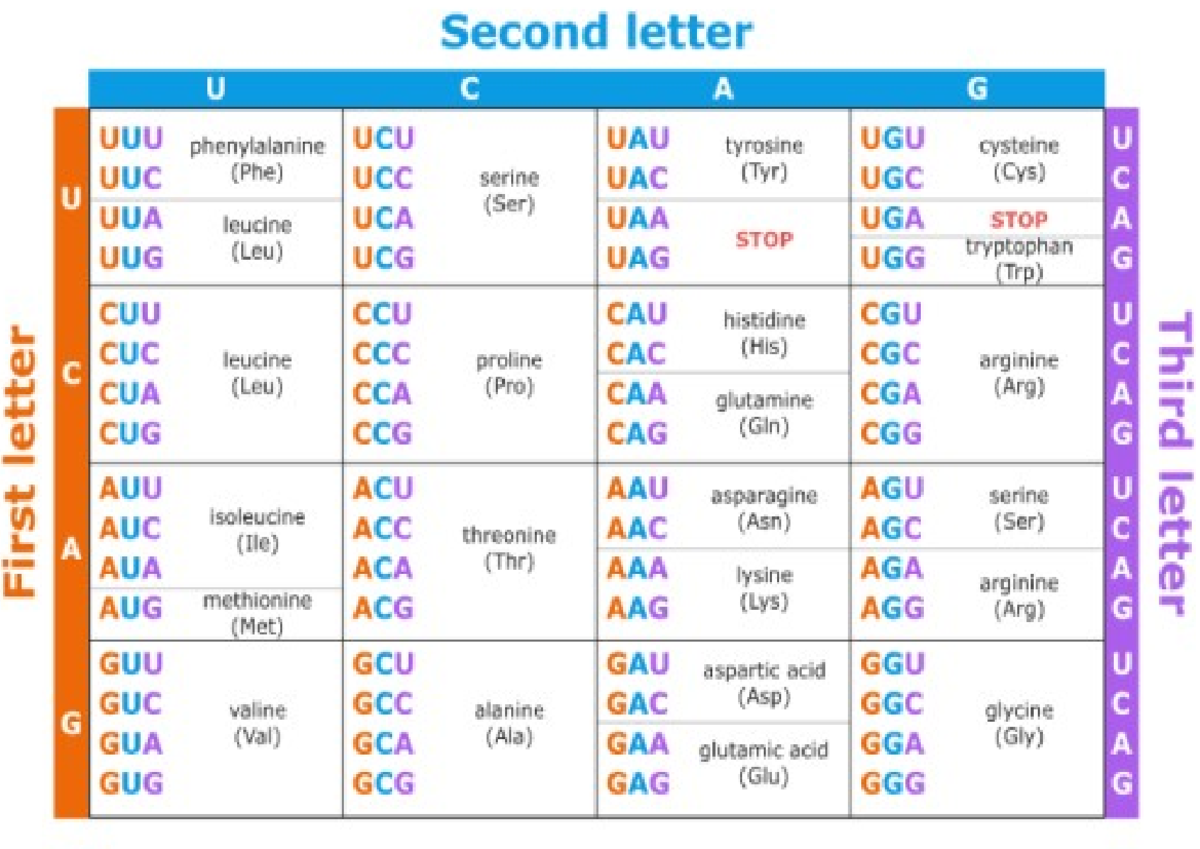
Phenylalanine is just one of 20 standard proteinogenic amino acids encoded by the universal genetic code. Below is a reference table comparing phenylalanine with other select amino acids to illustrate the logic behind both the three-letter and single-letter notation systems.
| Amino Acid Name | Three-Letter Code | Single-Letter Code | Chemical Classification |
|---|---|---|---|
| Phenylalanine | Phe | F | Non-polar, Aromatic |
| Alanine | Ala | A | Non-polar, Aliphatic |
| Glycine | Gly | G | Non-polar, Aliphatic |
| Proline | Pro | P | Non-polar, Cyclic |
| Tyrosine | Tyr | Y | Polar, Aromatic |
| Tryptophan | Trp | W | Non-polar, Aromatic |
Notice how letters like A, G, and P were naturally claimed by Alanine, Glycine, and Proline, forcing alternative single-letter assignments like F for Phenylalanine, Y for Tyrosine (since T was taken by Threonine), and W for Tryptophan (since T was taken and P was taken by Proline).
Practical Applications in Bioinformatics and Sequencing
The utility of the phenylalanine letter codes (Phe and F) becomes most apparent when examining real-world applications in genetics, molecular diagnostics, and database management.
1. FASTA File Formats
When downloading protein sequences from repositories like the National Center for Biotechnology Information (NCBI), data is typically formatted in FASTA files. These files begin with a header line describing the protein, followed by lines of single-letter amino acid codes.
>sp|P01008|ANT3_HUMAN Alpha-1-antitrypsin OS=Homo sapiens MPSSVSWGILLLAGLCCLVPVSLAEDPQGDAAQKTDTSHHDQDHPTFNK...
In this sequence context, finding an F tells the software exactly where a phenylalanine residue sits within the broader polypeptide chain, allowing automated scripts to calculate molecular weight, theoretical isoelectric point, and structural hydrophobicity.
2. Mutation Analysis and Nomenclature
In clinical genetics and research, naming specific mutations relies heavily on these codes. For example, a missense mutation where phenylalanine at position 508 is deleted is famously known as $\Delta$F508 (associated with cystic fibrosis). Here, the single-letter code F immediately communicates to researchers that phenylalanine is the affected residue, combined with its numerical position in the protein chain. If written out in traditional literature, it might be referred to as a phenylalanine deletion at position 508, but the shorthand code universally streamlines clinical reporting.
Common Misconceptions and Troubleshooting
When working with amino acid abbreviations, students and junior researchers often encounter specific stumbling blocks. Recognizing these issues helps prevent errors in data analysis.
- Confusing Single Letters: Because some single-letter codes are phonetically derived rather than alphabetically matched (such as F for Phenylalanine or W for Tryptophan), beginners often try to guess the letter based on the starting sound of similar words or misremember them. Always rely on a verified reference chart when translating unfamiliar sequences.
- Case Sensitivity: In modern bioinformatics pipelines, uppercase letters are standard for amino acid sequences. Lowercase letters are sometimes used in specific file formats (like certain alignment outputs) to denote masked regions, low-complexity filters, or unconfirmed predictions, but standard protein sequences should always be handled in uppercase.
- Three-Letter Capitalization Rules: When writing the three-letter code (e.g., Phe), standard biochemical convention dictates capitalizing only the first letter when writing out a sequence of mixed residues (e.g., Ala-Phe-Gly), or fully capitalizing them when referencing individual residues in structural descriptions.
Summary and Next Actions
The phenylalanine letter code—represented as Phe in the three-letter system and F in the single-letter system—is an essential piece of biochemical shorthand designed to make complex protein data manageable, readable, and computable. Whether you are analyzing genetic mutations, reading structural biology papers, or parsing FASTA files in a bioinformatics pipeline, recognizing these codes allows for instantaneous identification of this vital aromatic amino acid.
To deepen your understanding:
- Review a complete chart of all 20 standard amino acid codes to memorize the non-intuitive single-letter assignments (such as F, W, and Y).
- Practice translating a short three-letter sequence into its single-letter equivalent to build fluency in reading raw sequence data.
- Explore protein visualization software like PyMOL to see how phenylalanine residues interact within real three-dimensional protein structures.
Frequently Asked Questions
Why is the single-letter code for phenylalanine "F"?
The single-letter code is F because the more intuitive letter P was already assigned to Proline. Biochemists chose F based on the phonetic sound at the beginning of the word "phenylalanine" ("Eff").
Where is the three-letter code "Phe" most commonly used?
The three-letter code Phe is predominantly used in traditional scientific literature, textbooks, and detailed structural analyses of protein active sites where human readability is more important than space-saving compaction.
Are amino acid letter codes case-sensitive?
Yes, in computational biology and FASTA formatting, standard amino acid codes are written in uppercase. Lowercase letters in sequence files often carry specific formatting meanings, such as soft-masking or predicted low-complexity regions.
How do these codes assist in identifying genetic mutations?
Shorthand codes allow researchers to communicate mutations concisely. For example, a notation like F508L indicates that the phenylalanine (F) at position 508 has been mutated into a leucine (L), saving space and standardizing clinical communication globally.
Can phenylalanine be represented by any other codes?
No. The International Union of Pure and Applied Chemistry (IUPAC) and the International Union of Biochemistry and Molecular Biology (IUBMB) strictly standardize Phe and F as the sole official abbreviations for phenylalanine in standard biochemistry.
Image Gallery
Select an image to open it in a new tab.
Ingrid Bjornson
Global Cyber Policy and Regulation Analyst
