
Ohio operates an exclusive state fund system managed by the Ohio Bureau of Workers’ Compensation (BWC). Most employers must carry coverage for all employees. Key rules include a one-year statute of limitations for filing injury claims and the requirement that injuries must occur within the course and scope of employment to be compensable.
The Ohio workers’ compensation system is a "no-fault" insurance program designed to provide medical benefits and wage replacement to workers injured on the job. In exchange for these guaranteed benefits, employees generally forfeit the right to sue their employers for negligence. However, navigating the rules established by the Ohio Revised Code (ORC) and the Ohio Administrative Code (OAC) requires an understanding of specific filing deadlines, benefit structures, and administrative procedures.
The Exclusive State Fund Model
Ohio is one of only four states in the U.S. that operates an exclusive state fund. This means that, unlike most states where employers purchase workers’ compensation insurance from private carriers, Ohio employers must obtain coverage directly through the Ohio BWC unless they are large enough to be "self-insured."
In 2026, the BWC remains the sole administrator of these funds. For the worker, this creates a centralized system where all claims are processed through a single state agency. For the employer, it means premiums are paid to the state, and the state assumes the risk of the claim. This model is intended to stabilize costs and ensure that benefits are available regardless of an employer's individual financial health.
Mandatory Coverage and "Employee" Status
Under Ohio law, any employer with one or more employees must maintain workers’ compensation coverage. This rule is strictly enforced to protect the workforce. The definition of an "employee" is broad but has specific nuances regarding independent contractors and subcontractors.
Who is Covered?
- Full-time and Part-time Workers: All regular employees are covered from their first day on the job.
- Minors: Even if a minor is employed in violation of child labor laws, they are still entitled to workers’ compensation benefits if injured.
- Subcontractors vs. Independent Contractors: Ohio uses a "right to control" test to determine if a worker is an employee or an independent contractor. If the employer controls the manner and means of the work, the worker is likely an employee, regardless of how they are paid or what their contract says.
Exemptions
Certain individuals, such as sole proprietors, partners in a partnership, and officers of a family farm corporation, are not automatically covered but may opt-in for elective coverage. Domestic workers (like nannies or gardeners) who earn less than $160 in a calendar quarter from one employer are also generally exempt.

The Statute of Limitations: Filing Deadlines
One of the most critical rules in the Ohio system is the statute of limitations. If a claim is not filed within the legal timeframe, the injured worker loses all rights to benefits for that injury.
- Physical Injuries: For most workplace accidents, the claim must be filed within one year of the date of the injury. This deadline was shortened from two years in 2017 and remains the standard in 2026.
- Occupational Diseases: These are conditions that develop over time due to workplace exposure (e.g., carpal tunnel or respiratory issues). The deadline is generally two years from the date the disability began or six months after a medical diagnosis was made, whichever is later.
- Death Claims: If a workplace injury results in death, the dependents have one year from the date of death to file for death benefits.
The "Course and Scope" Requirement
To be compensable in Ohio, an injury must be "received in the course of, and arising out of, the injured worker’s employment." This dual requirement is the source of significant litigation within the Industrial Commission of Ohio.
The Coming and Going Rule
Generally, injuries sustained while commuting to or from a fixed place of employment are not covered. This is known as the "Coming and Going Rule." However, exceptions exist for "mobile" employees who do not have a fixed office or for situations where the employer's premises create a special hazard.
Special Hazards and Neutral Risks
If an employee is injured on a public sidewalk but is there because of a specific requirement of their job, or if they are in a parking lot owned and maintained by the employer, the injury may be covered. Ohio courts use a "totality of the circumstances" test to determine if the link between the employment and the injury is sufficient.
Types of Benefits Available in 2026
Ohio provides several categories of benefits depending on the severity and duration of the disability. The amounts are typically calculated based on the worker’s Average Weekly Wage (AWW) and Full Weekly Wage (FWW) during the period preceding the injury.
| Benefit Type | Description | Duration/Limit |
|---|---|---|
| Medical Benefits | Covers all "reasonable and necessary" medical expenses related to the allowed conditions. | No time limit as long as the claim remains active. |
| Temporary Total (TTD) | Paid when a worker is completely unable to work for a temporary period. | Ends when the worker returns to work or reaches Maximum Medical Improvement (MMI). |
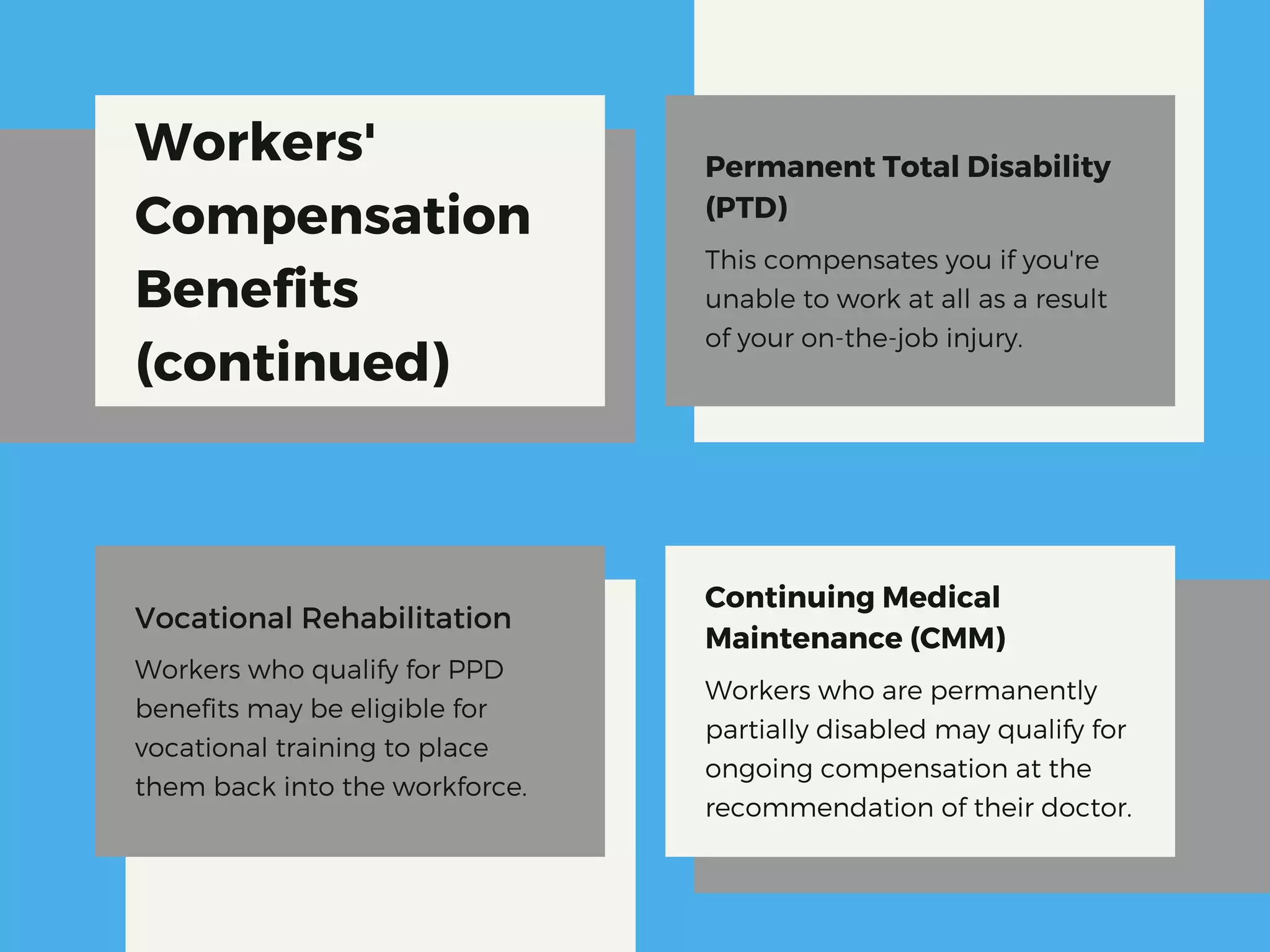
| Permanent Partial (PPD) | Compensation for permanent residual impairment (often called "C-92" benefits). | Based on a percentage of impairment determined by a medical exam. |
| Permanent Total (PTD) | Paid if the worker is permanently unable to perform any sustained remunerative employment. | Lifetime benefit. |
| Wage Loss | Paid if a worker returns to a lower-paying job because of physical restrictions. | Limited to a specific number of weeks (200 weeks maximum). |
| Vocational Rehab | Services to help the worker return to the job or find new employment. | Determined by BWC rehabilitation specialists. |
The Role of MCOs and TPAs
The administrative landscape in Ohio involves two types of entities that often confuse workers: Managed Care Organizations (MCOs) and Third-Party Administrators (TPAs).
Managed Care Organizations (MCO)
Every Ohio employer must select an MCO. The MCO is responsible for the medical management of the claim. They process medical bills, authorize treatments (like physical therapy or surgery), and coordinate with the BWC. The MCO does not decide if a claim is legally valid; that is the role of the BWC or the Industrial Commission.
Third-Party Administrators (TPA)
TPAs are hired by employers to help manage the financial and "risk" side of workers’ compensation. They often represent the employer's interests in hearings to keep premium costs low. Unlike MCOs, which are paid by the BWC through premium redirects, TPAs are private contractors paid directly by the employer.
Violation of Specific Safety Requirements (VSSR)
Ohio has a unique rule regarding safety violations. If an employer violates a Specific Safety Requirement (as outlined in the Ohio Administrative Code) and that violation leads to an injury, the worker can apply for a VSSR award.
This is an additional penalty paid by the employer directly to the injured worker. The award can range from 15% to 50% of the maximum weekly workers’ compensation rate. It serves as both a punishment for the employer’s failure to maintain safety standards and extra compensation for the worker. In 2026, VSSR claims continue to require a high burden of proof, specifically identifying the exact safety code violated.
The Industrial Commission (IC) Hearing Process
When there is a dispute—such as an employer contesting a claim or the BWC denying a specific medical procedure—the case goes to the Industrial Commission of Ohio. The IC is a separate adjudicatory body from the BWC.
The hearing process typically follows three levels:
- District Hearing Officer (DHO): The first level of formal hearing. Evidence is presented, and a written order is issued.
- Staff Hearing Officer (SHO): If either party disagrees with the DHO, they can appeal to the SHO. This is a de novo hearing, meaning the SHO looks at the evidence fresh.
- Commission Level: The highest level of administrative appeal. The three-member Commission has the discretion to hear or refuse the case. Most cases end at the SHO level.
After exhausting administrative appeals, parties may have the right to appeal certain "right to participate" issues to the County Court of Common Pleas.
Medical Treatment and the "Free Choice" Rule
In Ohio, an injured worker has the right to choose their initial treating physician, provided the doctor is BWC-certified. If a worker goes to an emergency room or an urgent care facility immediately after an injury, that does not lock them into that provider.
However, once a "Physician of Record" (POR) is established, changing doctors requires filing paperwork with the MCO. It is essential to ensure that the POR is familiar with BWC coding and reporting requirements, as the success of wage loss benefits (TTD) depends heavily on the doctor’s objective medical evidence and their completion of the MEDCO-14 (Physician's Report of Work Ability) form.
Psychological and Psychiatric Conditions
A common point of confusion involves mental health. In Ohio, a psychological condition is only compensable if it arises from a physical injury sustained on the job. "Mental-mental" claims—where a worker suffers a psychological breakdown due to workplace stress without a physical injury—are generally not covered under the Ohio workers’ compensation system. For example, if a worker develops depression as a direct result of chronic pain from a broken back, the depression can be "added" to the claim. If they develop anxiety purely due to a heavy workload, it likely will not be covered.
Frequently Asked Questions
Can I be fired for filing a workers' compensation claim in Ohio?
Under Ohio Revised Code Section 4123.90, it is illegal for an employer to retaliate against an employee for filing or pursuing a workers’ compensation claim. However, this does not grant "absolute immunity." An employer can still fire an injured worker for reasons unrelated to the claim, such as violation of a neutral company policy (e.g., absenteeism that exceeds the company's standard policy) or downsizing, provided the firing isn't a pretext for retaliation.
What is Maximum Medical Improvement (MMI)?
Maximum Medical Improvement is a legal and medical status where an injured worker's condition has stabilized to the point that no further fundamental functional improvement is expected, regardless of further medical treatment. Once a doctor or an MCO examiner finds a worker at MMI, their Temporary Total Disability (TTD) benefits will stop, even if they cannot return to their original job. At this point, the worker should be evaluated for Permanent Partial Disability (PPD).
Do I have to undergo a "90-Day Exam"?
If you have been receiving TTD benefits for 90 consecutive days, the BWC will likely schedule you for an Independent Medical Examination (IME). The purpose of this exam is to determine your ongoing work limitations, the necessity of your current treatment plan, and whether you have reached MMI. Failure to attend this exam can result in the immediate suspension of your benefits.
What happens if I have a pre-existing condition?
Ohio law allows for the "aggravation" of a pre-existing condition. If you had a prior back injury that was asymptomatic or stable, and a new work accident makes it worse, you can file a claim for the "substantial aggravation" of that pre-existing condition. You must provide objective medical evidence (like an MRI or X-ray) showing that the condition has worsened because of the workplace event.
How are benefits affected by drug or alcohol use?
Ohio is a "rebuttable presumption" state. If an employer has a posted policy and an employee tests positive for drugs or alcohol immediately after an accident, it is presumed that the intoxication caused the injury. The burden then shifts to the worker to prove that they were not intoxicated or that the intoxication did not cause the injury. If the worker refuses a requested drug test after an accident, this also creates a presumption that intoxication was the cause.
Practical Recommendation for Action
If you are injured on the job in Ohio in 2026, your first priority is to seek medical attention and clearly state to the provider that the injury occurred at work. Ensure your employer is notified in writing as soon as possible to establish a record of the event.
Given the complexity of the one-year statute of limitations and the technical requirements for "medical evidence," you should verify that your treating physician is BWC-certified and willing to complete the necessary MEDCO-14 forms. If your claim is "contested" (disputed) by your employer or the BWC, consider consulting with a legal professional who specializes in Ohio workers' compensation to ensure your rights are protected during Industrial Commission hearings.
Image Gallery
Select an image to open it in a new tab.

Simon Caldwell
Enterprise Technology and Systems Editor
