
To start an auto insurance business in Seattle, you must obtain a Resident Producer License from the Washington Office of the Insurance Commissioner (OIC), register your legal entity with the Secretary of State, and secure a Seattle business license. Success requires choosing between a captive or independent model and securing appointments with insurance carriers.
Starting an auto insurance agency in the Pacific Northwest, specifically within the Seattle metropolitan area, presents a unique set of opportunities and regulatory challenges. As of 2026, the local market is characterized by a high density of electric vehicles (EVs), sophisticated consumer demand for telematics-based pricing, and a regulatory environment that prioritizes consumer transparency. Whether you are a seasoned insurance professional or an entrepreneur entering the financial services sector, navigating the transition from a business concept to a licensed, revenue-generating agency requires a meticulous approach to state laws and local municipal requirements.
Understanding the Washington Resident Producer License
The foundation of any auto insurance business in Seattle is the individual and agency licensing required by the Washington Office of the Insurance Commissioner (OIC). In Washington, the term "agent" is legally categorized under the broader umbrella of an "Insurance Producer." To sell auto insurance, which falls under the "Property and Casualty" (P&C) lines of authority, you must complete several prerequisite steps before you can legally bind coverage or even discuss policy specifics with potential clients.
Pre-Licensing Education and Examination
Before sitting for the state exam, candidates must master the complexities of Washington insurance statutes. While Washington does not mandate a specific number of classroom hours for pre-licensing, the complexity of the P&C exam makes comprehensive study essential. The exam covers both general insurance concepts and Washington-specific regulations, such as the "Essential Property Insurance Inspection and Placement Program" and state-mandated minimum liability limits.
As of 2026, the Washington OIC utilizes third-party testing centers, primarily PSI Services, to administer these exams. You will need to schedule the "WA Property and Casualty Producer" exam. Upon passing, your results are electronically transmitted to the OIC.
Fingerprinting and Background Checks
Washington state law requires a criminal background check for all insurance producer applicants. You must submit fingerprints through a vendor approved by the OIC, typically IdentoGO. This process ensures that individuals handling fiduciary responsibilities and sensitive consumer data meet the ethical standards required by the state. Any history of financial crimes or fraud can be an immediate disqualifier for licensure.
Choosing a Business Legal Structure in Washington
Once you have secured your individual producer license, you must decide how your business will be legally organized. This choice impacts your personal liability, tax obligations, and your ability to scale the agency in the future.
Entity Formation
Most Seattle insurance entrepreneurs choose between a Limited Liability Company (LLC) or a Corporation (C-Corp or S-Corp). The Washington Secretary of State handles the registration of these entities.
- LLC: Offers flexibility in management and "pass-through" taxation, which is often preferred by solo practitioners or small partnerships.
- Corporation: Better suited for agencies looking to raise capital or those with complex ownership structures.
After registering with the Secretary of State, you must obtain a Unified Business Identifier (UBI) number. This number is used by all Washington state agencies to track your business for tax and regulatory purposes.
The Role of the Resident Licensed Agency (RLA)
In addition to your individual license, the entity itself must be licensed as a "Resident Licensed Agency" with the OIC. This requires designating a "Designated Responsible Licensed Producer" (DRLP) who is responsible for the agency's compliance with state insurance laws. If you are a solo operator, you will serve as the DRLP.

Seattle City Business License and Local Compliance
Operating within the city limits of Seattle introduces an additional layer of administrative requirements. The City of Seattle requires its own business license, separate from state-level registrations.
FileLocal and Municipal Licensing
Seattle participates in the FileLocal system, a multi-city portal that allows business owners to apply for and renew local business licenses. If your agency is located within Seattle—or if you are conducting business with residents inside the city—you must maintain a Seattle Business License Tax Certificate.
Business and Occupation (B&O) Taxes
Washington is one of the few states without a corporate or personal income tax. Instead, businesses pay a Business and Occupation (B&O) tax based on gross receipts. Seattle also levies its own local B&O tax. For an insurance agency, the "Service and Other Activities" B&O rate typically applies to the commissions and fees earned. It is critical to account for these taxes in your financial projections, as they are based on gross income, not net profit.
Choosing Your Model: Captive vs. Independent Agent
A pivotal decision in starting your Seattle auto insurance business is determining your relationship with insurance carriers. This choice dictates your product availability, commission structures, and marketing support.
| Feature | Captive Agent | Independent Agent |
|---|---|---|
| Carrier Representation | Represents a single insurance company (e.g., State Farm, Allstate). | Represents multiple insurance carriers. |
| Startup Support | Often provides significant branding, office setup, and lead support. | Agent is responsible for all branding and lead generation. |
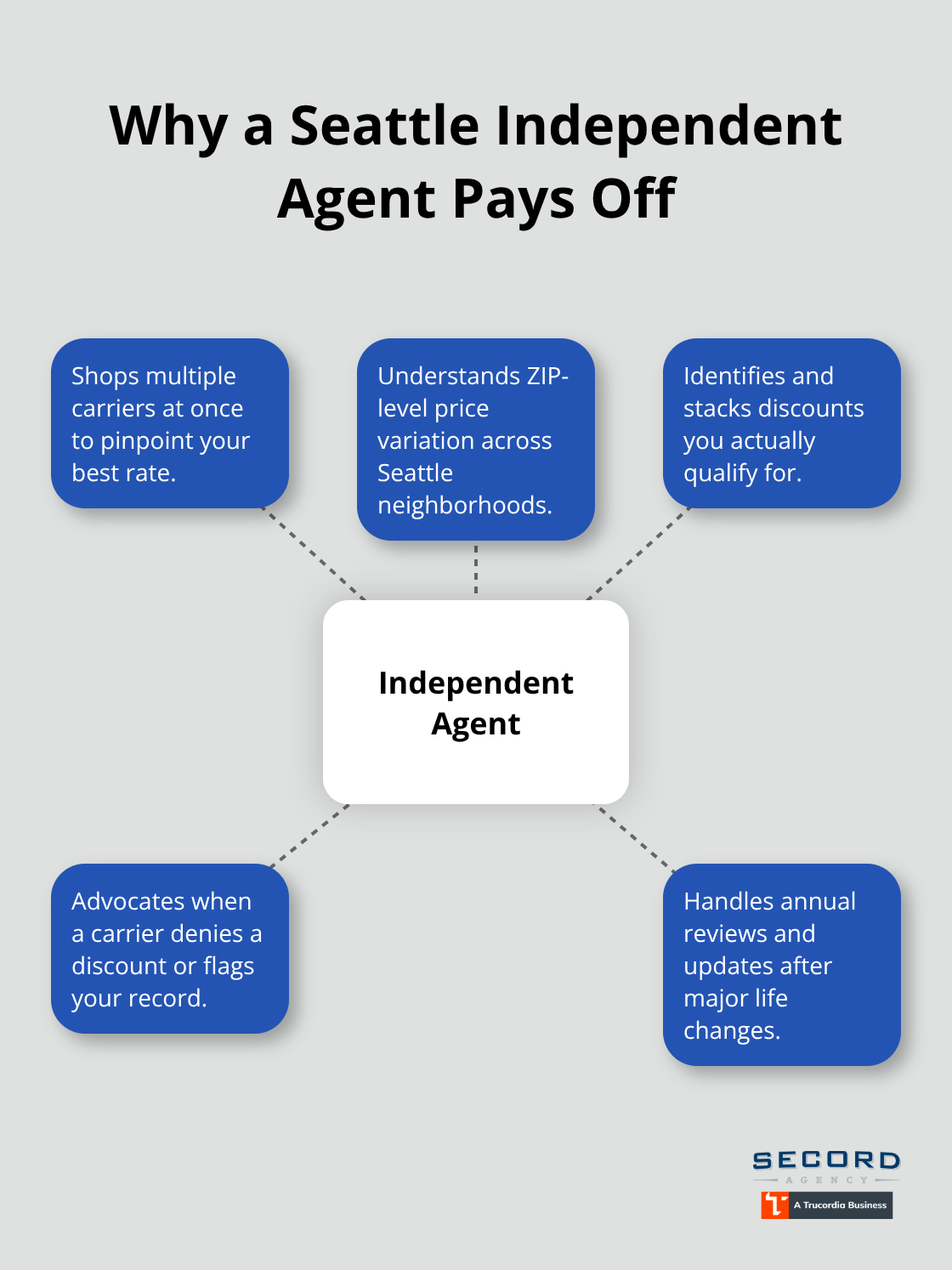
| Product Variety | Limited to one carrier's portfolio. | Can shop multiple carriers to find the best rate for the client. |
| Ownership of Book | The carrier typically owns the "book of business." | The agent usually owns the "book of business" and can sell it. |
| Commission Rates | Usually lower, but may include a base salary or subsidy initially. | Higher commission percentages per policy sold. |
The Independent Advantage in Seattle
In a diverse and competitive market like Seattle, the independent model is increasingly popular. Seattle drivers have varying needs—from high-net-worth individuals in Madison Park requiring umbrella policies to tech workers in South Lake Union seeking "pay-per-mile" insurance for vehicles that spend most of the week in a garage. Having access to 10+ carriers allows you to pivot based on the specific risk profile of the client.
Establishing Carrier Relationships and Appointments
Simply having a license does not allow you to sell a specific company’s insurance. You must be "appointed" by the carrier. An appointment is a legal contract where the insurance company grants you the authority to act as its agent.
Securing Appointments as a New Agency
For new independent agencies, securing appointments with "Standard" carriers (like Travelers, Safeco, or Progressive) can be difficult without a proven track record or a significant projected premium volume. To overcome this, many new Seattle agents join an Agency Cluster or Insurance Aggregator.
- Aggregators: Provide immediate access to multiple carriers in exchange for a portion of the commission or a monthly fee.
- Direct Appointments: Once your agency reaches a certain volume (often $250,000 to $500,000 in written premium), you can apply for direct appointments, which offer higher commissions and direct relationships with underwriters.
Financial and Operational Planning
The capital requirements for starting an auto insurance business in Seattle are significant, particularly given the city's commercial real estate market.
Office Space vs. Digital Presence
In 2026, the "storefront" model is evolving. While some clients still value a physical office in neighborhoods like West Seattle or Northgate, many agencies operate out of smaller professional suites or co-working spaces while maintaining a robust digital presence. However, if you plan to be a captive agent, the parent company may require a specific type of retail storefront with approved signage and interior layouts.
Errors and Omissions (E&O) Insurance
Before a carrier will appoint you, you must carry Errors and Omissions (E&O) insurance. This is professional liability insurance that protects you if a client sues you for making a mistake—such as failing to provide the requested coverage limits or neglecting to add a driver to a policy. In the litigious environment of 2026, carrying high E&O limits (typically $1 million or more) is both a regulatory necessity and a best practice for asset protection.
Essential Technology Stack
To compete in the Seattle market, your agency needs a modern tech stack:
- Agency Management System (AMS): Software like Vertafore or Applied Systems to track policies, renewals, and client communications.
- Comparative Rater: A tool that allows you to enter a client's data once and receive quotes from all your appointed carriers instantly.
- CRM and Automation: Tools to manage leads and automate "happy birthday" or "renewal reminder" emails, which are essential for retention.
Marketing Strategies for the Seattle Market
Seattle is a tech-heavy city, meaning your potential clients are likely to research you online before ever calling or visiting.
Local SEO and Hyper-Local Targeting
Generic "auto insurance" keywords are incredibly expensive and competitive. Instead, focus on hyper-local SEO. Target phrases like "auto insurance agent in Ballard" or "EV insurance specialists in Seattle." Building a Google Business Profile with consistent 5-star reviews from local clients is one of the most effective ways to generate organic leads.
Specializing in Niche Markets
Seattle’s unique demographics offer several niche opportunities:
- Electric Vehicles: With Washington's aggressive move toward zero-emission vehicles, positioning your agency as an expert in Tesla, Rivian, and Lucid insurance can set you apart.
- Rideshare and Delivery: Many Seattle residents drive for Uber, Lyft, or DoorDash. Offering specialized "rideshare endorsements" can be a powerful lead magnet.
- High-Value Transit: For clients who use the Sound Transit Link Light Rail and only drive occasionally, promoting telematics and "pay-per-mile" programs (like Metromile or similar 2026 products) can win over budget-conscious tech workers.
Regulatory Compliance and Ongoing Maintenance
The insurance industry is strictly regulated to protect consumers. Once your Seattle agency is operational, you must adhere to ongoing compliance requirements.
Continuing Education (CE)
Washington requires insurance producers to complete 24 hours of continuing education every two years, including 3 hours of ethics. Failure to complete CE credits will lead to the expiration of your license, which automatically terminates your carrier appointments and your ability to earn commissions.
Fiduciary Responsibilities and Premium Accounts
In Washington, premiums collected from clients are considered "fiduciary funds." You must maintain a separate premium trust account to hold these funds before they are remitted to the insurance company. Commingling these funds with your agency’s operating expenses is a serious violation that can lead to the permanent revocation of your license and criminal charges.
Frequently Asked Questions
How much does it cost to start an auto insurance agency in Seattle? Initial costs typically range from $10,000 to $50,000 for an independent agency, depending on office space and whether you join an aggregator. Captive agents may need $50,000 to $100,000 in liquid capital depending on the carrier's requirements. These figures include licensing, E&O insurance, initial marketing, and legal fees.
Do I need a physical office in Seattle to sell insurance to Seattle residents? No, Washington state does not require a physical "brick-and-mortar" storefront for independent producers, provided you have a registered business address. However, you must be reachable by the OIC and your clients. Many modern agencies use "virtual offices" or hybrid models.
Can I sell other types of insurance with a Property and Casualty license? Yes. A P&C license in Washington allows you to sell homeowners insurance, commercial property insurance, liability insurance, and pet insurance. To sell life or health insurance, you would need to pass additional exams for those specific lines of authority.
What are the minimum auto insurance limits I must sell in Washington? As of 2026, you must ensure all policies meet the state-mandated minimums. While these are subject to legislative updates, the historical baseline has been 25/50/10 ($25,000 for bodily injury per person, $50,000 per accident, and $10,000 for property damage). However, as a professional agent in a high-cost area like Seattle, you should generally recommend significantly higher limits to protect your clients' assets.
How long does the licensing process take? Typically, the process takes 4 to 8 weeks. This includes study time, passing the exam, fingerprint processing (7-10 days), and the OIC’s application review period.
Practical Next Action
Your immediate first step is to visit the Washington Office of the Insurance Commissioner website to create your account in the "Individual Producer" portal. Once registered, download the candidate handbook for the Property and Casualty exam and schedule your fingerprints. Concurrently, reach out to local insurance mentors or search for "Agency Aggregators in Washington" to begin evaluating which business model will support your long-term financial goals in the Seattle market.
Image Gallery
Select an image to open it in a new tab.




Declan O'Connor
Higher Education and Campus Culture Reporter
