How Dmitri Mendeleev Organized the Elements: The Evolution of the Periodic Table
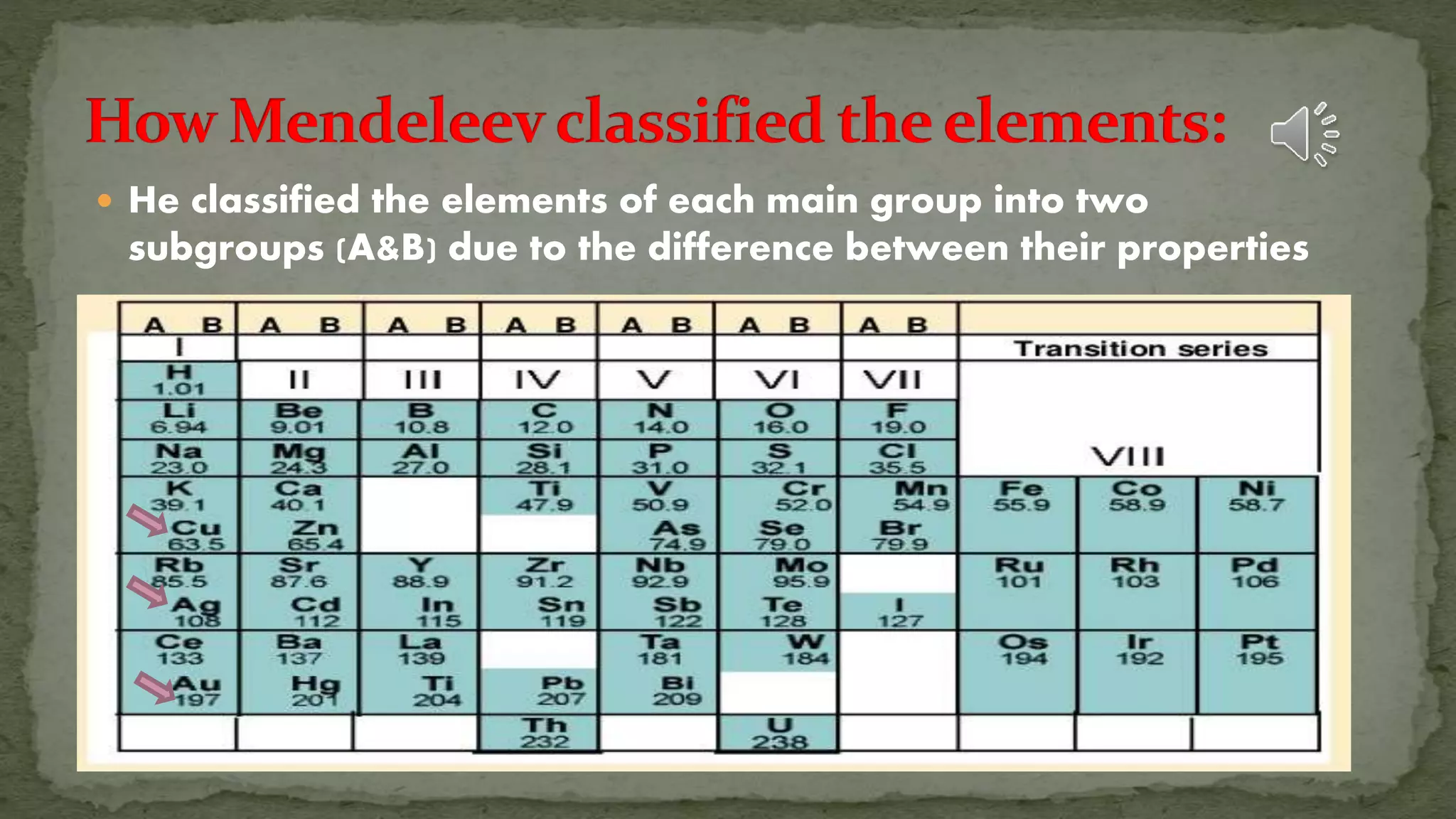
Dmitri Mendeleev organized the chemical elements by arranging them in order of increasing atomic mass while simultaneously grouping elements with similar chemical properties into vertical columns. His breakthrough, known as the Periodic Law, revealed that physical and chemical properties recur periodically when elements are sequenced by weight, famously allowing him to predict undiscovered elements by leaving strategic gaps in his 1869 table.
The organization of the periodic table remains one of the most significant achievements in science. It transformed chemistry from a fragmented collection of isolated observations into a structured, predictive discipline. In 1869, when Mendeleev first presented his "Principles of Chemistry," only about 63 elements were known. By focusing on the relationships between these elements rather than just their individual characteristics, he created a framework that accommodates the 118 elements recognized as of 2026.
The Scientific Landscape of the mid-19th Century
To understand how Mendeleev organized the elements, one must first grasp the scientific chaos of the 1860s. At that time, chemists were struggling to find a logical way to classify the building blocks of matter. While John Dalton had introduced the concept of atomic weights earlier in the century, there was significant disagreement over how to calculate them accurately.
The 1860 Karlsruhe Congress, the first international chemistry conference, was a turning point. It was here that Stanislao Cannizzaro championed Amedeo Avogadro’s ideas, providing a standardized method for determining atomic weights. Mendeleev attended this conference, and the clarity it provided regarding atomic mass became the foundation for his future organizational system.
Before Mendeleev, others had attempted classification. Johann Döbereiner identified "triads" (groups of three elements with similar properties), and John Newlands proposed the "Law of Octaves," suggesting that every eighth element shared similar traits. However, these systems were often rigid or failed when applied to heavier elements. Mendeleev’s approach was different because it was flexible enough to prioritize chemical logic over strict mathematical sequencing.
The Dual-Criteria Approach: Mass and Chemical Behavior
Mendeleev’s methodology relied on two primary data points: atomic mass and valence (combining power). He famously wrote the properties of each known element on individual cards—a process often described as "chemical solitaire." By shuffling these cards, he sought a pattern that satisfied both criteria simultaneously.
1. Arrangement by Atomic Mass
In the 1860s, the proton had not yet been discovered, so "atomic number" did not exist as a concept. The only measurable "size" of an atom was its weight relative to hydrogen. Mendeleev began by lining up elements from the lightest to the heaviest. However, he quickly realized that mass alone was an insufficient guide. If he followed mass strictly, elements with wildly different behaviors would end up grouped together.
2. Grouping by Periodicity and Valency
The term "periodic" implies a recurring pattern. Mendeleev noticed that after a certain number of elements, the chemical behavior of the next element would "reset" to match an earlier one. For example, after the reactive gas Fluorine, the next element (Sodium) behaved remarkably like Lithium.
He organized these similar elements into vertical columns, which we now call Groups. Elements in the same group shared:
- Valence: The number of bonds an atom can form.
- Reactivity: How they reacted with oxygen, hydrogen, or water.
- Physical State: Whether they were metallic, brittle, or gaseous at room temperature.

The Revolutionary Decision: Prioritizing Properties Over Mass
Perhaps the most brilliant aspect of Mendeleev’s organization was his willingness to break his own rules. When the atomic mass of an element suggested a position that contradicted its chemical behavior, Mendeleev assumed the mass was wrong or the placement needed adjustment.
A classic example is the case of Tellurium (Te) and Iodine (I). According to the measured atomic weights of the time, Tellurium was heavier than Iodine. A strict mass-based table would have placed Iodine before Tellurium. However, Iodine’s properties (a halogen) clearly matched those of Fluorine, Chlorine, and Bromine. Tellurium’s properties matched Oxygen, Sulfur, and Selenium.
Mendeleev placed Tellurium before Iodine, effectively swapping their positions based on their "chemical personalities." He boldly claimed that the atomic weights of these elements had been measured incorrectly. While we now know the weights were mostly correct, Mendeleev’s intuition was right—the underlying order was not purely about mass, but about what we now know as atomic number.
Leaving Gaps: Predicting the Undiscovered
While other scientists, such as Julius Lothar Meyer, were developing similar tables at the same time, Mendeleev is credited as the father of the periodic table primarily because of his predictive power. He realized that the pattern he had discovered contained holes.
Rather than forcing the known elements to fit into a continuous sequence, Mendeleev left empty spaces in his table. He argued that these gaps represented elements that had not yet been discovered. He went a step further by using the properties of the elements above and below the gaps to predict the characteristics of these missing elements. He used the Sanskrit prefix "eka" (meaning "one") to name these placeholders:
- Eka-aluminum: Predicted to be a metal with a low melting point and an atomic weight of about 68.
- Eka-boron: Predicted to have an atomic weight of 44.
- Eka-silicon: Predicted to be a grey metal with an atomic weight of 72.
The scientific community was initially skeptical. However, within 15 years, these elements were discovered: Gallium (1875), Scandium (1879), and Germanium (1886). The properties of these elements matched Mendeleev's predictions with staggering accuracy.
Comparison of Mendeleev’s Predictions for Germanium
| Property | Mendeleev’s Prediction (Eka-silicon) | Actual Discovery (Germanium, 1886) |
|---|---|---|
| Atomic Mass | Approximately 72 | 72.61 |
| Density (g/cm³) | 5.5 | 5.32 |
| Color | Dirty Grey | Greyish-white |
| Oxide Formula | EsO₂ | GeO₂ |
| Chloride Boiling Point | Below 100°C | 84°C |
This table demonstrates how Mendeleev’s organizational logic wasn't just a classification tool; it was a map of the physical laws of the universe.
The Transition to the Modern Periodic Table
As of 2026, the periodic table looks different from Mendeleev’s original sketches, yet it retains his fundamental logic. The most significant shift occurred in the early 20th century with the work of Henry Moseley.
From Atomic Mass to Atomic Number
Mendeleev organized by mass because protons were unknown. In 1913, Moseley used X-ray spectroscopy to prove that each element has a unique nuclear charge, which corresponds to the number of protons. This is the atomic number. When the table was re-ordered by atomic number, the anomalies Mendeleev struggled with—like the Tellurium-Iodine swap—were naturally resolved. Tellurium has 52 protons, and Iodine has 53, so Tellurium naturally precedes Iodine despite being heavier due to its isotopic distribution.
The Inclusion of Noble Gases
When Mendeleev created his table, the Noble Gases (Helium, Neon, Argon, etc.) were entirely unknown. Because they are inert and do not react with other elements, they left no "clues" in the form of chemical compounds. When William Ramsay discovered Argon in 1894, it initially seemed to threaten Mendeleev's system because there was no space for it. However, Mendeleev realized that these elements simply formed a new vertical group (Group 0, now Group 18), further validating the flexibility of his periodic structure.
Why Mendeleev’s Organization Still Matters in 2026
The periodic table is more than a classroom poster; it is a vital tool for modern industry and research. By understanding how Mendeleev organized the elements, scientists today can:
- Design New Materials: By looking at group properties, engineers can substitute rare elements with more common ones that share similar valency.
- Predict Reactivity: The "periodicity" Mendeleev identified helps chemists understand how elements will behave in high-pressure or high-temperature environments, such as inside stars or nuclear reactors.
- Synthesize Superheavy Elements: The search for elements beyond Oganesson (element 118) relies on the same periodic trends Mendeleev established over 150 years ago.
Mendeleev’s genius lay in his recognition that nature follows a blueprint. He didn't just list elements; he discovered the rhythm of matter.
Frequently Asked Questions
Why did Mendeleev leave gaps in his periodic table? Mendeleev left gaps because he realized that the sequence of elements based on atomic mass and chemical properties was incomplete. He correctly hypothesized that these gaps represented elements that existed in nature but had not yet been isolated by chemists. This allowed his table to be a "living" document that grew as new elements were discovered.
What was the main flaw in Mendeleev’s original organization? The primary flaw was using atomic mass as the organizing principle instead of atomic number. Because atomic mass is influenced by the number of neutrons (isotopes), it can sometimes result in elements being out of their "natural" chemical order. This was corrected in 1913 by Henry Moseley, who transitioned the table to an atomic number basis.
How did Mendeleev handle elements with similar properties? Mendeleev placed elements with similar chemical properties, such as reactivity and valence, into the same vertical columns. If an element's mass suggested it should go in a column where it didn't belong chemically, he would move it to a column that matched its behavior, often assuming the recorded atomic mass was inaccurate.
What are 'groups' and 'periods' in the context of Mendeleev’s work? In Mendeleev’s organization, periods are the horizontal rows. Moving across a period shows the gradual change in properties as mass increases. Groups are the vertical columns containing elements with similar chemical characteristics. This grid system allowed for the visualization of both trends (horizontal) and families (vertical).
Did Mendeleev discover all the elements on his table? No, Mendeleev did not discover the elements themselves; he discovered the relationship between them. He used the data collected by hundreds of other chemists to synthesize a unified theory. While he predicted the existence of elements like Gallium and Germanium, they were physically discovered by other scientists years after he published his table.
Practical Recommendation for Students and Educators
To truly master the organization of the periodic table, do not simply memorize the elements. Instead, focus on the trends. If you understand why Mendeleev placed Sodium (Na) and Potassium (K) in the same group (both are highly reactive metals with one valence electron), you can predict the behavior of any element in that column. Study the "Periodic Law" as a map of electronic structure, and the logic of the table will become clear.
For those interested in the deep history of chemical classification, the Royal Society of Chemistry offers extensive primary source documents from Mendeleev's era. Additionally, the International Union of Pure and Applied Chemistry (IUPAC) provides the most current standards for the table as it stands in 2026.
Image Gallery
Select an image to open it in a new tab.


Vivian Cho
Executive IT and Emerging Technologies Reporter
