Why the IRS Automated Collection System Rarely Saves You Money

The IRS Automated Collection System (ACS) is an automated infrastructure designed to maximize tax collections and secure delinquent returns through standardized computer algorithms and call-center operations. While interacting with ACS can quickly stop initial collection notices, relying on its default resolution paths rarely saves taxpayers money. ACS representatives prioritize securing full payment or standardized installment agreements based on strict national guidelines, without proactively evaluating cost-saving tax relief options like penalty abatement, Partial Payment Installment Agreements, or an Offer in Compromise.
Understanding the IRS Automated Collection System (ACS)
The IRS Automated Collection System is a nationwide, computerized network of call centers and automated databases used by the Internal Revenue Service to manage unpaid tax liabilities and unfiled tax returns. When a taxpayer accumulates a balance due and does not resolve it during the initial billing phase, the account is routinely transferred from the local service center to ACS.
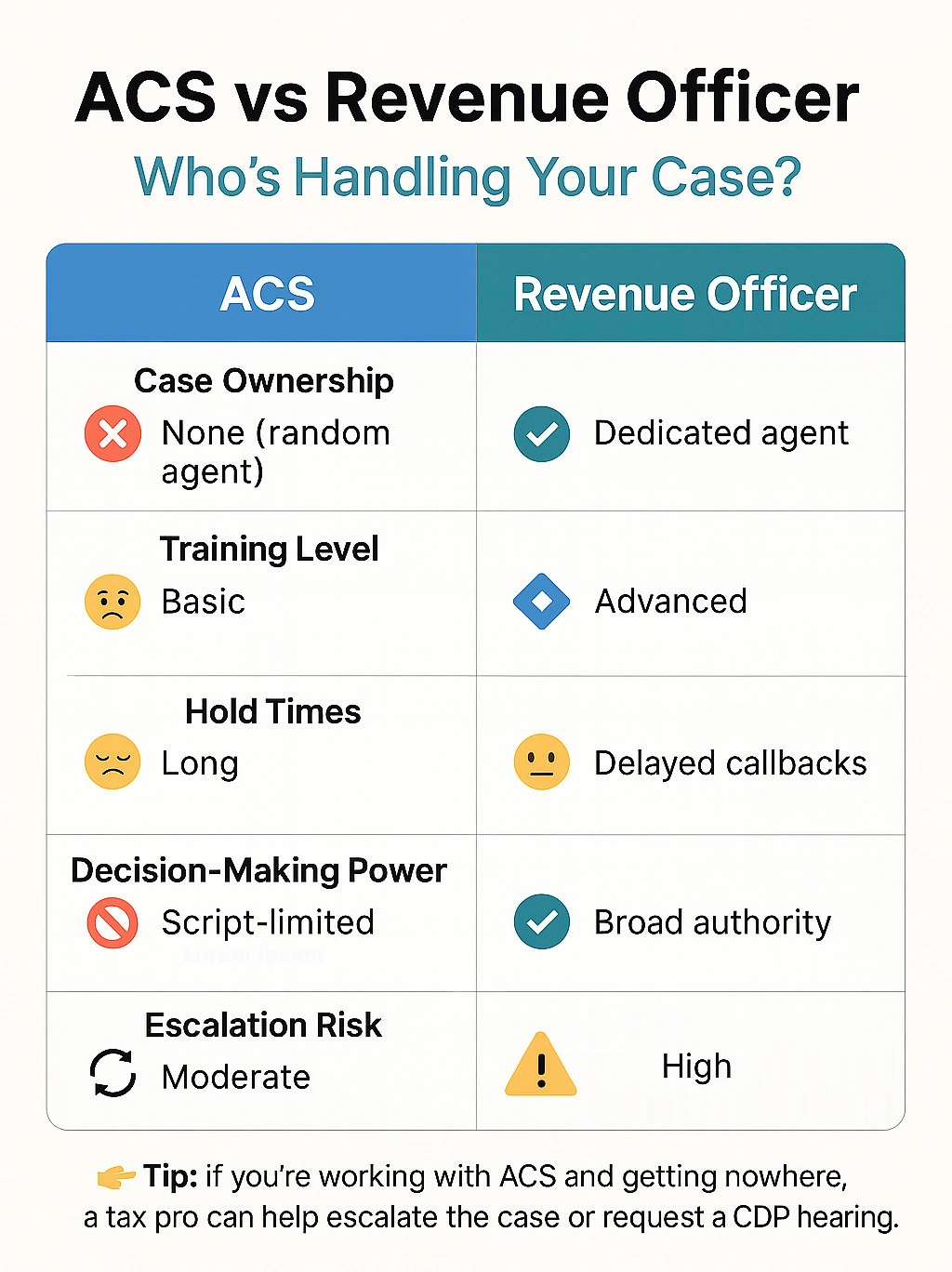
ACS operates differently from field collections, where a local IRS Revenue Officer is assigned to personally investigate a case. Instead, ACS relies on computerized tracking systems that automatically issue statutory notices, systematically cross-reference third-party financial data (such as W-2, 1099, and bank reporting forms), and queue accounts for automated levy actions.
Call-center representatives staffing ACS phone lines possess broad authority to request financial statements, issue administrative levies, set up monthly payment arrangements, and file Notices of Federal Tax Lien (NFTL). However, ACS is built for volume processing and operational efficiency. The primary objective of the system is to bring non-compliant accounts into immediate payment status, not to minimize a taxpayer's overall financial burden.
How the ACS Process Operates: From Automated Notices to Enforced Collection
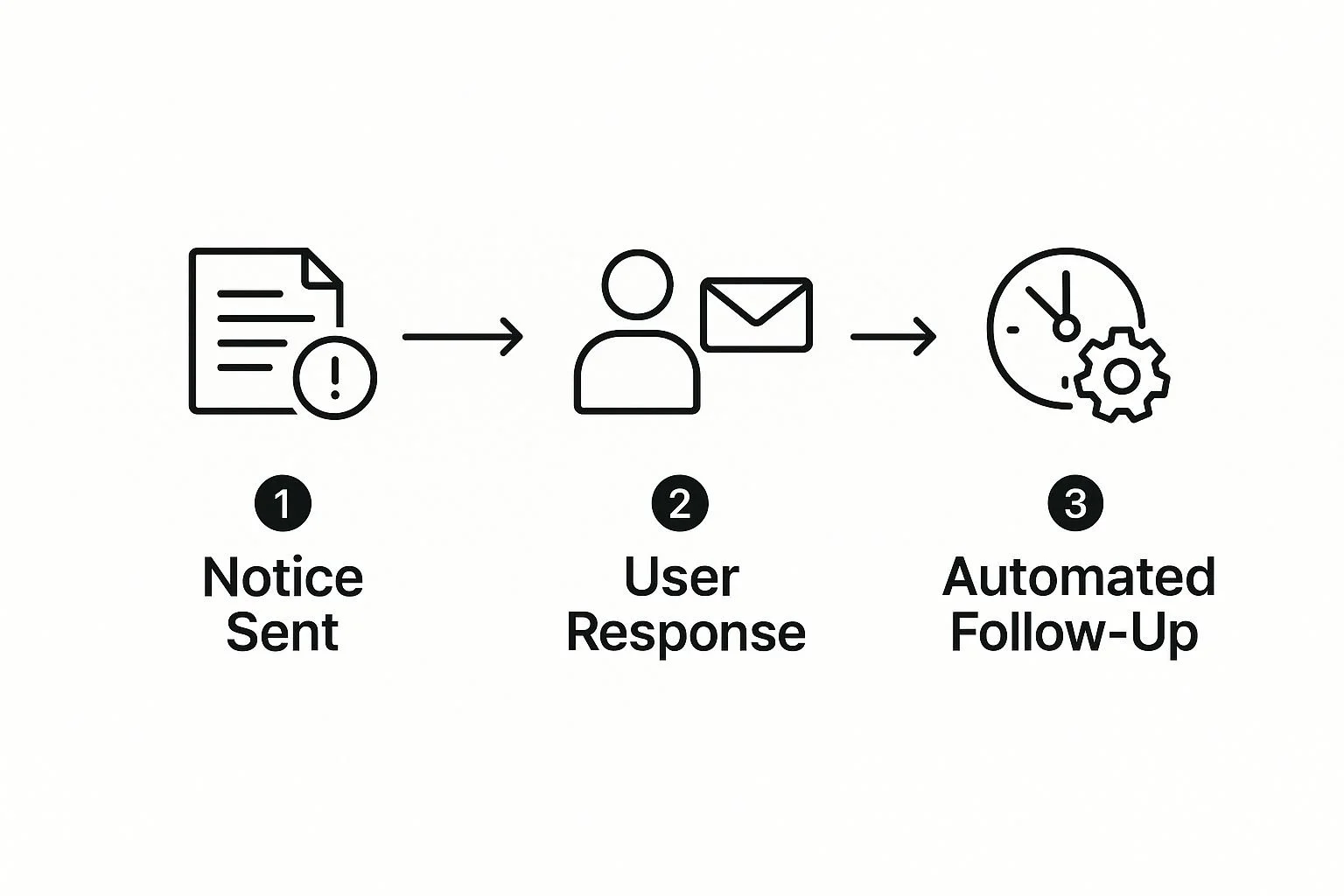
When an account enters the ACS database, it moves through a structured, calendar-driven sequence of computer-generated notices designed to compel voluntary compliance before resorting to compulsory enforcement.
- Tax Debt Accrual
- CP14 Notice
- CP503 / CP504 Notice
- LT11 / Letter 1058 (Final Notice)
- Automated Levy / Lien Execution
1. The Statutory Notice Sequence
The collection lifecycle typically begins with a series of automated letters sent to the taxpayer's last known address:
- Notice CP14: The initial balance due notice informing the taxpayer of an unpaid tax liability, including initial penalties and interest.
- Notice CP503 & CP504: Reminder notices warning that the account remains unpaid. Notice CP504 serves as a Notice of Intent to Levy on state tax refunds and specific assets.
- Letter 1058 / Notice LT11: The Final Notice of Intent to Levy and Notice of Your Right to a Hearing. This is the statutory prerequisite for the IRS to issue third-party levies on bank accounts, wages, and receivables.
2. Automated Enforcement Actions
If a taxpayer fails to respond to the notice sequence or does not reach an agreement with ACS, the system automatically triggers enforcement actions based on electronic records:
- Wage Garnishments (Form 668-W): The system issues automated administrative orders to employers, requiring them to withhold a substantial portion of the employee’s net paycheck.
- Bank Account Levies (Form 668-A): ACS sends electronic attachment orders to financial institutions, freezing funds present in the account up to the total debt balance for 21 days before transmitting the funds to the U.S. Treasury.
- Federal Tax Liens: ACS automatically generates public legal claims against all current and future property owned by the taxpayer to secure the government's priority interest over other creditors.

5 Reasons Why Relying on the ACS Rarely Saves You Money
While taxpayers often assume that negotiating directly with an ACS representative over the phone will yield a fair deal, the system's structural constraints frequently lead to higher total out-of-pocket costs.
1. ACS Is Programmed for Collection Efficiency, Not Debt Minimization
ACS personnel operate under strict call handling metrics and standardized scripts. Their mandate is to secure immediate full payment or establish a streamlined payment plan that liquidates the balance within the statutory Collection Statute Expiration Date (CSED)—typically 10 years from the assessment date.
ACS representatives are not incentivized to analyze whether a taxpayer qualifies for debt reduction programs. If a taxpayer asks, "What is the fastest way to resolve this today?", an ACS agent will generally present a standard Installment Agreement based on full repayment, even if the taxpayer legally qualifies to settle the debt for a fraction of the total balance.
2. Failure to Address Accumulating Penalties and Compounding Interest
Interest and failure-to-pay penalties accrue automatically under the Internal Revenue Code (IRC) every month an account balance remains unpaid.
- Failure-to-Pay Penalty: Accrues at 0.5% per month (up to a maximum of 25% of the unpaid tax).
- Statutory Interest: Set quarterly based on the federal short-term rate plus 3 percentage points, compounding daily.
ACS automated installment setups do not automatically freeze penalties or interest. In fact, if an installment payment amount is set too low relative to the size of the liability, the monthly payment may barely cover the accruing interest and monthly administrative fees, prolonging the payoff duration and significantly increasing the total amount paid over time.
3. Application of Rigid Collection Financial Standards
When financial documentation is required to establish a collection resolution, ACS evaluates a taxpayer's monthly income and expenses using Form 433-F (Collection Information Statement). However, ACS applies strict caps known as the IRS Collection Financial Standards for housing, utilities, food, clothing, and transportation.
| Expense Category | How ACS Evaluates the Expense | Impact on Taxpayer Out-of-Pocket Costs |
|---|---|---|
| National Standards (Food, Clothing, Miscellaneous) | Fixed dollar allowance based on family size and income tier, regardless of actual spending. | Disallows actual spending if it exceeds national caps, driving up calculated disposable income. |
| Housing & Utilities (Local Standards) | Capped by county-level maximum allowances based on family size. | Outlays exceeding local caps (e.g., high rent or mortgages) are disallowed, raising required payment amounts. |
| Transportation Standards | Standard operating and ownership costs based on nationwide or regional averages. | Private loan or lease payments exceeding IRS caps are ignored when computing monthly repayment capacity. |
| Unsecured Debt Payments (Credit Cards) | Generally disallowed completely as conditional expenses. | Taxpayers are forced to divert money from private creditors to the IRS, increasing private debt default risks. |
Because ACS agents strictly enforce these expense caps, they often conclude that a taxpayer has substantial "disposable monthly income" available to pay the IRS, resulting in monthly payment demands that taxpayers struggle to maintain over the long term.
4. No Proactive Application of Tax Relief Programs
The IRS offers several relief structures established by statutory authority and administrative policy. ACS algorithms do not automatically apply these provisions to your account; they must be formally requested, documented, and justified by the taxpayer:
- Offer in Compromise (OIC): An agreement allowing qualified taxpayers to settle their tax liability for less than the full amount owed under specific financial hardship criteria. ACS agents do not process OIC applications over the phone; applications must be submitted separately to dedicated IRS OIC units.
- First-Time Penalty Abatement (FTA): Administrative relief that waives penalties for taxpayers who have a clean filing and payment compliance record for the preceding three tax years. ACS representatives rarely offer FTA unless the taxpayer specifically asks for it using the correct administrative terminology.
- Reasonable Cause Penalty Relief: Relief granted if non-compliance resulted from severe personal hardship, disaster, or illness. Proving reasonable cause requires written documentation and legal substantiation, which cannot be negotiated during a brief ACS call.
5. High Risk of Entering Default-Prone Installment Agreements
Under pressure from automated levy threats or urgent bank freezes, taxpayers frequently accept ACS-proposed monthly installment payments that exceed their actual budget capabilities.
When a taxpayer defaults on an ACS installment agreement due to unmanageable monthly obligations:
- The IRS charges a reinstatement fee to restore the agreement.
- The account is returned to automated collection status.
- The system re-issues automated levy notices, restarting the collection cycle and adding additional administrative costs.
Comparing Collection Paths: ACS Automation vs. Proactive Tax Resolution
Relying solely on automated ACS prompts often results in higher overall payments compared to proactive, strategic tax resolution.
| Feature / Dimension | Relying on Default ACS Collection | Proactive Strategic Resolution |
|---|---|---|
| Primary Objective | Fast account closure and full liability recovery. | Debt minimization, rights protection, and affordable compliance. |
| Financial Analysis Basis | Standardized IRS national caps (Form 433-F). | Detailed accounting, legal expense substantiation, and hardship evaluation. |
| Treatment of Penalties | Penalties continue to accrue; abatement is rarely volunteered. | Formal evaluation and application for First-Time Abatement or Reasonable Cause. |
| Settlement Options Evaluated | Full Payment or Standardized Monthly Installment Agreement. | Offer in Compromise (OIC), Partial Payment Installment Agreement (PPIA), or Currently Not Collectible (CNC). |
| Protection Against Levies | Ceases only after an agreement is finalized or full payment is made. | Immediate statutory holds via Collection Due Process (CDP) or formal relief filings. |
| Long-Term Financial Impact | Highest total cash outflow due to accrued interest and fixed expense caps. | Lowest legal cash outflow based on actual Reasonable Collection Potential (RCP). |
Alternatives to ACS Collection Demands That Can Reduce Total Debt
Taxpayers facing ACS collection actions have several legal options under the Internal Revenue Code to reduce their total debt liability or adjust monthly payment terms based on actual financial capacity.
1. Offer in Compromise (OIC)
Under IRC § 7122, the IRS is authorized to compromise a tax liability based on Doubt as to Collectibility, Doubt as to Liability, or Effective Tax Administration. An Offer in Compromise allows eligible taxpayers to settle their debt for an amount equal to their net asset equity plus their calculated future disposable income over a 12- or 24-month period. If the resulting figure is lower than the total tax debt, the IRS accepts the reduced offer as full satisfaction of the balance.
2. Partial Payment Installment Agreement (PPIA)
If a taxpayer does not qualify for an Offer in Compromise but cannot afford a standard monthly installment plan that pays off the full debt before the statute of limitations expires, they may qualify for a Partial Payment Installment Agreement. Under a PPIA, monthly payments are based on actual proven ability to pay after accounting for allowable living expenses. The remaining tax balance is written off by the government upon the expiration of the statutory collection period.
3. Currently Not Collectible (CNC) Status
Taxpayers experiencing severe financial hardship may request that their account be placed in Currently Not Collectible status (Status 53). When an account is classified as CNC:
- The IRS temporarily halts all automated collection activities, including levies and garnishments.
- The statutory 10-year collection clock continues to run down.
- The IRS conducts periodic reviews of the taxpayer's annual gross income (via future tax returns) to determine if financial circumstances have improved.
4. Administrative Penalty Abatement
Requesting IRS penalty relief can substantially reduce the overall account balance. Under First-Time Abatement (FTA) rules, the IRS waives failure-to-file and failure-to-pay penalties for a single tax period if the taxpayer has no prior penalties for the preceding three tax years and is current on all required filings. Where FTA does not apply, penalties can be abated by demonstrating "Reasonable Cause"—showing that the taxpayer exercised ordinary business care and prudence but was nevertheless unable to file or pay on time due to circumstances beyond their control.
How to Navigate ACS Contact Effectively Without Overpaying
If your account is actively assigned to ACS, taking structured, deliberate steps can prevent automated enforcement actions while protecting your financial rights.
- Step 1: Secure Account Transcripts & Verify Collection Expiration (CSED)
- Step 2: Prepare Form 433-F with Supporting Financial Documentation
- Step 3: Evaluate Relief Eligibility (OIC, PPIA, CNC, Penalty Abatement)
- Step 4: Execute Formal Administrative Requests or File Form 12153 (CDP)
Step 1: Secure Transcripts and Audit the Balance
Before contacting ACS, request official Wage and Income Transcripts along with Account Transcripts from the IRS. Audit the figures to ensure:
- All tax credits, withholding, and prior payments have been accurately credited.
- The statutory Collection Statute Expiration Date (CSED) for each tax module is calculated correctly.
- Substitute for Return (SFR) assessments performed by the IRS have not overstated your tax liability due to missing deductions or exemptions.
Step 2: Prepare Accurate Financial Disclosures
Do not complete a phone interview with ACS without compiling a comprehensive financial profile using Form 433-F (Collection Information Statement). Gather supporting evidence for all income and necessary living costs, including bank statements, utility bills, medical receipts, and payroll stubs. If an expense exceeds standard IRS caps, prepare documentation demonstrating that the expense is necessary for the health and welfare of your family or the production of income.
Step 3: Utilize Collection Due Process (CDP) Rights
If you receive Notice LT11 or Letter 1058, you have a statutory right under IRC § 6330 to request a Collection Due Process (CDP) hearing by filing Form 12153 within 30 days of the notice date.
Filing a timely CDP request:
- Stops all levy and garnishment actions immediately while the hearing is pending.
- Transfers jurisdiction of your case away from ACS call centers to an independent Appeals Officer within the IRS Independent Office of Appeals.
- Preserves your legal right to challenge the collection action or proposed resolution in U.S. Tax Court if an agreement cannot be reached.
Step 4: Work with Qualified Tax Representation
Taxpayers facing complex ACS actions can authorize an Enrolled Agent (EA), Certified Public Accountant (CPA), or Tax Attorney to represent them by submitting Form 2848 (Power of Attorney). A qualified representative communicates directly with the IRS on your behalf, preventing aggressive phone solicitations, enforcing procedural protections, and negotiating structured settlements based on statutory guidelines rather than automated scripts.
Frequently Asked Questions
What is the difference between an IRS Revenue Officer and the Automated Collection System (ACS)?
An IRS Revenue Officer is a local field agent assigned to handle complex or high-dollar tax delinquencies through direct, personal contact, field visits, and tailored investigations. The Automated Collection System (ACS) is a centralized, phone-based infrastructure that manages routine collection accounts through automated notice issuance, computerized database matching, and call-center representatives.
Can the IRS ACS garnish my bank account without warning?
No. Under federal law, the IRS must issue a series of statutory billing notices, culminating in a Final Notice of Intent to Levy and Notice of Your Right to a Hearing (such as Letter 1058 or Notice LT11), at least 30 days prior to executing a bank levy or wage garnishment.
Will setting up an online payment agreement with ACS stop interest from growing?
No. An IRS Installment Agreement stops collection enforcement actions like levies and liens, but it does not freeze interest or failure-to-pay penalties. Statutory interest and reduced failure-to-pay penalties (typically 0.25% per month while an agreement is active) continue to accrue on the remaining balance until the debt is paid in full.
What happens if I cannot afford the monthly payment requested by ACS?
If the monthly payment requested by ACS exceeds your realistic financial capacity, you should not sign or verbally accept the agreement. Instead, submit Form 433-F with complete supporting financial records to demonstrate actual living expenses and request an alternative resolution, such as Currently Not Collectible (CNC) status or a Partial Payment Installment Agreement (PPIA).
How long can the IRS ACS pursue unpaid tax debt?
The IRS generally has 10 years from the date of tax assessment to collect unpaid tax liabilities, known as the Collection Statute Expiration Date (CSED). Certain taxpayer actions—such as filing a bankruptcy petition, submitting an Offer in Compromise, or requesting a Collection Due Process hearing—pause the 10-year clock and extend the collection period accordingly.
Strategic Recommendation
If you receive collection notices from the IRS Automated Collection System, avoid agreeing to rapid, automated payment plans without first auditing your tax liabilities and evaluating your legal relief options.
Begin by requesting your official IRS Account Transcripts to verify assessment dates and penalty calculations. Review your actual monthly living expenses against IRS Collection Financial Standards to determine whether you qualify for alternative programs such as First-Time Penalty Abatement, Currently Not Collectible status, or an Offer in Compromise. If you receive a Final Notice of Intent to Levy (Notice LT11 or Letter 1058), exercise your statutory right to a Collection Due Process hearing using Form 12153 within 30 days to halt enforcement actions and move your account out of the automated collection environment. For complex liabilities or severe financial hardship, consult a licensed tax professional—such as an Enrolled Agent, CPA, or Tax Attorney—to establish a tailored resolution strategy before contacting ACS.
Disclaimer: This article is for informational purposes only and does not constitute legal, tax, or financial advice. Tax laws and administrative procedures are subject to change. Consult a qualified tax professional or legal counsel regarding your specific financial situation.
Image Gallery
Select an image to open it in a new tab.
Declan O'Connor
Higher Education and Campus Culture Reporter
