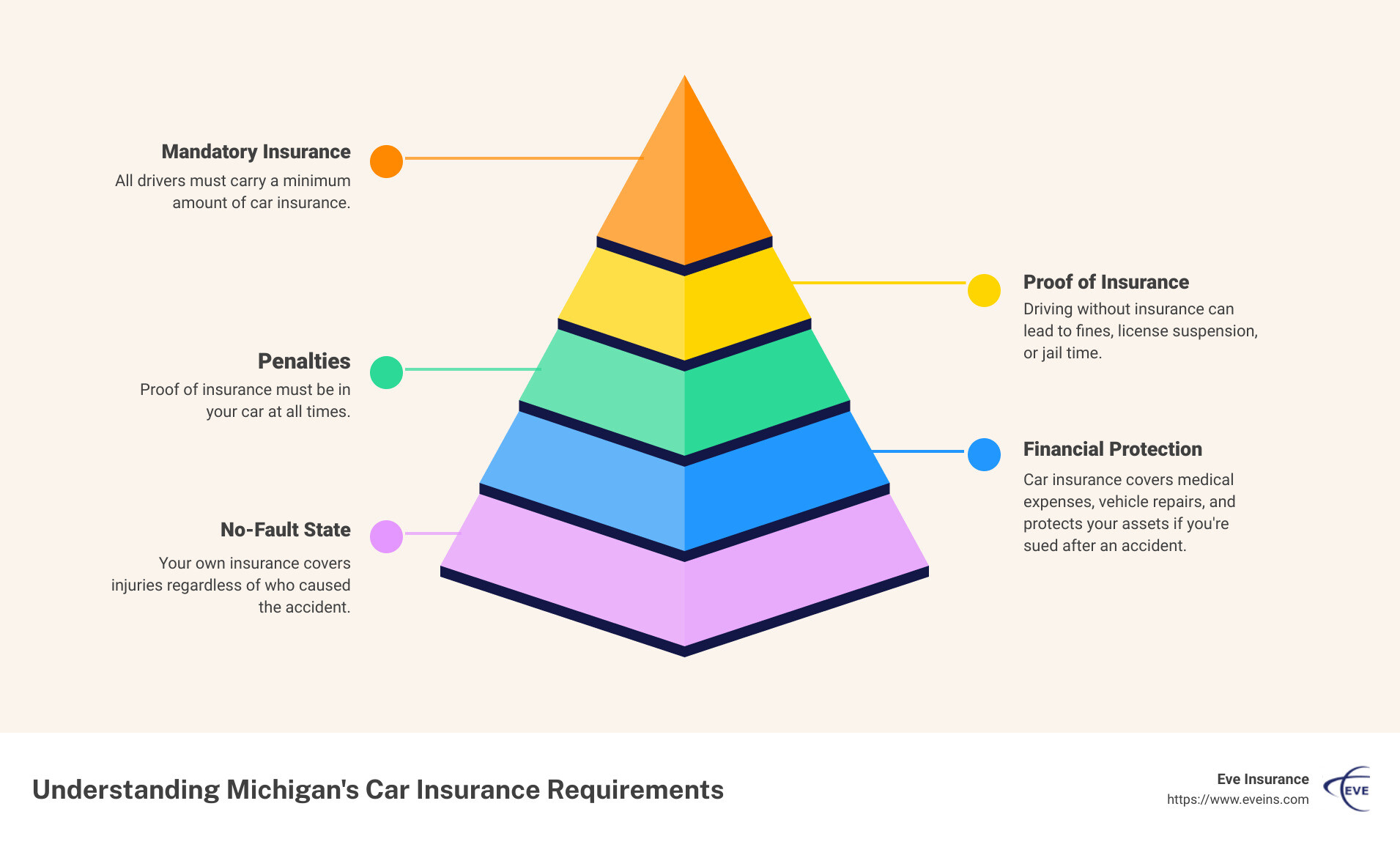
The Michigan auto insurance 500000 option allows drivers to select $500,000 in Personal Injury Protection (PIP) medical coverage, providing a balanced middle-tier choice between state minimums and unlimited lifetime medical benefits. This selection directly affects premium costs, catastrophic injury protection, and how health insurance coordinates with auto policies in the state of Michigan.
The Evolution of Michigan Auto Insurance and PIP Coverage
Michigan’s auto insurance landscape underwent a sweeping transformation following major legislative reforms enacted under Public Act 21 and Public Act 22 of 2019, which took full effect in July 2020. Before these reforms, Michigan was entirely unique in the United States for requiring every registered vehicle owner to purchase unlimited, lifetime Personal Injury Protection (PIP) medical benefits. While this guaranteed comprehensive lifetime care for catastrophic accident victims, it also drove Michigan's average insurance premiums to some of the highest in the nation.
To address affordability concerns, the legislature introduced a tiered structure for PIP medical coverage limits. Instead of a one-size-fits-all mandate for unlimited benefits, drivers gained the ability to choose from several coverage tiers based on their personal financial situation, health insurance coverage, and risk tolerance. Among these choices, the $500,000 PIP option emerged as a popular middle-ground solution. It offers substantial financial protection for severe accidents while avoiding the maximum cost associated with unlimited lifetime medical coverage.
Understanding how this option functions requires a close look at the mechanics of Michigan's no-fault system. Even with the introduction of coverage caps, Michigan remains a compulsory no-fault state. This means that regardless of who causes a car accident, each driver's own auto insurance company pays for their medical expenses, lost wages, and replacement services up to the selected policy limit. Choosing the $500,000 option places a strict ceiling on the medical benefits your insurer will pay out per person, per accident, changing your financial exposure if you sustain catastrophic injuries.
Detailed Breakdown of the Michigan Auto Insurance 500000 Option
Selecting the $500,000 PIP limit means your insurer will cover up to $500,000 in allowable expenses for medical care, rehabilitation, specialized nursing, and other medical-related services arising from a covered motor vehicle crash. However, navigating this coverage requires understanding what happens when medical costs exceed that half-million-dollar threshold.
Once medical expenses cross the $500,000 mark, the auto insurance policy is exhausted for that individual claim. At that juncture, the financial responsibility shifts. If the injured person has private health insurance, Medicaid, or Medicare, those secondary payers may be required to pick up subsequent medical bills, subject to their own terms, deductibles, and network restrictions. If no secondary health coverage is available, the injured party or their estate may become personally responsible for ongoing medical bills, potentially leading to significant financial distress or legal complications.
It is also important to separate PIP medical benefits from other mandatory components of a Michigan auto insurance policy:
- PIP Work Loss and Replacement Services: These are subject to statutory limits and monthly maximums distinct from the medical benefit cap.
- Property Protection Insurance (PPI): Covers up to $1 million for damage your vehicle causes to other people's tangible property, such as buildings, fences, and improperly parked cars in Michigan.
- Residual Bodily Injury and Property Damage Liability: Protects you if you are sued for causing death, disfigurement, or serious impairment of body function in an accident, or property damage outside of Michigan.
Coordination of Benefits Under the $500,000 Limit
One of the most effective ways to manage the cost of the $500,000 option is through the "coordination of benefits" (COB). Drivers can choose to coordinate their auto PIP coverage with a qualified health plan—typically an employer-sponsored group health plan or individual health insurance policy.
When you coordinate your PIP coverage, your health insurance acts as the primary payer for auto accident-related injuries, and your auto insurance steps in as the secondary payer to cover deductibles, co-pays, and services not covered by your health plan, all up to your $500,000 limit. To qualify for coordination, your health plan must either cover auto accident injuries completely or not exclude them explicitly, and it must have an individual deductible below a specific statutory threshold determined by the Michigan Department of Insurance and Financial Services (DIFS).

Comparing Michigan PIP Coverage Options
To understand the context of the $500,000 option, it must be evaluated alongside the other statutory PIP tiers available to Michigan drivers. The table below outlines the primary choices, target audiences, and financial implications of each tier.
| PIP Option Tier | Description & Benefit Limit | Primary Target Audience | Risk Profile & Considerations |
|---|---|---|---|
| Unlimited | Lifetime medical benefits with no monetary cap per person, per accident. | Drivers without comprehensive health insurance or those seeking maximum safety against catastrophic care costs. | Highest premium cost; provides absolute financial security for long-term rehabilitation and medical care. |
| $500,000 Option | Up to $500,000 in medical benefits per person, per accident. | Homeowners, middle-income families, and drivers seeking substantial protection without paying for unlimited coverage. | Moderate premium savings; requires careful evaluation of secondary health insurance to cover costs exceeding $500k. |
| $250,000 Option | Up to $250,000 in medical benefits per person, per accident. | Cost-conscious drivers with robust private health insurance that covers auto accidents. | Significant premium reduction; higher exposure to out-of-pocket costs if medical bills escalate rapidly. |
| $250,000 with Exclusion | $250,000 limit, with the option for certain named insureds or household members to opt out entirely if they have Medicare or Medicaid. | Retirees on Medicare or individuals with qualifying Medicaid coverage. | Substantial premium savings; completely eliminates PIP medical coverage for opted-out individuals, relying entirely on government programs. |
| $50,000 Option | Restricted strictly to drivers enrolled in Medicaid, capping medical benefits at $50,000. | Low-income drivers qualifying for state Medicaid assistance. | Lowest PIP premium option; strictly limited to Medicaid recipients with minimal coverage margins. |
Financial Impact and Premium Savings
The primary motivator for selecting the $500,000 option instead of unlimited coverage is premium reduction. Under Michigan law, insurance companies are required to pass on specific statewide average savings for PIP medical charges depending on the tier chosen. While savings vary by insurance provider, driving record, vehicle type, and geographic territory (such as Wayne County versus rural northern Michigan), moving from unlimited coverage to the $500,000 tier generally yields a noticeable decrease in the PIP premium portion of the bill.
However, consumers must analyze the trade-off between immediate premium savings and long-term financial exposure. Medical care for severe traumatic brain injuries, spinal cord damage, or prolonged ICU stays can easily surpass $500,000 within the first few weeks or months of treatment. According to healthcare industry data, the cost of specialized rehabilitation facilities and 24/7 attendant care can accumulate rapidly. Therefore, saving a few hundred dollars annually on insurance premiums must be weighed against the risk of exhausting a $500,000 policy cap in a major collision.
Furthermore, drivers should review the Michigan Catastrophic Claims Association (MCCA) assessment fee. The MCCA fee is a per-vehicle charge assessed annually to reimburse insurers for the cost of long-term care for individuals catastrophically injured in auto accidents. While vehicles with unlimited PIP pay the full MCCA assessment, vehicles with the $500,000 option or lower tiers pay a reduced or zero MCCA fee, further reducing the overall policy cost.
Prerequisites and Eligibility for the $500,000 Option
Any licensed vehicle owner in Michigan registering a private passenger automobile, motorcycle, or truck is generally eligible to select the $500,000 PIP option. There are no specialized government approvals required to select this tier, unlike the Medicaid-specific $50,000 or fully excluded options.
However, before making the selection, policyholders must complete several practical verification steps:
- Audit Existing Health Coverage: Examine current health insurance policies to confirm whether auto accident injuries are covered. Some health plans contain exclusions for motor vehicle accidents, leaving policyholders entirely dependent on their auto PIP coverage.
- Evaluate Out-of-Pocket Limits: Review health insurance deductibles, co-insurance percentages, and out-of-pocket maximums to determine how much financial liability would remain if an accident occurred.
- Assess Household Member Policies: Ensure that all family members or regular drivers residing in the household are accounted for. If a household member lacks independent health insurance, selecting a capped option like $500,000 without coordination requires ensuring the auto policy itself can absorb potential claims without leaving dependents unprotected.
Common Mistakes and Risks When Choosing PIP Limits
Selecting the $500,000 PIP option without a comprehensive risk assessment can lead to unexpected financial liabilities. Many drivers make critical errors during the policy selection process.
One common mistake is assuming that health insurance will automatically cover all accident-related costs once the $500,000 auto limit is exhausted. Many private health insurance policies, employer-sponsored ERISA plans, and managed care organizations have strict limitations on rehabilitation therapy, durable medical equipment, and long-term home health aide services. If health insurance refuses to pay for specific long-term care services required after a crash, the injured party must pay out of pocket.
Another frequent error is failing to update coverage selections when employment or health insurance changes. If a driver selects the $500,000 option and coordinates it with an employer-provided health plan, but later changes jobs or transitions to a high-deductible health plan that excludes auto accidents, the underlying assumptions of the insurance contract are invalidated. This can create coverage gaps during a claim dispute.
Finally, drivers often underestimate the legal implications of being underinsured. If a driver causes an accident and the injured parties' medical expenses exceed available coverage limits, the at-fault driver may face aggressive subrogation lawsuits from insurance companies seeking to recover payouts.
Frequently Asked Questions
What happens if my medical bills exceed the $500,000 Michigan auto insurance limit?
Once your $500,000 PIP medical limit is exhausted, your secondary health insurance plan (if you have one that covers auto accidents) may begin paying for subsequent medical care according to its terms. If you do not have health insurance or if your health plan excludes auto accidents, you or your estate may be held personally liable for remaining medical bills and care costs.
Can I change my $500,000 PIP option to another limit during my policy term?
Generally, you can modify your PIP coverage limits at any time by contacting your insurance agent or carrier, though changes typically take effect upon policy renewal or endorsement processing. Insurers require signed form disclosures acknowledging the risks and statutory impacts of changing PIP selections.
Does the $500,000 option apply per person or per accident?
In Michigan, PIP medical benefit limits apply on a per-person, per-accident basis. This means that if multiple people are injured in the same vehicle crash, each insured individual has access to up to $500,000 in medical benefits under the policy, rather than the total pool of $500,000 being shared among all occupants.
How does Medicare or Medicaid interact with the $500,000 PIP option?
Medicare and Medicaid have complex federal and state coordination rules regarding auto insurance. While Medicare can pay secondary to auto insurance after PIP limits are exhausted, Medicaid recipients must meet specific low-income criteria to access lower PIP tiers like the $50,000 option or full exclusions. Drivers on Medicare or Medicaid should consult DIFS guidelines or a licensed insurance professional before selecting a capped PIP tier.
Is the MCCA fee eliminated if I choose the $500,000 option?
The Michigan Catastrophic Claims Association assessment is adjusted based on the PIP tier selected. While vehicles with unlimited PIP pay the standard MCCA assessment fee per vehicle, vehicles with the $500,000 option pay a lower assessment fee, reflecting the reduced exposure of the catastrophic fund for those policies.
Practical Next Actions for Michigan Drivers
Choosing the right auto insurance structure requires balancing monthly premium savings against long-term financial security. If you are considering the Michigan auto insurance 500,000 option, follow these practical steps to finalize your decision safely:
- Request Written Confirmation from Health Providers: Contact your health insurance provider or human resources department to obtain written confirmation regarding how your health plan handles motor vehicle accident injuries and whether it coordinates with auto insurance.
- Compare Multiple Quotes: Obtain localized insurance quotes from multiple licensed carriers comparing the price difference between unlimited, $500,000, and $250,000 options to verify the actual premium savings in your rating territory.
- Consult an Independent Insurance Agent: Speak with an experienced, licensed insurance producer in Michigan who can review your household's unique asset protection needs, liability coverage limits (such as bodily injury and umbrella policies), and specific risk exposures before executing your policy change form.
Image Gallery
Select an image to open it in a new tab.

Vivian Cho
Executive IT and Emerging Technologies Reporter
