
Financial planning for high net worth individuals (HNWIs) at a CPA firm integrates sophisticated tax strategy with long-term wealth management. By leveraging the technical expertise of Certified Public Accountants, these firms provide holistic oversight of estate planning, investment tax-efficiency, risk management, and philanthropic goals, ensuring every financial decision is optimized for the client’s total tax liability and multi-generational legacy.
In 2026, the financial landscape for affluent families and business owners has become increasingly complex. With the sunsetting of various provisions from the Tax Cuts and Jobs Act (TCJA) and the evolution of global reporting standards, the traditional "siloed" approach to wealth management—where an investment advisor and an accountant rarely speak—is no longer sufficient. High net worth individuals now prioritize a "tax-first" lens for their portfolios, which is the primary reason for the rise of CPA-led wealth management practices.
The Intersection of Tax Strategy and Wealth Management
The fundamental advantage of seeking financial planning at a CPA firm is the inherent focus on tax alpha. While a traditional broker focuses primarily on market returns, a CPA-led advisor looks at "net-of-tax" returns. For an individual in the highest federal and state tax brackets, a 10% gross return can easily dwindle to 6% or less after taxes if the portfolio is not managed with extreme care.
CPA firms that offer wealth management services often employ advisors who hold the Personal Financial Specialist (PFS) credential. This is an exclusive designation for CPAs that requires extensive experience and education in all areas of financial planning. In 2026, the PFS credential is widely recognized as the gold standard for HNWIs because it combines the rigorous ethical standards of the accounting profession with the technical depth of comprehensive wealth advisory.
The Holistic View of the Balance Sheet
Unlike a bank that may only see the assets under their direct management, a CPA firm typically has a view of the client's entire financial life. This includes:
- Closely held business interests and K-1 distributions.
- Real estate holdings and depreciation schedules.
- Foreign bank accounts and cross-border tax obligations (FBAR and FATCA).
- Complex compensation packages, including Restricted Stock Units (RSUs) and Incentive Stock Options (ISOs).
By housing these details under one roof, the CPA firm can execute "location optimization"—placing tax-inefficient assets (like high-yield bonds) in tax-deferred accounts while keeping tax-efficient assets (like index funds or municipal bonds) in taxable accounts.
Key Pillars of HNWI Financial Planning in 2026
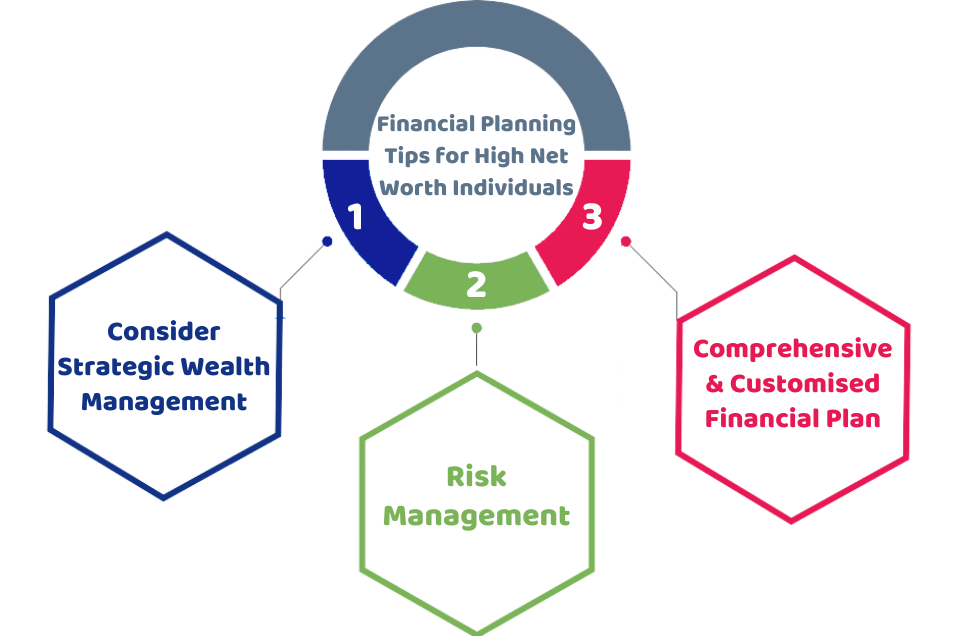
Effective wealth management for the affluent requires a multi-dimensional strategy. In the current 2026 fiscal environment, four pillars stand out as critical for capital preservation and growth.
1. Advanced Estate Planning and Wealth Transfer
As of 2026, many of the record-high estate and gift tax exemptions seen in the early 2020s have adjusted. For HNWIs, this has triggered a renewed focus on irrevocable trusts and sophisticated transfer techniques. CPA firms play a vital role here by modeling the future tax impact of different trust structures.
Common strategies include:
- Spousal Lifetime Access Trusts (SLATs): Allowing one spouse to benefit from assets while removing them from the taxable estate.
- Grantor Retained Annuity Trusts (GRATs): Transferring the appreciation of assets to heirs with minimal gift tax consequences.
- Charitable Remainder Trusts (CRTs): Providing an income stream to the donor while eventually benefiting a chosen charity, offering significant immediate tax deductions.
2. Tax-Efficient Investment Management
In 2026, volatility remains a constant in global markets. A CPA-led firm manages this volatility through automated tax-loss harvesting. This process involves selling securities at a loss to offset capital gains, a move that requires precise tracking to avoid "wash sale" violations. Furthermore, CPAs ensure that the timing of asset sales aligns with the client’s broader income year to prevent pushing the individual into a higher tax bracket or triggering the Net Investment Income Tax (NIIT).
3. Risk Management and Asset Protection
For HNWIs, wealth management is as much about protection as it is about growth. CPA firms evaluate a client’s exposure to litigation, creditors, and unforeseen life events. This involves auditing umbrella insurance policies, evaluating the structure of Limited Liability Companies (LLCs) for rental properties, and ensuring that life insurance is held within an Irrevocable Life Insurance Trust (ILIT) to keep death benefits out of the taxable estate.
4. Philanthropic and Legacy Planning
Many HNWIs wish to leave a mark beyond their family. CPAs help facilitate this through the setup and administration of Donor-Advised Funds (DAFs) or private foundations. In 2026, DAFs have become particularly popular because they allow for an immediate tax deduction while the actual charitable distributions can occur over many years. A CPA ensures that the most tax-advantaged assets—typically highly appreciated long-term securities—are the ones donated, rather than cash.

Navigating the 2026 Regulatory and Tax Landscape
The year 2026 marks a significant turning point in tax history. With many provisions of the 2017 tax reforms having expired or reverted at the end of 2025, HNWIs are facing a "new normal" in tax rates and deduction limits. CPA firms are currently at the forefront of helping clients navigate:
- Reverted Income Tax Brackets: Preparing for the return of higher individual top rates.
- The Expiration of the Qualified Business Income (QBI) Deduction: For business owners, this requires a total re-evaluation of entity structures (e.g., switching from an S-Corp to a C-Corp or vice versa).
- State and Local Tax (SALT) Changes: As federal caps on SALT deductions have evolved, CPAs are utilizing "workaround" strategies like Pass-Through Entity (PTE) elective taxes to help clients maximize their deductions.
Comparing CPA-Led Firms vs. Traditional Wealth Management
It is important for HNWIs to understand the structural differences between these two types of providers.
| Feature | CPA-Led Wealth Management | Traditional Broker / Investment Bank |
|---|---|---|
| Primary Focus | Tax efficiency and holistic balance sheet | Investment performance and asset allocation |
| Fiduciary Duty | Always a Fiduciary (Legal obligation to client) | May be Fiduciary or "Suitability" standard |
| Fee Structure | Often flat fee, hourly, or AUM-based | Usually based on Assets Under Management (AUM) |
| Tax Integration | Tax planning and prep integrated into strategy | Tax planning often outsourced or secondary |
| Credentialing | CPA, PFS, CFP® | Series 7, Series 66, CFP® |
| Business Advice | Deep expertise in business exit/succession | Limited to personal liquid wealth |
Succession Planning for High-Net-Worth Business Owners
For many HNWIs, the bulk of their wealth is tied up in a closely held business. A CPA firm is uniquely qualified to handle succession planning because they have likely managed the company’s books for years.
By 2026, the complexity of exiting a business has increased due to stricter valuation rules by the IRS. A CPA-led team helps the owner through:
- Valuation Analysis: Determining a "defensible" fair market value for the IRS and potential buyers.
- Buy-Sell Agreements: Structuring agreements between partners to ensure a smooth transition in the event of death or disability.
- Exit Strategy Tax Modeling: Comparing the net-proceeds of an asset sale versus a stock sale, and utilizing Section 1202 (Qualified Small Business Stock) exclusions where applicable.
Common Mistakes HNWIs Make Without Integrated CPA Oversight
Even the most successful individuals can fall into traps when their financial planning is fragmented. Without the technical oversight of a CPA, HNWIs often suffer from:
- Phantom Income: Paying taxes on mutual fund distributions even when the fund's overall value has decreased.
- Incorrect Asset Titling: Holding assets in personal names rather than in trusts or LLCs, leading to probate delays and estate tax exposure.
- Missing RMDs: Failing to properly calculate Required Minimum Distributions from inherited IRAs, which in 2026 carries heavy penalties.
- Incoherent Gifting: Giving cash to heirs when gifting appreciated stock would have wiped out the capital gains tax for the entire family unit.
Selecting the Right CPA Firm for Your Wealth Management
Not every CPA firm is equipped to handle high-level financial planning. When evaluating a firm in 2026, HNWIs should ask the following questions:
- Do you have an in-house wealth management division, or do you refer out? In-house integration is usually superior for data sharing and strategy alignment.
- What percentage of your clients are HNWIs? The needs of a family with $20 million in assets are vastly different from those of a small business with $500,000 in revenue.
- Are you a "Fee-Only" advisor? This ensures the advisor is not receiving commissions for selling specific financial products, reducing conflicts of interest.
- How do you coordinate with my estate attorney? A high-quality CPA firm will act as the "quarterback," ensuring that the tax strategy discussed in their office is legally codified in the attorney's documents.
Frequently Asked Questions
What is the difference between a CPA and a PFS?
A CPA (Certified Public Accountant) is licensed to perform accounting and tax services. A PFS (Personal Financial Specialist) is a CPA who has met additional requirements for education, experience, and testing specifically in the realm of financial planning. Think of a PFS as a CPA who is also a high-level wealth manager.
Why is 2026 such a critical year for financial planning?
Many tax laws established in 2017 were designed to "sunset" after December 31, 2025. This means that 2026 is the first year where many individuals see higher tax rates and lower estate tax exemptions. Proactive planning at a CPA firm is necessary to mitigate these "automatic" tax increases.
Does a CPA firm manage my actual investments (stocks/bonds)?
Many modern CPA firms have a Registered Investment Advisor (RIA) arm that manages portfolios directly. They use the same institutional-grade platforms as large banks but apply a much higher level of tax scrutiny to every trade.
How much does it cost to have a CPA firm handle wealth management?
Costs vary based on the complexity of the estate. Most firms charge a percentage of assets under management (typically 0.50% to 1.25%), while some offer "Family Office" services for a fixed annual retainer that covers both tax preparation and wealth advisory.
Can a CPA firm help with international assets?
Yes, and this is a major reason HNWIs choose them. CPA firms specializing in wealth management are often well-versed in the reporting requirements for foreign trusts, offshore corporations, and non-resident alien beneficiaries, which are high-audit-risk areas for the IRS.
Is it better to have a separate accountant and financial advisor?
While you can have separate professionals, it requires you to be the "middleman" for all data. In an integrated CPA firm, the tax team and the investment team share a single database, allowing them to spot tax-saving opportunities—like a mid-year tax loss—instantly rather than waiting until the following April.
Practical Recommendation: Next Actions for HNWIs
If your current net worth exceeds $5 million, your first step should be a comprehensive tax and estate audit. Contact a CPA firm with a dedicated wealth management or "Family Office" division. Request a "Gap Analysis" to identify where your current investment strategy may be creating unnecessary tax friction.
By the end of 2026, the window for many legacy planning techniques may be tighter than in previous decades. Engaging a professional who views your portfolio through the dual lens of growth and tax compliance is the most effective way to ensure your wealth remains intact for future generations.
Image Gallery
Select an image to open it in a new tab.




Simon Caldwell
Enterprise Technology and Systems Editor
