
Buying a curved TV involves prioritizing immersion and aesthetic appeal over standard flat-panel displays. The primary advantage of a curved screen is its ability to reduce perceived image distortion at the edges of large displays and potentially increase the viewer's field of view. While popularity has fluctuated since their introduction, they remain a specific choice for dedicated home theater setups and immersive gaming environments.
Understanding the Curved Display Technology
The fundamental premise of a curved television is based on the anatomy of the human eye and how we process visual information. A flat screen requires the human eye to adjust focus slightly as it moves from the center to the edges of the display, because the distance between the eye and the screen surface is not uniform.
A curved display is engineered to be equidistant from the viewer's eyes at any given point along the horizontal axis, assuming the viewer is positioned at the "sweet spot" of the arc. This uniform distance reduces the burden on the ocular muscles to compensate for distance changes. Proponents argue that this makes for a more natural viewing experience, particularly for individuals who are sensitive to peripheral image distortion or who prefer a more enveloping visual field.
When you sit in front of a high-quality curved television, the display effectively wraps around your peripheral vision. This design choice mimics the experience of an IMAX theater screen, which is also curved to ensure that the image remains sharp and consistent for all audience members, though home curved TVs are specifically optimized for a single primary viewer or a very small group.
The Case for Immersion and Depth Perception
One of the most frequently cited benefits of a curved television is the enhanced sense of depth. Because the edges of the screen are angled toward the viewer, the image creates a subtle 3D-like effect, even when viewing standard 2D content. This occurs because the curve emphasizes the foreground-to-background relationship within the composition of the video.
For cinema enthusiasts and gamers, this creates an increased sense of "being inside" the content. In high-definition gaming, for instance, a curved screen can make wide-angle environments feel more expansive. The curvature helps to diminish the presence of the room around you, allowing the screen to dominate your field of view more effectively than a flat panel of the same size.
However, it is vital to understand that this effect is highly dependent on seating distance and room lighting. The benefit is most pronounced when the user sits within the optimal curvature radius—often measured by a number like "1800R" or "1000R." The "R" stands for the radius of the circle the curve would form if it were a full loop; a 1000R curve is more pronounced than an 1800R curve.
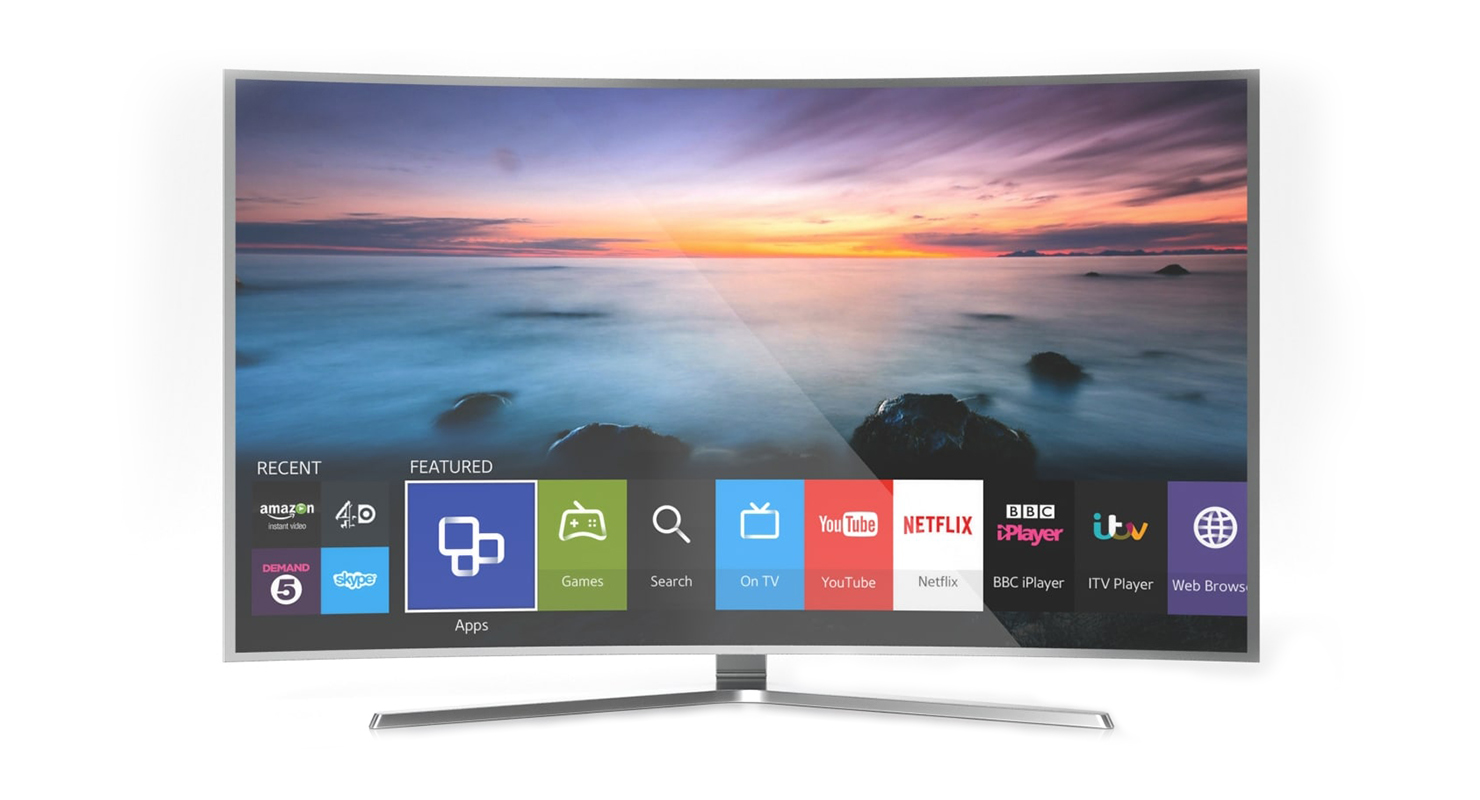
Technical Considerations: Seating and Geometry
Choosing a curved TV is not just a matter of design preference; it is a commitment to a specific viewing geometry. Unlike a flat TV, which offers a relatively uniform viewing experience from various angles across the couch, a curved TV has a narrow "sweet spot."
The Seating Sweet Spot
The further you move away from the center of the arc, the more distorted the image becomes. If you have a wide seating arrangement where people are sitting on the far ends of a large sofa, those individuals may experience an asymmetrical image where one side appears slightly stretched or compressed compared to the other.
Room Lighting and Glare
One of the most significant challenges with curved displays is how they interact with ambient light. Because the screen is shaped like a concave mirror, it tends to capture and focus light sources—such as lamps or windows—differently than a flat screen. While a flat screen might have a single, diffuse glare patch, a curved screen can streak light across a larger portion of the display, potentially obscuring more content. Owners of curved TVs often find that they must be more meticulous about controlling their room lighting, perhaps utilizing blackout curtains or shifting lamps to prevent distracting reflections.
Comparison: Curved TVs vs. Flat Panels
When determining whether to invest in a curved display, it is helpful to contrast them directly with their flat-panel counterparts. The following table highlights the operational trade-offs for a typical home environment.
| Feature | Curved TV | Flat TV |
|---|---|---|
| Immersion | High; wraps around peripheral vision | Standard; requires larger size for immersion |
| Viewing Angles | Restricted to the center sweet spot | Wide; consistent across the room |
| Wall Mounting | Difficult; visually protrudes from wall | Seamless; sits flush against the wall |
| Glare Handling | Susceptible to elongated reflections | Standard; easier to manage light placement |
| Aesthetics | Unique, modern, and prominent | Minimalist and versatile |
| Cost Efficiency | Often higher due to specialized manufacturing | Generally more cost-effective per inch |
Who Should Buy a Curved TV?
A curved TV is not a "one size fits all" upgrade. It is a niche product designed for specific use cases.
- The Solo Gamer: If you have a dedicated gaming setup where you sit at a desk or a single chair roughly 4–6 feet from the screen, a curved display—particularly an ultra-wide monitor or smaller television—is a significant upgrade. It provides a level of engagement that flat screens simply cannot replicate.
- The Movie Buff: For someone who has a dedicated home theater seat placed at the perfect distance from the screen, the curved display offers a professional, cinematic feel that is distinct from standard living room televisions.
- The Design Enthusiast: If your living space is designed with a modern or futuristic aesthetic, a curved television acts as a statement piece of technology that breaks the monotony of rigid, straight lines in a room.
Conversely, if your primary usage involves a large family gathering for sports or movies, where viewers are spread out across a large couch or multiple rows of seating, a flat-panel display is almost certainly the superior choice for consistent quality for all viewers.
Common Challenges and Troubleshooting
Transitioning to a curved screen requires minor adjustments to your home media strategy.
Wall Mounting Issues
Mounting a curved TV is structurally similar to mounting a flat one, but aesthetically, it is different. The edges of the TV will sit further away from the wall than the center. This creates a gap that some users find visually jarring. You must ensure that your mount is compatible with the specific depth of your TV's curve. Some specialized mounts are designed to accommodate this profile, but standard VESA-compliant mounts will work as long as the hardware accounts for the protruding shape.
Addressing Reflections
If you notice light streaks on your display, do not attempt to solve it by moving the TV. Instead, relocate the light source. Because the curvature is a fixed geometry, the reflection is a product of the angle between the light, the screen, and your eyes. Small, adjustable LED lamps are often better for rooms with curved TVs than large, overhead fixtures that spread light across the entire room.
Image Calibration
Calibration for a curved TV follows the same principles as a flat screen, but ensure that your calibration pattern tests are performed from the exact seat where you plan to watch the most. If you calibrate from a standing position, you will not be accurately adjusting for the way the curve affects color and contrast when viewed from a seated perspective.
Frequently Asked Questions (FAQ)
Is a curved TV better for my eyes?
There is no medical consensus that curved TVs are objectively "better" for ocular health. They do reduce the effort required for the eye to refocus when scanning across a very large screen, but for standard 55-inch or 65-inch models, the benefit is largely experiential rather than physiological.
Do curved TVs have better picture quality?
No. The curvature of the panel is an ergonomic and aesthetic choice; it does not inherently improve the resolution, color accuracy, or brightness of the display technology (such as OLED or LED) being used. You are buying the curve for the viewing experience, not for higher technical specs.
Why are curved TVs less common now than they were a few years ago?
The market shifted because manufacturers realized that the benefits of curvature are only realized under specific conditions. As consumers moved toward larger, thinner flat-panel wall-mounted designs, the curved aesthetic became less practical for the average living room, leading to a focus on flat, bezel-less designs.
Can I mount a curved TV like a regular TV?
Yes, you can. Most modern curved TVs utilize standard VESA mounting patterns. However, you should check the mounting bracket's depth, as you will need spacers to ensure the bracket sits securely against the curved back of the television.
Is the curve distracting during fast-paced action?
For a single viewer in the sweet spot, the curve actually makes fast-paced action feel more stable and contained. If you are sitting off-center, the distortion caused by the curve might make fast-moving objects appear to "warp" slightly, which some viewers find distracting.
Final Recommendation: Making Your Decision
Before purchasing a curved television, determine your primary use case. If your viewing habits are solitary and you prioritize immersive experiences, such as cinematic storytelling or high-fidelity gaming, the curved format is an excellent choice that justifies the premium and the specific seating requirements.
If your household usage is communal, or if your living room is filled with bright, uncontrollable ambient light, you will likely find the limitations of a curved display—specifically the restricted viewing angles and reflection issues—more frustrating than the immersive benefits. For most families, a high-quality, high-refresh-rate flat-panel display remains the most reliable and versatile investment.
Image Gallery
Select an image to open it in a new tab.
Celine Dubois
Contemporary Living and Global Arts Columnist
