Why Osmosis and Diffusion Matter for Life: The Fundamental Mechanics of Survival
Osmosis and diffusion are the essential passive transport mechanisms that allow cells to exchange gases, absorb nutrients, and eliminate waste without consuming cellular energy. By moving substances down concentration gradients, these processes maintain the chemical balance, known as homeostasis, required for every biological function ranging from cellular respiration to the structural integrity of plants.
The Thermodynamic Foundation of Passive Transport
To understand why osmosis and diffusion matter for life in 2026, one must first look at the underlying physics that governs molecular movement. All matter is composed of particles in constant, random motion, a phenomenon known as Brownian motion. In a biological system, this kinetic energy drives the movement of molecules from areas of high concentration to areas of low concentration.
This movement is categorized as passive transport because it requires no input of metabolic energy (ATP) from the cell. Instead, it relies on the second law of thermodynamics: systems tend toward a state of equilibrium or maximum entropy. For a living organism, the ability to move vital substances like oxygen or water "for free" is a massive evolutionary advantage, allowing the organism to reserve its energy for complex tasks like movement, reproduction, and repair.
The Role of the Concentration Gradient
The concentration gradient is the physical difference in the density of a substance between two regions. In diffusion, molecules move "down" this gradient. The steepness of the gradient—how great the difference is between the two areas—directly dictates the rate of movement. Life has evolved numerous ways to maintain these gradients to ensure that diffusion never stops. For example, as soon as oxygen enters a cell, it is often used up in mitochondria, keeping the internal oxygen concentration low and ensuring that more oxygen continues to diffuse inward from the bloodstream.
Diffusion: The Universal Molecular Leveler
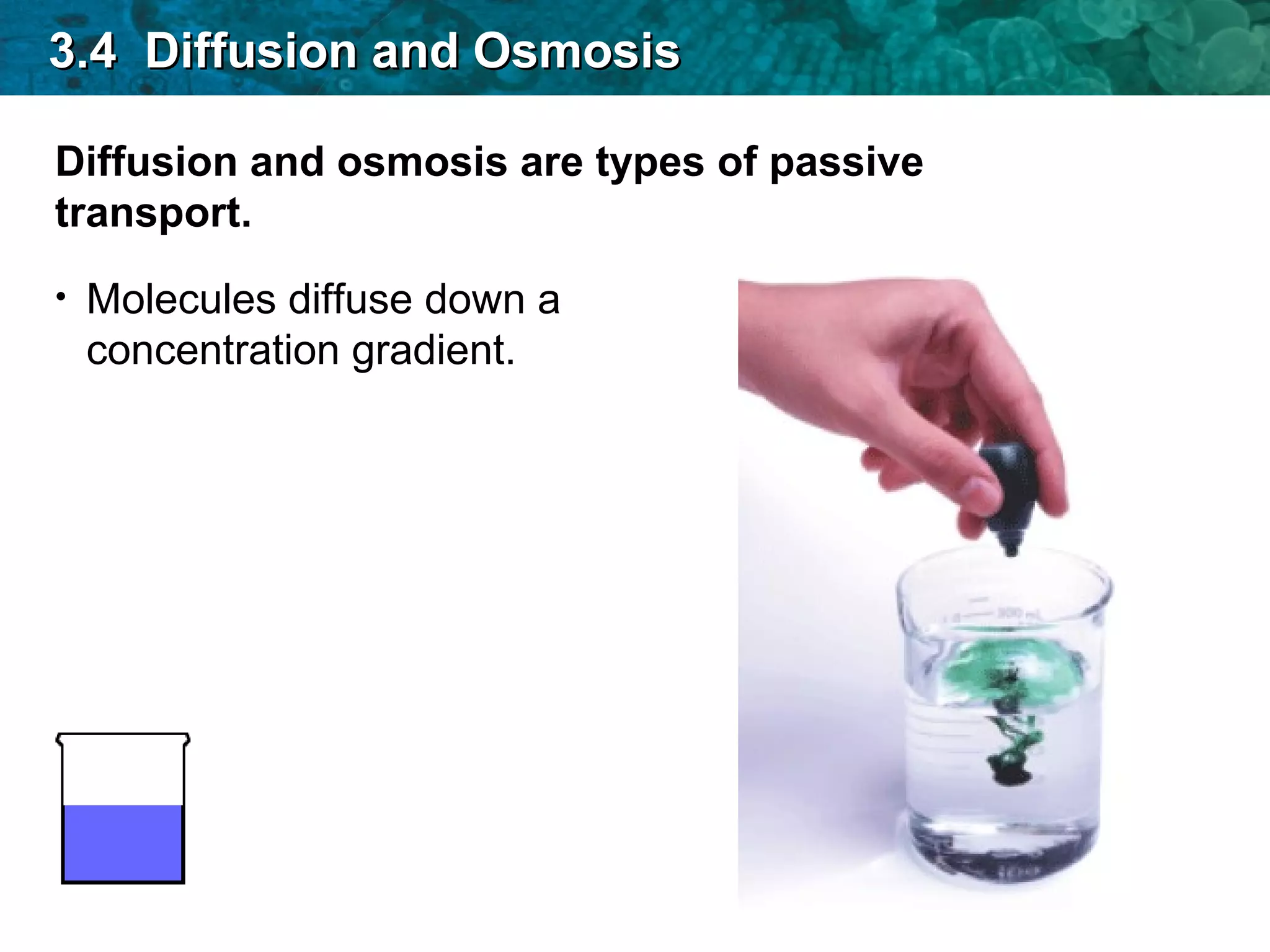
Diffusion is the net movement of particles from a region of higher concentration to a region of lower concentration. While it sounds simple, it is the primary method by which single-celled organisms interact with their environment and the fundamental process behind gas exchange in complex animals.
Gas Exchange in Respiratory Systems
In humans and other mammals, diffusion is the only reason we can breathe. When we inhale, the concentration of oxygen in the tiny air sacs of the lungs (alveoli) is higher than the concentration of oxygen in the blood circulating through the adjacent capillaries. Oxygen molecules naturally diffuse across the thin alveolar and capillary membranes into the blood.
Simultaneously, carbon dioxide, a waste product of cellular metabolism, exists in a higher concentration in the blood than in the lungs. It diffuses in the opposite direction, moving from the blood into the alveoli to be exhaled. If diffusion were to fail—due to fluid buildup in the lungs or membrane scarring—the body would be unable to oxygenate tissues, leading to rapid systemic failure.
Nutrient Absorption and Waste Removal
Diffusion also plays a critical role in the digestive system. Once food is broken down into glucose, amino acids, and fatty acids, these small molecules must enter the bloodstream. While some nutrients require active transport, many move via facilitated diffusion. In this process, specific carrier proteins or channel proteins in the cell membrane act as "gates" that allow larger or polar molecules to pass through the lipid bilayer following their concentration gradient.
On a microscopic level, every cell in the body uses simple diffusion to shed metabolic byproducts. Ammonia and other small waste molecules diffuse out of the cell into the interstitial fluid and eventually into the circulatory system for filtration by the liver or kidneys. Without this constant "molecular cleaning," cells would quickly become toxic environments.
Osmosis: The Selective Flow of Water
Osmosis is a specific type of diffusion: it is the movement of water molecules across a selectively permeable membrane. In biological systems, the "solute" (such as salt or sugar) cannot always pass through the cell membrane, but the "solvent" (water) can. Water moves from a region with a low solute concentration (high water potential) to a region with a high solute concentration (low water potential).
Tonicity and Cellular Stability
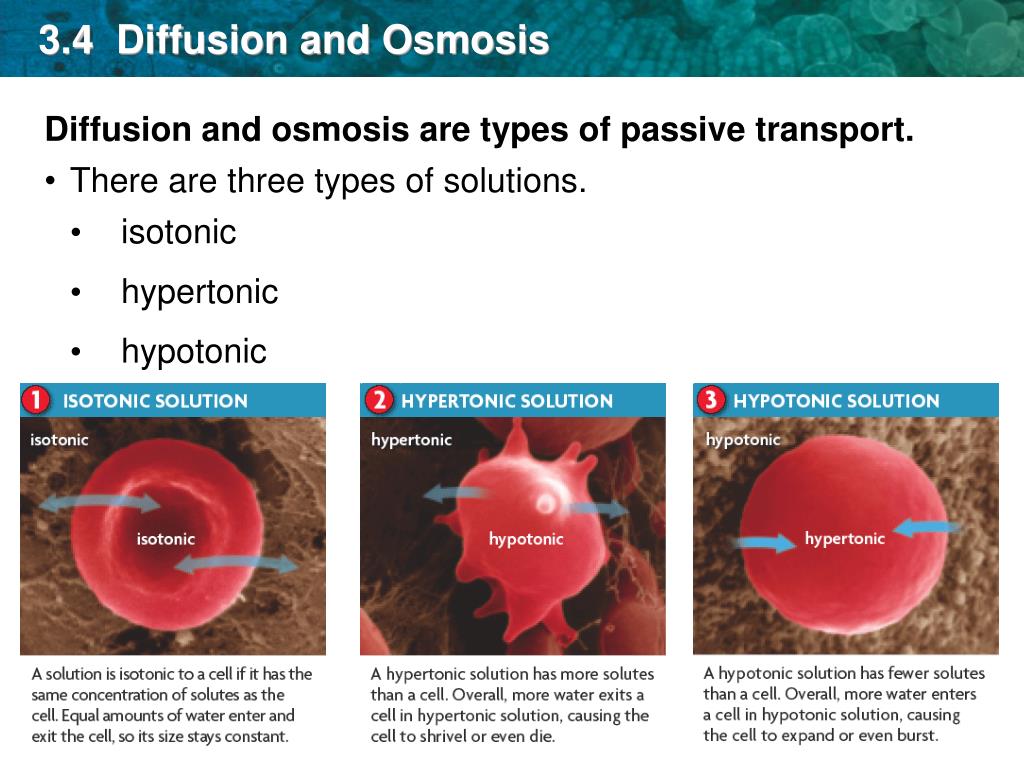
The survival of a cell depends heavily on the tonicity of its environment—the ability of an extracellular solution to make water move into or out of a cell by osmosis.
- Isotonic Environments: The concentration of solutes is equal inside and outside the cell. There is no net movement of water. This is the ideal state for human red blood cells.
- Hypertonic Environments: The external solution has a higher solute concentration than the cell's cytoplasm. Water exits the cell, causing it to shrivel (crenation in animals, plasmolysis in plants).
- Hypotonic Environments: The external solution has a lower solute concentration than the cell. Water rushes into the cell. Animal cells, lacking a rigid cell wall, may swell and eventually burst (lysis).
Osmoregulation in Animals
Complex organisms must actively manage their internal salt and water balance to prevent osmotic shock. The human kidneys are the primary organs of osmoregulation. They filter the blood and use osmotic gradients to reabsorb water back into the body, ensuring we do not dehydrate while producing urine to excrete waste.
In the natural world, fish provide a classic example of osmotic management. Saltwater fish live in a hypertonic environment; they constantly lose water to the sea through their gills and must drink seawater and excrete excess salt to survive. Conversely, freshwater fish live in a hypotonic environment; water constantly rushes into their bodies, so they rarely drink and produce very dilute urine to get rid of the excess water.
Why Plants Depend on Osmosis for Structure
While animal cells prefer isotonic environments, most plant cells thrive in hypotonic environments. This is because plants utilize osmotic pressure to maintain their physical structure.
Turgor Pressure and Growth
When a plant is well-watered, water moves into the cells via osmosis, filling the large central vacuole. The resulting internal pressure, known as turgor pressure, pushes the plasma membrane against the rigid cell wall. This pressure makes the cell "turgid" and keeps the plant upright. Without sufficient water, the cells become flaccid, turgor pressure drops, and the plant wilts.
Osmosis also drives the absorption of water from the soil. Root hair cells maintain a higher concentration of minerals and sugars than the surrounding soil water. This creates an osmotic gradient that pulls water into the roots, which is then transported upward through the xylem to the rest of the plant.
Comparing Diffusion and Osmosis
Understanding the distinctions and similarities between these two processes is vital for grasping biological transport as a whole.
| Feature | Diffusion | Osmosis |
|---|---|---|
| Definition | Movement of any particles from high to low concentration. | Movement of water molecules across a semi-permeable membrane. |
| Substance Moved | Solutes (gases, minerals, small molecules). | Solvent (specifically water). |
| Membrane Required | No (can occur in air or liquid). | Yes (must cross a selectively permeable membrane). |
| Energy Source | Kinetic energy (Passive). | Kinetic energy (Passive). |
| Direction | Down the concentration gradient. | Down the water potential gradient. |
| Biological Example | Oxygen entering the bloodstream. | Water absorption by root hairs. |
Practical Applications and Medical Significance
The principles of osmosis and diffusion are not merely theoretical; they are applied daily in clinical medicine and food science.
- Intravenous (IV) Therapy: Medical professionals must ensure that IV fluids are isotonic to human blood (typically 0.9% saline). If a patient were accidentally given a large volume of pure water (hypotonic) via IV, their red blood cells would undergo lysis, leading to catastrophic internal damage.
- Kidney Dialysis: For patients with renal failure, dialysis machines use the principle of diffusion to clean the blood. Blood is passed through a tube made of a semi-permeable membrane submerged in a dialysis fluid (dialysate). Waste products like urea diffuse from the blood into the dialysate, while essential electrolytes are maintained at proper levels.
- Food Preservation: High concentrations of salt or sugar are used to preserve food (like jerky or jam). These substances create a hypertonic environment that draws water out of bacterial cells via osmosis, dehydrating and killing the microbes that would otherwise cause spoilage.
Factors Influencing the Rate of Transport
Several variables determine how quickly these processes occur. In a living system, these variables are often the difference between health and disease.
- Temperature: Higher temperatures increase the kinetic energy of molecules, leading to faster diffusion. This is why metabolic rates often fluctuate with body temperature.
- Surface Area: The greater the surface area of the membrane, the more molecules can cross at once. This explains why the lungs have millions of alveoli and why the small intestine is lined with villi and microvilli.
- Molecular Size: Smaller molecules diffuse faster than larger, heavier ones. Oxygen (O2) and Carbon Dioxide (CO2) are small enough to pass directly through the lipid bilayer, whereas larger molecules like glucose require protein assistance.
- Distance: Diffusion is efficient only over very short distances. This is why cells are microscopic; if a cell were too large, it would take too long for oxygen to reach the center, and the cell would die.
FAQs
Can osmosis happen without a membrane?
No, the process is specifically defined by the movement of water across a selectively permeable membrane. Without a membrane, the process is simply the diffusion of water within a larger body of liquid. The membrane is essential because it restricts the movement of solutes while allowing the solvent (water) to pass.
What is the difference between simple and facilitated diffusion?
Simple diffusion occurs when small, non-polar molecules (like oxygen) pass directly through the phospholipid bilayer of the cell membrane. Facilitated diffusion is used for larger or charged molecules (like glucose or ions) that cannot pass through the lipid layer; instead, they move through specific protein channels or carriers embedded in the membrane. Both remain passive processes.
Is osmosis a form of active transport?
No, osmosis is a passive transport process. It does not require the cell to expend energy in the form of ATP. The movement of water is driven entirely by the potential energy created by the difference in solute concentrations on either side of the membrane.
How does "water potential" relate to osmosis?
Water potential is a measure of the "free energy" of water in a solution. Pure water has the highest potential. As solutes are added, the water potential decreases. In osmosis, water always moves from an area of higher water potential (fewer solutes) to an area of lower water potential (more solutes).
Why do grocery stores spray vegetables with water?
Grocery stores use a mist of water to create a hypotonic environment outside the vegetables. Through osmosis, water moves into the plant cells, increasing turgor pressure and making the vegetables appear crisp and fresh rather than wilted.
Summary and Next Steps
Osmosis and diffusion are the "invisible hands" that sustain life. They allow for the effortless movement of life-sustaining gases, the regulation of cellular volume, and the structural support of the plant kingdom. Without these passive mechanisms, the energy cost of maintaining basic cellular functions would be prohibitively high, likely preventing the evolution of complex, multicellular life.
For students and professionals looking to apply this knowledge, the next step is to explore membrane physiology and the role of aquaporins—the specialized protein channels that significantly accelerate the rate of osmosis in specific tissues like the kidneys and brain. Understanding the math behind Fick's Laws of Diffusion can also provide deeper insights into how biological systems optimize their geometry for maximum efficiency.
Image Gallery
Select an image to open it in a new tab.


Zara El-Hashem
Sociocultural Dynamics and Academics Writer
