
Identifying an orange and black bird depends primarily on your geographic location, the bird’s size, and the specific distribution of its colors. In North America, the most common species fitting this description are the Baltimore Oriole, the Bullock’s Oriole, the American Redstart, and the Black-headed Grosbeak.
The Primary Suspects: Understanding the Oriole Family
When most people in North America ask about "the" orange and black bird, they are typically referring to a member of the Icterid family, specifically the orioles. These birds are famous for their vibrant plumage and melodic whistling songs. However, the exact species changes depending on whether you are east or west of the Rocky Mountains.
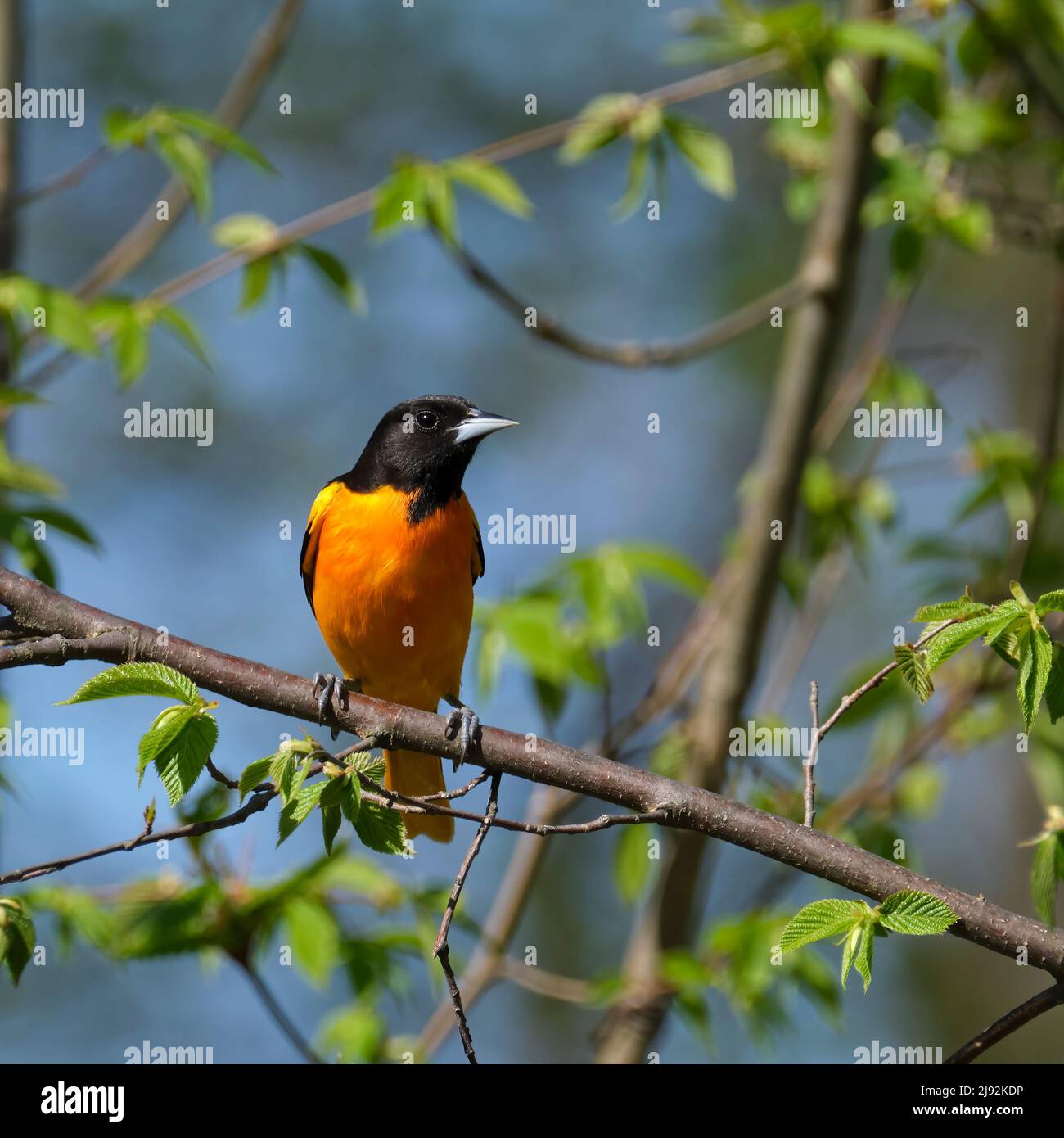
The Baltimore Oriole (Icterus galbula)
The Baltimore Oriole is the quintessential orange and black bird of the Eastern and Central United States. The adult male is unmistakable with a solid black head, throat, and back, contrasted against a brilliant, fiery orange breast, rump, and outer tail feathers. Their wings are black with white wing bars.
In 2026, conservation data continues to highlight the importance of migratory stopovers for these birds. They arrive in the northern U.S. and Southern Canada in late April and early May. Their presence is often first signaled by their rich, flute-like song. Baltimore Orioles are unique not just for their color, but for their architectural prowess; females weave intricate, hanging pouch-like nests from the tips of slender tree branches, often using fibers like horsehair, wool, and even fishing line.
The Bullock’s Oriole (Icterus bullockii)
If you are in the Western United States, the orange and black bird you see is likely a Bullock’s Oriole. While similar to the Baltimore Oriole, the male Bullock’s has a distinct black "eyeline" or mask running through a mostly orange face, and a black crown. They also possess a much larger white patch on their wings compared to the thin white bars of their eastern cousins.
These two species are so closely related that they were once considered a single species (the Northern Oriole). In the Great Plains, where their ranges overlap, they occasionally interbreed, creating hybrids that display a mix of facial patterns.
The Orchard Oriole (Icterus spurius)
While often overlooked because it is smaller and darker, the Orchard Oriole is a common sight in open woodlands and orchards. The male is not "bright" orange but rather a deep, burnt chestnut or brick-red color paired with a black head and back. From a distance or in poor lighting, this chestnut can appear orange, leading to identification confusion. They are shy birds, often staying higher in the canopy than Baltimore Orioles.
The "Butterfly" of the Woods: The American Redstart
For those looking at a smaller bird—roughly the size of a chickadee—the American Redstart (Setophaga ruticilla) is the likely candidate. This warbler is often described as the "butterfly of the bird world" because of its constant motion and habit of spreading its tail and wings.
The male American Redstart is coal-black with vivid orange patches on the sides of its breast, the middle of its wings, and the base of its tail. This "flash" behavior is not just for show; the bird uses these bright patches to startle insects out of the foliage, catching them mid-air. Unlike the orioles, which have long, pointed beaks for fruit and nectar, the Redstart has a flatter, wider beak at the base, equipped with "rictal bristles" that help it sense and capture flying insects.
Large Songbirds: Grosbeaks and Thrushes
If the bird in question has a very thick, heavy beak or resembles a robin in shape, you may be looking at a Black-headed Grosbeak or a Varied Thrush.
Black-headed Grosbeak (Pheucticus melanocephalus)
Common in the West, the male Black-headed Grosbeak features a black head, black-and-white wings, and a rich cinnamon-orange breast and neck. Their massive, cone-shaped beaks are designed for cracking seeds and large insects. They are frequent visitors to bird feeders, especially those offering sunflower seeds. Their song is often described as a "drunken robin," being more melodic and hurried than a standard American Robin's tune.
Varied Thrush (Ixoreus naevius)
Residents of the Pacific Northwest and the dark, coniferous forests of the West will recognize the Varied Thrush. While it has an orange breast like a robin, it is distinguished by a bold black "necklace" or V-shaped band across its chest. Its wings are intricately patterned with orange and black. These birds are ground-feeders, often seen hopping through leaf litter in damp, shaded environments. In 2026, citizen science reports indicate that they are becoming more common in suburban gardens during harsh winters as they move down from higher elevations.
Ground Foragers: The Towhees
Towhees are large sparrows that spend much of their time on the ground, scratching through mulch and leaves. While their color palette is black and orange (or rufous), the distribution is different from orioles.
- Eastern Towhee: The male has a solid black head, throat, and back, with bright white underparts and distinct rufous (orange-brown) sides.
- Spotted Towhee: Found in the West, this bird looks nearly identical to the Eastern Towhee but features heavy white spotting on its black back and wings.
Both birds are famous for their "double-scratch" foraging move—hopping forward and then kicking back with both feet to uncover insects. Their call, a sharp "chewink!" or "towhee!", is often the first sign of their presence in thickets.
Comparing Key Identification Features
To help you distinguish between these species, the following table breaks down the critical visual and behavioral markers.
| Species | Primary Region | Face/Head Color | Key Identifying Mark | Typical Behavior |
|---|---|---|---|---|
| Baltimore Oriole | East / Midwest | Solid Black | Bright orange rump and breast | Hanging in high branches |
| Bullock's Oriole | Western U.S. | Orange with Black Eyeline | Large white wing patches | Whistling from treetops |
| American Redstart | North America | Solid Black | Orange patches on tail/wings | Constant wing-flicking |
| Black-headed Grosbeak | Western U.S. | Solid Black | Massive, heavy beak | Visiting seed feeders |
| Varied Thrush | Pacific Coast / West | Grey-Black | Black breast band (necklace) | Ground foraging in shade |
| Spotted Towhee | Western U.S. | Solid Black | Rufous sides, white spots on back | Scratching in leaf litter |
Beyond Plumage: Habitat and Diet Differences
Understanding "the" orange and black bird requires looking past the feathers and into the bird’s ecological niche. For instance, if you see an orange and black bird at a hummingbird feeder, it is almost certainly an oriole. Orioles have a specialized brush-tipped tongue that allows them to lap up nectar.
Dietary Preferences
- Orioles: Highly attracted to sugar water, halved oranges, and grape jelly. During the breeding season, they shift toward caterpillars and beetles to provide protein for their young.
- Warblers (Redstarts): Almost exclusively insectivorous. You will rarely see them at a feeder unless you have a specialized suet or mealworm station.
- Grosbeaks: Generalists that enjoy both insects and large seeds. They are often the "bullies" at the bird feeder due to their size.
- Thrushes: Prefer berries and ground-dwelling invertebrates like worms and snails.
Nesting and Territory
The habitat where you see the bird is a major clue. A bird seen in a dense, swampy thicket is more likely to be an American Redstart or a Towhee. A bird seen in a tall, solitary elm or maple tree in a suburban backyard is a prime candidate for a Baltimore Oriole. In 2026, urban forestry initiatives have increasingly focused on planting native hardwoods to support these canopy-dwelling species, making them more common in developed areas than they were a decade ago.
Why are They Orange and Black?
The striking coloration of these birds serves two primary purposes: mate attraction and territorial signaling. The orange pigments (carotenoids) are typically derived from the bird's diet. A male bird with a more vibrant, intense orange hue is signaling to potential mates that he is a superior forager and possesses a strong immune system.
The black coloration (melanin) provides a high-contrast background that makes the orange "pop," ensuring the bird is visible to others of its species from a distance. Interestingly, the females of these species are rarely orange and black. Instead, they sport duller yellows, olive-greens, or browns. This "sexual dimorphism" allows the females to remain camouflaged while incubating eggs, protecting the nest from predators like hawks and crows.
How to Attract Orange and Black Birds to Your Yard
If you want to get a closer look at these species, you can tailor your backyard habitat to meet their specific needs. By 2026, bird-friendly gardening has moved toward "layering" habitats to support multiple species.
- Offer the Right Food: For Orioles, hang specialized orange-halves or nectar feeders in early spring. Avoid jellies with high-fructose corn syrup or artificial dyes; stick to organic or natural grape jelly.
- Provide Water: A birdbath with a "mister" or "dripper" is highly attractive to warblers and orioles, which are drawn to the sound of moving water.
- Plant Native Berries: Serviceberry (Amelanchier), Elderberry, and Mulberry trees provide essential sugar for orioles and grosbeaks, especially during the fall migration.
- Avoid Pesticides: Because many orange and black birds (especially Redstarts and Grosbeaks) rely on insects, a pesticide-free yard is a more productive hunting ground.
Frequently Asked Questions
Is there a bird that is orange and black but looks like a robin?
Yes, the Varied Thrush looks very similar to a robin in shape and size. It has an orange breast but is distinguished by a black band across its chest and orange patterns on its wings. Additionally, the American Robin itself can sometimes have very dark, almost black feathers on its head and back, though it lacks the intricate black-and-orange patterns found on orioles or grosbeaks.
What is the small black bird with orange on its wings?
This is most likely the American Redstart. It is a small warbler that frequently flicks its wings and tail, revealing bright orange patches against its black body. Another possibility is the Red-winged Blackbird, though its patch is technically red and yellow, which can appear orange in certain lighting conditions.
Why do I only see these birds in the spring?
Many orange and black birds, such as Baltimore Orioles and Blackburnian Warblers, are neotropical migrants. They spend the winter in Central or South America and only travel north to breed. They are most visible in the spring when they are actively singing and establishing territories. By late summer, they become quieter and more reclusive before heading south in the fall.
Can a Monarch butterfly be mistaken for an orange and black bird?
Surprisingly, yes. At a distance or in flight, the large size and flapping motion of a Monarch butterfly or a Viceroy butterfly can mimic the movement of a small bird like an American Redstart. However, once the "bird" lands, the lack of a beak and feathers will quickly clarify the identification.
What is the orange and black bird in the Western U.S.?
The most common Western species are the Bullock’s Oriole, the Black-headed Grosbeak, and the Spotted Towhee. If you are in the Pacific Northwest forests, the Varied Thrush is also a primary candidate.
Final Recommendation for Identification
To accurately identify your bird, observe the beak shape first. A long, thin beak points to an oriole; a short, thick, triangular beak points to a grosbeak; and a tiny, needle-like beak points to a warbler. Combined with your location and the specific distribution of the orange and black feathers, these physical traits will lead you to a definitive answer. For the best results in 2026, use a high-quality pair of 8x42 binoculars and a contemporary digital field guide that allows you to filter species by region and season.
Image Gallery
Select an image to open it in a new tab.


Declan O'Connor
Higher Education and Campus Culture Reporter
