
In clinical coding, there is no singular ICD-10-CM code for "total brain injury" because the term is not a specific medical diagnosis. Most professionals use S06.2X (Diffuse traumatic brain injury) for widespread trauma or G93.1 (Anoxic brain damage) for non-traumatic global injuries. Selection depends on the mechanism of injury and the patient’s documented level of consciousness.
Understanding "Total Brain Injury" in Medical Coding
The phrase "total brain injury" is often used colloquially or by legal professionals to describe a catastrophic event where the entire brain is affected. However, the ICD-10-CM (International Classification of Diseases, 10th Revision, Clinical Modification) system, which remains the standard in 2026 for diagnostic reporting in the United States, requires a higher degree of specificity. To code this accurately, a coder must distinguish between traumatic causes—such as a high-impact motor vehicle accident—and non-traumatic causes—such as oxygen deprivation or medical illness.
In a traumatic context, "total" usually implies a diffuse injury, where the damage is not localized to one lobe (like the frontal or temporal) but is spread across the entire intracranial space. In a non-traumatic context, it may refer to anoxic encephalopathy or brain death. Because the ICD-10-CM system is hierarchical and granular, the "correct" code is determined by the clinical documentation regarding the etiology, the severity of the injury, and the duration of any loss of consciousness (LOC).
Traumatic Intracranial Injuries: The S06 Category
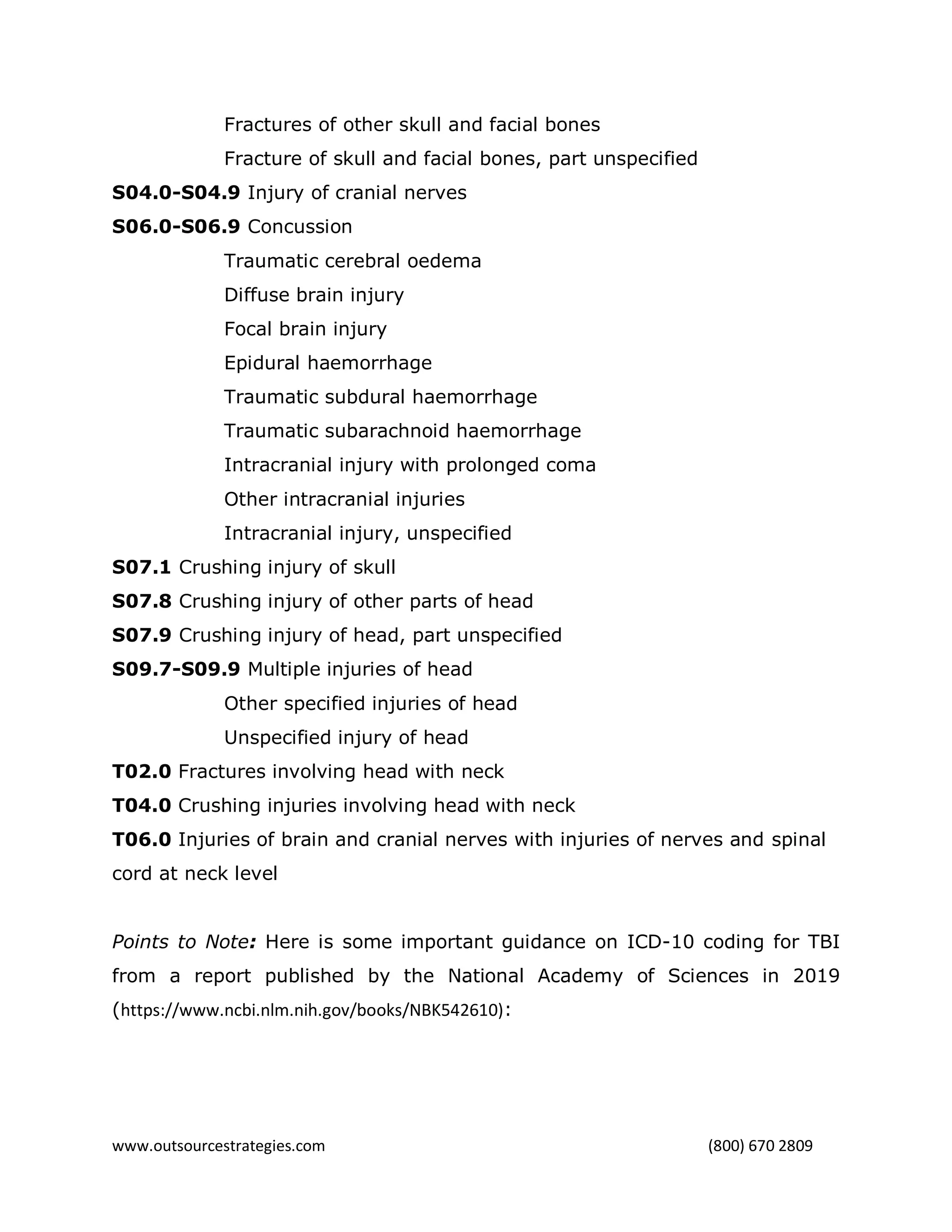
When a brain injury is caused by an external force, it is classified under the S06 (Intracranial injury) category. For an injury that affects the brain globally or "totally," the most appropriate subcategory is S06.2 (Diffuse traumatic brain injury). This subcategory includes conditions such as diffuse axonal injury (DAI), which involves widespread tearing of the brain's long connecting nerve fibers.
S06.2: Diffuse Traumatic Brain Injury
Diffuse traumatic brain injury occurs when the brain moves rapidly inside the skull, leading to widespread damage. This is the closest clinical equivalent to a "total" traumatic brain injury. The coding structure for S06.2 requires a 6th character to indicate the duration of the loss of consciousness and a 7th character for the encounter type.
- S06.2X0A: Diffuse traumatic brain injury without loss of consciousness, initial encounter.
- S06.2X1A: Diffuse traumatic brain injury with loss of consciousness of 30 minutes or less, initial encounter.
- S06.2X5A: Diffuse traumatic brain injury with loss of consciousness of greater than 24 hours with return to pre-existing conscious level, initial encounter.
- S06.2X9A: Diffuse traumatic brain injury with loss of consciousness of unspecified duration, initial encounter.
S06.9: Unspecified Intracranial Injury
If the documentation is sparse and merely states "brain injury" following a trauma without specifying it as diffuse or focal, coders may be forced to use S06.9X9A (Unspecified intracranial injury with loss of consciousness of unspecified duration, initial encounter). However, in 2026, payers and regulatory bodies increasingly reject unspecified codes, making detailed clinical documentation of "diffuse" damage essential for proper reimbursement and data tracking.
Non-Traumatic Global Brain Injuries
If "total brain injury" refers to a condition not caused by physical trauma—such as a heart attack that stopped oxygen flow to the brain—the S-codes are inappropriate. Instead, the coder must look to the G-category (Diseases of the nervous system).
G93.1: Anoxic Brain Damage
Anoxic brain damage, also known as hypoxic-ischemic encephalopathy (HIE) in certain contexts, occurs when the brain is completely deprived of oxygen. This results in global, "total" damage to the cerebral tissues. This code is frequently used for patients who have suffered a prolonged cardiac arrest or near-drowning.
G93.82: Brain Death
In cases where "total brain injury" describes the irreversible cessation of all functions of the entire brain, including the brainstem, the specific code is G93.82 (Brain death). This code is vital for legal and ethical documentation, particularly in the context of organ donation or the withdrawal of life support. It is important to note that brain death is a clinical diagnosis and must be explicitly stated by a physician according to established neurologic criteria before this code can be applied.
The Necessity of the 7th Character Extension
For all traumatic brain injury codes (S06 series), a 7th character is mandatory. This character identifies the phase of care the patient is receiving. Misapplying these extensions is a primary cause of claim denials.
- A – Initial Encounter: Used while the patient is receiving active treatment for the injury. This includes emergency department care, surgical intervention, and admission to an acute care hospital.
- D – Subsequent Encounter: Used for encounters after the patient has received active treatment and is now receiving routine care during the period of healing or recovery. This typically applies to rehabilitation or outpatient follow-up visits.
- S – Sequela: Used for complications or conditions that arise as a direct result of the injury after the acute phase has passed (e.g., post-traumatic epilepsy occurring years later). When using the "S" extension, the injury code is sequenced after the actual complication.
Supplementary Coding: Glasgow Coma Scale (R40.2-)
When coding for a significant or "total" brain injury, ICD-10-CM guidelines often require the use of supplementary codes to capture the patient's neurological status. The R40.2- (Glasgow Coma Scale) codes provide a standardized way to report the level of consciousness.
These codes are structured to capture three specific responses:
- R40.21-: Coma scale, eyes open.
- R40.22-: Coma scale, best verbal response.
- R40.23-: Coma scale, best motor response.
For a patient with a "total" brain injury, the total score is often calculated and reported using R40.24- (ICD-10-CM Glasgow coma scale, total score). This provides a clear picture of the injury's severity to researchers and insurance payers, supporting the medical necessity of intensive care or high-level rehabilitation services.
External Cause Codes: The How and Where
In addition to the diagnosis code (what the injury is), ICD-10-CM requires "External Cause" codes (V00-Y99) to describe how the injury happened and where it occurred. For a total brain injury resulting from a car accident, the code would describe whether the patient was the driver or passenger and whether it was a collision with another vehicle or a stationary object.
- Example: A patient with diffuse brain injury from a motor vehicle accident would require an S06.2 code, followed by a code like V43.52XA (Passenger in rolled-over car injured in collision with SUV).
- Place of Occurrence: Codes from category Y92 identify where the injury happened (e.g., Y92.411 for a state highway).
Summary Table of Codes for Brain Injury
| Clinical Condition | ICD-10-CM Code | Description |
|---|---|---|
| Diffuse Traumatic Brain Injury | S06.2X- | Widespread damage due to trauma (e.g., DAI). |
| Unspecified Intracranial Injury | S06.9X- | Brain injury documented without specific details. |
| Anoxic Brain Damage | G93.1 | Global damage due to lack of oxygen (non-traumatic). |
| Brain Death | G93.82 | Irreversible cessation of all brain activity. |
| Encephalopathy, Unspecified | G93.40 | General brain dysfunction or disease. |
| Cerebral Edema | G93.6 | Swelling of the brain (often follows total injury). |
Common Coding Errors and Documentation Gaps
The transition from general terms like "total brain injury" to specific ICD-10-CM codes is fraught with potential errors. One common mistake is the failure to distinguish between concussion (S06.0) and diffuse axonal injury (S06.2). While both are types of traumatic brain injury, the latter implies a much higher severity level and "total" involvement of the brain's white matter.
Another frequent error is the omission of the loss of consciousness (LOC) duration. The 6th character in the S06 series depends entirely on whether the patient was unconscious for 30 minutes, 6 hours, or over 24 hours. If the physician does not document the duration, the coder is forced to use "unspecified," which may result in a lower DRG (Diagnosis-Related Group) weight and lower reimbursement for the facility, as it does not accurately reflect the intensity of care required for a "total" injury.
Finally, in 2026, the integration of ICD-10 and the emerging ICD-11 standards highlights the need for clinicians to document whether the injury is primary (the immediate result of trauma) or secondary (damage resulting from swelling, ischemia, or intracranial pressure). While ICD-10-CM is the primary system used in the U.S. currently, providing this level of detail prepares the medical record for future coding transitions.
Practical Guidance for Coders and Providers
To ensure the most accurate coding for a "total brain injury," providers should be queried if the documentation is ambiguous. If a patient is described as having "total" damage, the following questions should guide the final code selection:
- Was the injury caused by trauma? If yes, use S06.2. If no (e.g., cardiac arrest), use G93.1.
- Is the damage localized or diffuse? "Total" usually implies S06.2 (Diffuse).
- What was the duration of LOC? This determines the 6th character.
- Is the patient currently in acute care? This determines the 7th character (A).
- What are the associated symptoms? Include codes for coma scale (R40.2-), cerebral edema (G93.6), and any skull fractures (S02-).
Accurate coding is not merely a billing requirement; it is essential for the patient's long-term care management. A diagnosis of diffuse traumatic brain injury (S06.2) vs. a simple concussion (S06.0) can significantly impact the patient's eligibility for specialized neuro-rehabilitation programs and long-term disability benefits.
Frequently Asked Questions
What is the specific ICD-10 code for diffuse axonal injury?
The specific code for diffuse axonal injury is found within the S06.2 subcategory. Depending on the duration of loss of consciousness and the encounter type, it might be coded as S06.2X9A (unspecified duration, initial encounter) or a more specific variation if the unconscious period is documented.
Can G93.1 be used with traumatic brain injury codes?
Generally, no. G93.1 (Anoxic brain damage) is reserved for non-traumatic events. If a trauma causes the heart to stop, which then causes anoxia, the traumatic injury (S06-) is typically sequenced first as the primary cause, though coding guidelines may allow for both in specific clinical scenarios where both conditions are treated.
How do I code a "total brain injury" that results in a vegetative state?
If the injury resulted in a persistent vegetative state, you would first code the primary injury (e.g., S06.2X9A or G93.1). Then, you would add the code R40.3 (Persistent vegetative state) as a secondary diagnosis to describe the patient's ongoing clinical status.
Is "total brain injury" the same as "severe TBI" in ICD-10?
In clinical practice, "total" and "severe" are often used interchangeably, but in coding, "severe" is usually defined by the Glasgow Coma Scale score (typically 3-8). There is no "severity" adjective in the ICD-10 code titles themselves; the severity is instead reflected through the choice of "diffuse injury" and the "duration of loss of consciousness" characters.
Are there new codes for brain injury in 2026?
While the core structure of the S06 and G93 categories remains stable in 2026, annual updates from the CDC and CMS occasionally introduce new sub-codes for complications like specific types of encephalopathy or post-traumatic syndromes. Always refer to the official CMS ICD-10-CM browser for the most current fiscal year updates.
Final Recommendation
When documenting or coding for a "total brain injury," always prioritize specificity over generic terms. Ensure the medical record clearly states the mechanism of injury (traumatic vs. non-traumatic) and the specific nature of the brain damage (diffuse vs. focal). For traumatic cases, focus on the S06.2 category, and for non-traumatic global damage, utilize G93.1. Precise coding ensures that the severity of these life-altering injuries is correctly captured for clinical, legal, and financial purposes.
Image Gallery
Select an image to open it in a new tab.



Ingrid Bjornson
Global Cyber Policy and Regulation Analyst
